
 English
 Tiếng Việt
E-2 Visa Application Timeline: A Comprehensive Guide for 2026
What is an E-2 VisaE-2 Visa Business PlanUS Business Start-UpE-2 Visa FAQsList of E-2 Treaty Investor CountriesE-2 Visa Costs and FeesE-2 Visa requirementsE-2 Visa ProcessE-2 Visa RenewalE-2 Visa FranchiseCompare US Investor Visas
Executive Summary: E-2 Visa Timeline
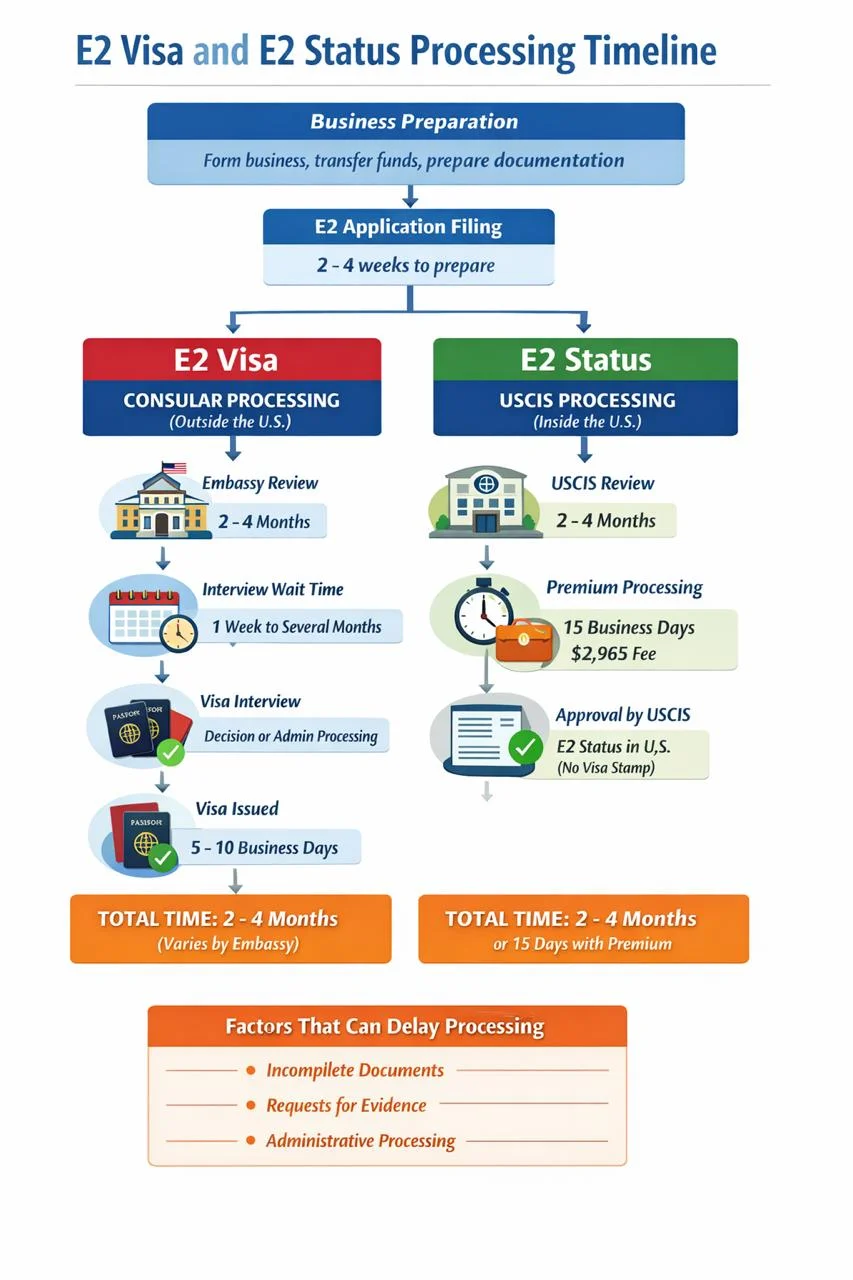
There are two distinct processes for E-2 Processing:
Each of these processes has a different timeline:
1. E-2 Visas in a U.S. consulate; OR
2. Change of Status to E-2 Status from within the U.S.
Timeline Stages in E-2 Processing
For all E-2 applications the timeline critical first steps are the same:
1. Business and Investment Preparation
2. Assembly of E-2 Package
3. Submission of E-2 Package: This is where the processes diverge.
I. Business and Investment Preparation Timeline
Careful planning is essential for a successful E-2 visa application. Below is a practical preparation timeline outlining the typical stages involved in structuring the investment, preparing the business plan, and assembling the supporting documentation.
This section focuses strictly on pre-application preparation timing. Detailed discussion of filing strategy, consular submission, and interview preparation is addressed separately to avoid duplication. Other pages on our website provide substantive "how to" guides for each step of the process.
While individual circumstances vary, most well-prepared E-2 cases follow a structured progression similar to the one below.
1. Time to Prepare Business Plan
Total Time: 1 to 2 Months
(In parallel with Source of Funds and Corporate Preparation)
The foundation of a strong E-2 case is a credible, well-documented business plan supported by a committed and traceable investment.
Timing of Our Typical Business Plan Process
Process will vary by attorney. Our approach is structured and collaborative:
- Provide client business plan questionnaire immediately upon engagement
- Client completes business plan questionnaire, timing varies by client responsiveness
- Draft business plan prepared within approximately 2 weeks, expedited drafting available when necessary
- Finalization phase, typically a 1 to 2 week dialogue refining projections, staffing assumptions, and operational details
The business plan must demonstrate that the enterprise is real, active, and capable of generating more than marginal income. Immigration officers expect to see realistic hiring projections, credible financial assumptions, and a clear roadmap for growth.
Because the business plan integrates financial projections and staffing forecasts, it should be developed simultaneously with source of funds documentation and entity formation.
📖 Read Our Guide
2. Timing for Documentation of Source of Funds
Total Time: Approximately 3 Days to 3 Weeks
(Prepared in parallel with the Business Plan)
Although E-2 adjudication practice can vary by consulate, we apply EB-5 style lawful source and path of funds discipline to reduce the risk of follow-up questions or requests for evidence. For that reason, we follow the evidentiary principles articulated in the EB-5 precedent decision Matter of Ho.
The goal is to document the lawful origin of the invested capital and to trace the path of funds from origin to the United States enterprise.
Our Typical Source of Funds Process
- Client provides a brief written explanation of the source of the investment funds, typically a short paragraph outlining how the funds were earned or obtained
- D&A sends a detailed Source of Funds Checklist, usually within 6 hours of receiving the initial funds explanation
- Client gathers and provides supporting documentation, typically over a 1 to 2 week period
Every significant transfer should be documented to demonstrate a clean path from lawful origin to business investment. In our experience, applicants who prepare this documentation early — rather than treating it as an afterthought once the business plan is complete — recover several weeks of timeline that would otherwise be lost to follow-up questions later in the application process.
📖 Read Our Guide
Our "How to" Source of Funds Guide for 2026 (coming soon).
3. Corporate Documentation Timeline
Total Time: 1 Week to 3 Months
(Prepared in parallel with Business Plan and Source of Funds)
During the initial preparation stage, the investor should:
- Form or acquire a United States business entity, if needed
- Open a United States business bank account
- Begin transferring investment funds
- Secure a commercial lease or office space where appropriate
- Engage an accountant and, ideally, immigration counsel
Corporate setup timelines vary greatly depending on whether the business is a simple services company, a regulated business, a franchise offering, or a location-based operation requiring licenses.
Example of Longer Required Timing
One client was a dessert manufacturer planning to expand across the United States by selling franchised locations to franchisees. Part of the business model required registering a franchise system in two states and obtaining multiple business licenses.
Most clients do not require the many months needed to register complex franchise systems in multiple states or obtain numerous licenses. This example simply illustrates how proper business planning can extend preparation timelines depending on the industry and regulatory environment.
📖 Read Our Guide
4. Fund the Business: Committing the Investment Capital
Total Time: Usually 2-3 Days
Under 9 FAM 402.9, E-2 funds must be "at risk" and irrevocably committed to the enterprise. The FAM specifically permits the use of escrow arrangements, provided the only condition for release of funds is approval of the E-2 visa.
Use of Escrow in Funding and E-2 Business
If purchasing an existing business, the purchase price can be placed into escrow pursuant to a binding agreement. If starting a new business, investment funds can likewise be held in escrow pending visa issuance. In both cases, the funds are considered committed for E-2 purposes once the agreement is executed and the only contingency is visa approval.
Advantage of Escrow
The practical advantage of escrow is protection. If the E-2 visa is approved, the funds are released and the business proceeds. If the visa is refused, the investor can either address the consular concerns and reapply, or withdraw from the transaction and have the funds returned. This structure demonstrates a committed investment while limiting financial risk if the visa is not granted.
5. Completion of E-2 Visa 'Package'
Total Time: 2 days - 1 Week
Once all the documentation is complete an experienced immigration lawyer will supervise collating everything into an application. The package will vary accordingly to whether you're filing for change of status using form I-129 or consular processing using form DS-160.
If you're a visa applicant applying for the first time outside the U.S., then you have to submit your Form DS-160 (Online Nonimmigrant Visa Application) through the CEAC website.
February 2026 FAM Update: Form DS-156E No Longer Required for Principal Investors
A 17 February 2026 update to 9 FAM 402.9 removed the requirement that principal E-2 investors submit Form DS-156E. Form DS-156E is still required for E-1 treaty traders and for E-2 executive, manager, or essential employee applicants. From a timing perspective this is a small but real saving in package-assembly time, and it shifts more of the case narrative into the business plan and supporting documents. The legal test for E-2 eligibility is unchanged. (Source: U.S. Department of State DS-160 FAQ; 9 FAM 402.9 transmittal CT:VISA-2190, 17 February 2026.)
In the case of consular processing different procedures exist in different consulates. Timelines vary significantly by consulate.
Parallel Timing Strategy: Optimal Efficiency
A properly managed E-2 visa preparation timeline is not sequential. The business plan, source of funds documentation, and corporate structuring should proceed simultaneously.
When coordinated effectively, many investors can complete full E2 preparation within approximately 4 to 8 weeks. Delays typically arise from incomplete financial documentation, complex fund tracing issues, or late-stage business restructuring.
Strategic early planning strengthens the overall application and reduces the risk of follow-up requests for evidence.
💡 Hot Tip
Your corporate structure and business plan will impact your immigration eligibility. Having the business plan professionals, immigration lawyers and corporate lawyers work as one team optimizes timing and efficiency.
II. Application Processing Times: Change of Status vs. Consular Processing
⚡ Quick Answer
Most E-2 visa applications at U.S. consulates take 2 to 4 months from package submission to visa issuance, depending on the post's document review time, interview wait, and any administrative processing. For change of status filings inside the U.S., standard USCIS processing on Form I-129 is also 2 to 4 months, or about 15 business days with premium processing.
📖 Related Reading
This page focuses on processing times for each route. For a detailed walk-through of the application itself, see our E-2 Visa Process page and our comparison of Consular Processing vs. Change of Status.
E-2 Visa Processing Time at the Embassies/Consulates
It is interesting to note that you can apply for the E-2 visa directly with the Embassy/Consulate. You do not need to get a petition approved by USCIS before you can apply for the E-2 visa unlike other visa classifications like H-1B or L-1.
If you're applying for an E-2 Treaty Visa, here are the necessary steps you'd take including the processing times:
Step 1: Submit your E-2 visa application to the U.S. Embassy or Consulate
First, you have to submit your E-2 non-immigrant visa application to the U.S. Consulate or Embassy. The length of time to review your documents would depend on the applicable US consulate or embassy.
Generally, however, the consulate process can take from about two weeks to four months. Once they have reviewed your documents, they may ask for additional documents or proceed to schedule the interview.
If you have accompanying family members, such as your spouse or unmarried children under the age of 21, they may also apply at the same time as you or even after your E-2 visa has been issued.
Step 2: E-2 Visa Interview
Your visa interview may be scheduled within 1 week or 2 of your application getting reviewed and accepted, but note that appointment wait times vary in every Embassy or Consulate.
Step 3: Acquiring the E-2 Visa
At the end of the interview, the officer will usually approve or deny the application, but it is also possible for the officer to put the application for administrative processing if they need more documents or more time to verify the records. Upon approval of the application, it may take 5 to 7 days to receive your passport back with the E-2 visa stamp.
Timing of Consular Interview
Once the U.S. Embassy or Consulate in your home country has done an initial review of all of your documents, all identity and security concerns are resolved, and all questions about eligibility have been answered satisfactorily, they will schedule a visa interview.
The availability of the appointments depends on your country. There are times when national emergencies and natural disasters may also introduce delays to the process.
After a successful in-person interview, you may receive your visa within 5 to 7 days.
Processing Time for Change of Status to E-2 Treaty Investor Status
If you are currently in the U.S. on a valid nonimmigrant visa/status (like B1/B2 or F-1), you may be eligible to apply to change your status to E-2. If you're applying for an E-2 visa through a change of status, here are the following processing times:
Form I-129 Processing Time
After you've filed your Form I-129 (Petition for a Nonimmigrant Worker), it would take 2 to 3 months for the United States Citizenship and Immigration Services (USCIS) to review and issue a response. If they approve your petition, your change of status will begin from the date specified on your approval notice.
The USCIS may also issue a request for additional evidence. They will give you time to prepare them, which may take additional wait times from 3 to 6 months.
Premium Processing Time
What Premium Processing is
The USCIS also offers a premium processing service for an additional fee. Under premium processing, USCIS will take adjudicative action — issuing an approval, denial, Request for Evidence, or Notice of Intent to Deny — within 15 business days. If USCIS does not act within that timeframe, the premium processing fee is refunded and processing continues.
What Premium Processing is Not
Premium processing does NOT guarantee an approval — only a timely decision or other adjudicative action. If USCIS issues a Request for Evidence, the 15-business-day clock pauses until you respond. Once you submit your response, USCIS again has 15 business days to act. Paying the premium processing fee does not improve the merits of your petition.
I-129 Premium Processing Fee (Effective 1 March 2026)
The current I-129 premium processing fee is $2,965 USD. This rate took effect on 1 March 2026 under the USCIS final rule adjusting premium processing fees for inflation. The fee applies to nonimmigrant worker petitions including E-2 change of status filings.
Please check with USCIS website for updated fees.
📖 Read Our Guide
For applicants present in the U.S. physically, their applications to change status can be filed directly with the USCIS. However, it is important to understand that USCIS will not issue your E-2 visa. If your application to change status is approved, you will only receive a new I-94 with your new authorized dates, which should be an additional period of two years. If you leave the U.S., you will need to apply for the E-2 visa at an Embassy or Consulate to be able to re-enter the U.S. Your application will be treated as a new application and the Embassy or Consulate is not bound by the decision of USCIS to approve your change of status application.
Real-World Timing Examples
In our experience, total E-2 timelines vary widely based on the nature of the business and the post handling the case. A few illustrative scenarios from cases we have seen:
- London (U.S. Embassy): the Embassy currently gives its initial review time as over 90 working days, so allow well over four months from submission to visa in hand. For more information updated for 2026 →
- Acquisition of an existing operating business with clean source-of-funds, Toronto: approximately 10 to 14 weeks total, including the Toronto E-Visa Unit's 70-page document review and the typical interview wait.
- New start-up with complex source-of-funds (multiple jurisdictions, asset sales, gifted capital): often 4 to 8 weeks longer than a clean case, mainly because source-of-funds documentation extends the preparation phase before the package is even submitted.
- Franchise system requiring multi-state registration and licensing: can add several months to the preparation phase. The consular process itself runs on its normal timeline; what extends is everything upstream of filing.
- Change of status with USCIS premium processing: response within 15 business days, but the underlying business preparation must already be complete — premium processing does not shorten the work, only the wait at USCIS.
The single biggest variable across all of these is whether the applicant arrives with a complete, internally consistent package on day one. Cases that arrive piecemeal, or with gaps in source-of-funds documentation, frequently lose 4 to 8 weeks before they ever reach the consulate.
How to Avoid Delays in E-2 Visa Processing in 2026
There are some actions and steps you can take to avoid delays in the processing of your E-2 application. A comprehensive and compelling application is key to an efficient and successful application:
Eligibility for an E-2 Visa
Treaty investors must show the following E-2 Visa requirements and evidence to be eligible:
-
That you are a national from an eligible E-2 treaty country that maintains a treaty of commerce and navigation or a qualifying international agreement with the U.S.;
-
That you have a non-immigrant intent, which is an intent to depart once your E-2 nonimmigrant status ends.
-
You have invested or are due to invest a substantial amount of investment in a bona fide enterprise in the U.S. to ensure the successful operation of the enterprise. This means that there must be a real, active and operating commercial or entrepreneurial undertaking that produces services or products for profit;
-
That your investment funds were lawfully obtained;
-
That the U.S. business is active and for-profit, and not a marginal enterprise.
-
That the invested funds are put at risk in the commercial sense.
-
That you own at least 50% of the enterprise possession of operational control through a managerial position or other corporate device, as this demonstrates that the sole purpose of your entry is to manage your investment in the U.S.
Take note that the main difference between an E1 Treaty Trader visa to an E-2 Visa is that an E1 Visa, allows nationals from treaty countries to conduct trade between the U.S. and their country.
The E-2 visa also allows the investor to bring certain employees or of a qualifying organization to the U.S. If you're an employee, these are the things you would need to show:
-
That you have the same nationality as your E-2 employer.
-
That you are working either in an executive and supervisory character or you have a special qualification as an employee.
-
That you pass the general grounds for admission to the U.S.
Special qualifications are aptitudes of an employee which makes their services essential to the efficient operation of the enterprise.
Organize Documents in Advance
Take your time in gathering and preparing your personal, legal, and financial and necessary documentation. This ensures that you have a greater chance of success when you file for your application with the USCIS or the U.S. Embassy or Consulate.
Your application may be served with a Request for Evidence, which requires that you submit additional information or documents for your application. This can unduly delay your visa process, so submitting all the needed information and documents is key to a fast process.
How to Speed Up E-2 Visa Processing Time
⚡ Quick Answer
Three ways to accelerate an E-2 case: (1) USCIS premium processing for a 15-business-day response — change of status filings only, $2,965; (2) expedite requests at USCIS or the consulate for documented urgent circumstances — no fee, no guarantee; and (3) actively monitoring the consular booking system for cancellation appointment slots — the most underused option, costs nothing.
While the E-2 visa is generally one of the faster U.S. investor visa options, applicants who need to begin business operations on a tight schedule often ask whether the process can be accelerated. There is no single "fast-track" button for the E-2, but there are three legitimate strategies that can meaningfully shorten the overall timeline. Each has a specific use case, and not all of them apply to every applicant.
1. Premium Processing (Change of Status Only — Not Available for Consular E-2 Visas)
Premium processing is the most commonly misunderstood option in the E-2 context. It is a USCIS service, not a Department of State service, which means it is only available when you are filing inside the United States on Form I-129 to change or extend status to E-2.
Premium processing is not available for E-2 visa applications filed at a U.S. Embassy or Consulate abroad. The State Department does not offer a paid expedite tier for visa stamping. If you are applying through a consulate, premium processing is simply not relevant to your case, regardless of how urgent your circumstances are.
Where premium processing does apply (i.e. a USCIS change of status filing), USCIS commits to issuing a response — approval, denial, Request for Evidence, or Notice of Intent to Deny — within 15 business days for a fee of $2,965. A response is not the same as an approval. If USCIS issues a Request for Evidence, the 15-day clock pauses until you respond, then restarts. For the full mechanics, eligibility list, and current fees see our USCIS Premium Processing guide.
Important caveat: A USCIS approval grants E-2 status, not an E-2 visa. If you leave the U.S. after an approved change of status, you will still need to apply for the visa stamp at a consulate before re-entering — and the consulate is not bound by USCIS's decision.
2. Expedite Requests
Both USCIS and U.S. consulates have formal mechanisms for requesting expedited processing in cases of genuine urgency. These are not premium processing — there is no fee, and there is no guaranteed timeline — but in the right circumstances they can move a case forward significantly.
USCIS expedite requests may be granted for reasons such as severe financial loss to a company or person, emergencies and humanitarian reasons, U.S. government interests, or clear USCIS error. The threshold is high and the supporting evidence must be specific and documented. Generic urgency — "I want to start my business sooner" — is not sufficient.
Consular expedite requests are made directly to the U.S. Embassy or Consulate handling the application. Each post has its own procedure, typically through the online appointment system or by emailing the post directly. According to the Department of State, consular sections may expedite an interview date for "an urgent, unforeseen situation such as a funeral, medical emergency, or school start date." (Source: travel.state.gov, Visa Appointment Wait Times.)
The official guidance also clarifies what does not qualify. Travel for weddings, graduation ceremonies, assisting pregnant relatives, annual business/academic/professional conferences, or last-minute tourism does not meet the threshold. And in all cases the applicant must first submit Form DS-160, pay the application fee, and book the first available regular appointment before any expedite request is considered. Approval rates and procedures still vary substantially from post to post.
An experienced immigration lawyer can assess whether your circumstances meet the threshold and prepare a properly evidenced request — this is generally far more effective than a self-filed expedite request.
3. Monitoring for Cancellation Appointments at the Consulate
At many U.S. consulates, the longest single delay in the E-2 process is not document review — it is the wait for an interview slot. Posts in high-demand jurisdictions can show wait times of several weeks to several months for E-2 interview appointments.
Cancellations happen constantly. Other applicants reschedule, withdraw, or fail to show. Each cancellation opens a slot that the appointment system releases back into the pool, often at unpredictable times of day. In our experience, applicants (or their representatives) who actively monitor the consular booking system can frequently pick up an interview slot weeks or even months earlier than the originally scheduled date.
Practical points to keep in mind:
- Once your DS-160 is submitted and your case is at the post, log in to the appointment system regularly — daily checks are not excessive at high-demand posts.
- Cancellation slots often appear in short windows and are taken within hours.
- Third-party "appointment monitoring" services exist but vary widely in reliability; many simply automate what you can do yourself.
- Never cancel your existing confirmed appointment before securing the new one — at some posts you cannot reinstate a released slot.
This is the most underused acceleration strategy in E-2 practice. It costs nothing, requires no government approval, and routinely shaves weeks off the overall timeline.
⚡ Comparison with Other Investor Visas
Speeding up an E-2 is one part of choosing the right investor visa for your timeline. If you are weighing the E-2 against permanent residence options such as the EB-5, processing times and acceleration strategies differ significantly. Read our EB-5 Visa Guide for a fuller comparison →
E-2 Speed Options Compared
| Speed Option | Available For | Typical Timeline | Key Limitation |
|---|---|---|---|
| Premium Processing | USCIS Change of Status only (Form I-129) | 15 business days | No visa stamp — international travel ends status |
| Expedited Consular Appointment | All consular E-2 applicants | Days to a few weeks after approval | Requires documented urgent justification |
| Cancelled Appointment Monitoring | All consular E-2 applicants | Variable — can move months earlier | Requires daily monitoring; first-come, first-served |
| Choosing a Faster Consulate | Limited — most posts require residence ties | Depends on chosen post | Third-country processing is at consulate discretion |
🔥 Davies & Associates E-2 Visa Tip: Don't Rely on a Single Speed Strategy
We combine three speed levers in parallel for time-sensitive E-2 cases: (1) book the earliest standard appointment immediately to lock in a baseline date, (2) submit a formal expedite request with documented justification, and (3) monitor the appointment portal daily for released slots. Layering these strategies typically produces a faster outcome than relying on any single one.
Need Your E-2 Visa Fast? Let's Talk Strategy →
Difficulty in obtaining an E-2 Visa
While the approval rate for E-2 visa is quite high, applications can still be denied for a lot of reasons.
-
You are not a national or citizen of a treaty country. You should not apply for E-2 visa if you do not hold a passport of a treaty country. It may be possible to obtain a passport of a treaty country if you make a donation or an investment in countries that offer a citizenship program.
-
You are unable to prove the source and path of your investment funds.
-
You are unable to prove that your business will be more than marginal.
-
You are unable to demonstrate that you have ties to your home country.
E-2 Visa Success Rate
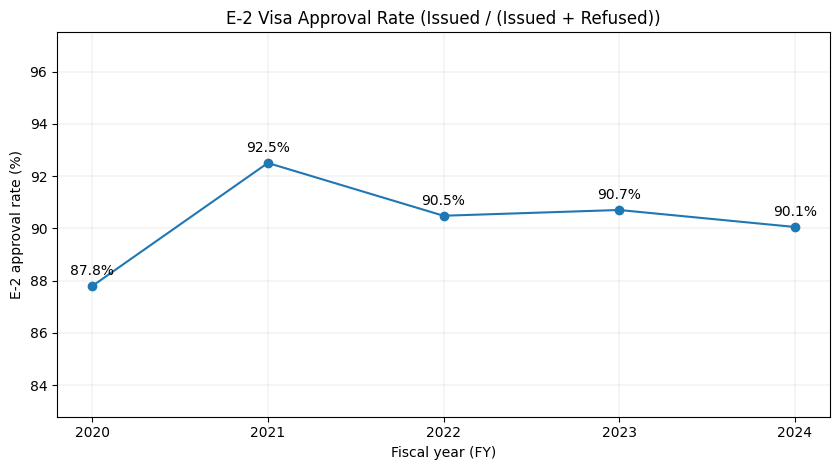
Approval rates for E-2 visa are very high.
- FY 2020: 23,493 issued / 3,266 refused → 87.8%
- FY 2021: 33,129 issued / 2,683 refused → 92.5%
- FY 2022: 45,878 issued / 4,823 refused → 90.5%
- FY 2023: 54,812 issued / 5,615 refused → 90.7%
- FY 2024: 55,324 issued / 6,108 refused → 90.1%
These figures are across all jurisdictions.
Cases involving:
- an experienced E-2 visa lawyer; and/or
- a lower-risk consulate
Would be likely to have even higher aggregate approval rates.
To ensure a higher success in getting your E-2 Visa approved, we recommend that you include in your application process hiring an immigration attorney.
Timing of E-2 Renewal
⚡ Quick Answer
E-2 visa validity is set by reciprocity schedule — five years for most treaty countries, but as short as three months for some (e.g. Egypt, Jordan). Regardless of visa stamp validity, each U.S. entry grants a two-year authorized stay. Renewal at the consulate follows the same package process as the initial application, with continued investment in the existing business as the key evidentiary update.
The validity of the E-2 visa depends on a reciprocity schedule with the treaty country. For most treaty countries, the reciprocity schedule is 5 years, but for some it is 4 years. There are also countries like Egypt or Jordan with reciprocity schedule of 3 months. Regardless of the validity of the visa, when you enter on a valid E-2 visa, you will be given a period of two years or authorized stay. This means that you can stay in the U.S. for a full period of two years without having to leave. With a valid E-2 visa, you are free to come in and out of the U.S. and you will be given a period of authorized stay of two years for every entry.
If you are traveling, you need to make sure that your visa is valid to be able to re-enter the U.S. If you are in the U.S. on E-2 status after an approved change of status application or if your visa has expired, but you still have a valid I-94, you may choose to remain in the U.S., but you have to make sure that you apply to extend your E-2 status with USCIS so that you can get another two year period provided that you continue to meet the eligibility requirements.
The process to renew an E-2 Visa is the same as filing an initial application. The main difference is that the applicant must show that they are continuously investing and developing the existing business in the U.S.
📖 Read Our Guide
Renewals now require an in-person interview
This is the biggest change to E-2 renewals in years, and it changes how far ahead you should plan.
Until autumn 2025, many E-2 renewal applicants could submit by post under an interview waiver — the “dropbox” route. From 1 October 2025 the State Department restricted interview waivers to diplomatic and official applicants, B-1/B-2 and Border Crossing Card renewals within 12 months, and H-2A renewals within 12 months. E visas are not on that list. Every E-2 renewal applicant now attends a fresh consular interview, and so does every dependant — including children under 14 and applicants over 79.
Practically, your renewal timeline is now governed by interview availability at your post, not by postal turnaround. Some E-visa units run their own queues separately from the general appointment calendar, and registration review can take weeks before you are invited to book. Our advice to begin six months before expiry assumes you secure a slot early in that window — at a busy post you may need longer.
Source: DOS Interview Waiver Update, 18 September 2025.E-2 Visa to Green Card: Processing Time and Pathways
⚡ Quick Answer
There is no single E-2 to green card processing time. The E-2 is a nonimmigrant visa and does not lead directly to permanent residence. Typical pathway timelines: EB-5 ~24–48 months from I-526E filing to conditional residence; EB-1C multinational manager/executive generally faster than EB-5; EB-2 NIW highly variable by country of birth. Because the E-2 is not formally a dual-intent visa, the timing of a green card filing matters strategically.
The E-2 is a nonimmigrant visa and does not lead directly to a green card. Because of that, there is no single "E-2 to green card" processing time — the timeline depends entirely on which immigrant category the E-2 holder transitions into. The three most common pathways have very different timelines.
EB-5 Immigrant Investor: approximately 24 to 48 months
From filing the I-526E petition through to conditional permanent residence, EB-5 timelines typically range from about 24 to 48 months. The exact figure depends heavily on the applicant's country of birth and current visa bulletin backlogs. Where the priority date is current and the applicant is in the U.S., concurrent filing of adjustment of status (Form I-485) is possible and can compress the overall timeline.
For full eligibility, investment thresholds, and the EB-5 process, see our EB-5 Visa Guide.
EB-1C Multinational Manager or Executive: generally faster than EB-5
For E-2 holders who qualify on corporate-structure grounds, EB-1C processing time is generally faster than EB-5 for most nationalities, though country-of-birth backlogs still apply. Eligibility for EB-1C depends on the corporate relationship and the applicant's prior role, not addressed here.
EB-2 National Interest Waiver: highly variable
EB-2 NIW processing time depends on the applicant's country of birth and visa bulletin caps, and can range from roughly 12 months to several years for backlogged countries.
Timing Consideration: E-2 and Non-Immigrant Intent
Because the E-2 is not formally a dual-intent visa, the timing of a green card filing relative to E-2 consular renewals is a strategic consideration in its own right. The point here is purely about timing — not eligibility. For a detailed treatment of the E-2 application strategy and how it interacts with longer-term plans, see our E-2 Treaty Investor Visa page.
⚡ Compare Investor Visa Timelines
The EB-5 is the most common green card pathway for E-2 holders. Read our EB-5 Visa Guide for detailed processing times and investment requirements →
FAQ for E-2 Timeline
E-2 Visa Processing Time — Frequently Asked Questions
How long does E-2 visa processing take?
Most E-2 visa applications filed at a US embassy or consulate take approximately 2 to 4 months from submission to visa issuance. However, total processing time depends on:
- The embassy's document review time
- Interview appointment availability
- Whether administrative processing is required
Some cases move faster. Others take longer depending on the post and case complexity.
How long does E-2 status processing take inside the United States?
If you are already in the US and file with USCIS for a change of status to E-2 status:
- Standard processing typically takes 2 to 4 months
- With premium processing, USCIS issues a response within 15 business days
Remember, USCIS approval grants E-2 status in the United States, not an E-2 visa stamp. If you travel internationally after approval, you must apply for an E-2 visa at a US consulate before re-entering the US.
What is E-2 visa premium processing time?
Premium processing applies to eligible E-2 filings submitted to USCIS inside the United States.
- Timeline: 15 business days
- If USCIS issues a Request for Evidence, the clock pauses until a response is submitted
- Government premium processing fee (current): $2,965
There is no premium processing option at US embassies or consulates abroad. For the full fee schedule, eligibility list, and procedural detail, see our USCIS Premium Processing guide.
Is premium processing available for E-2 visa applications at the consulate?
No. Premium processing is a USCIS service and is only available for Form I-129 filings inside the United States (i.e. change of status or extension of status to E-2).
The U.S. Department of State does not offer a paid expedite tier at consulates. Applicants applying for an E-2 visa stamp abroad cannot use premium processing, regardless of urgency.
If you are outside the U.S., the options to accelerate your case are limited to consular expedite requests and monitoring for cancellation appointments.
How can I speed up my E-2 visa processing time?
There are three legitimate ways to accelerate an E-2 case:
- Premium processing — only available if you are filing inside the U.S. with USCIS on Form I-129 (change of status or extension). Not available at consulates.
- Expedite requests — available at both USCIS and U.S. consulates for documented urgent circumstances such as severe financial loss, humanitarian reasons, or government interest. There is no fee and no guaranteed timeline.
- Monitoring for cancellation appointments at the consulate — the most underused acceleration strategy. Other applicants cancel or reschedule constantly, and those slots often release back into the booking system. Active daily monitoring can secure an interview weeks or months earlier than the originally scheduled date.
For a fuller comparison with other investor visa timelines, see our EB-5 Visa Guide.
What is a consular expedite request for an E-2 visa?
A consular expedite request is a formal request to the U.S. Embassy or Consulate to move an interview appointment earlier than the standard wait time.
Each post has its own procedure, typically through the online appointment system or by emailing the post directly. Commonly accepted grounds include:
- Urgent medical situations
- Deaths or serious illness of immediate family
- Time-sensitive business commitments supported by documentation
There is no fee and no guaranteed timeline. Approval rates and procedures vary substantially from post to post.
How long does it take to go from an E-2 visa to a green card?
The E-2 is a nonimmigrant visa and does not lead directly to a green card. E-2 holders who want permanent residence typically transition through one of three immigrant pathways:
- EB-5 Immigrant Investor: Approximately 24 to 48 months from I-526E filing to conditional permanent residence, depending on country of birth.
- EB-1C Multinational Manager or Executive: Generally faster than EB-5 for most nationalities, but requires a qualifying corporate relationship and one year of qualifying foreign employment.
- EB-2 National Interest Waiver: Variable depending on country of birth and visa bulletin caps.
Because the E-2 is not formally a dual-intent visa, timing the green card filing relative to E-2 consular renewals is a strategic consideration. See our EB-5 Visa Guide for detailed processing times on the most common pathway.
How long does E-2 spouse visa processing take?
An E-2 spouse can apply for their E-2 dependent visa at the same time as the principal applicant, or separately after the principal's visa has been issued.
When the spouse applies concurrently with the principal at the same consulate, processing time is generally the same — typically falling within the 2 to 4 month range that applies to the principal case.
When the spouse applies separately after the principal has been issued an E-2 visa, processing is often faster because the underlying eligibility has already been adjudicated. Wait times then depend primarily on interview appointment availability at the post.
For eligibility, work authorization, and how spouses apply, see our E-2 Treaty Investor Visa page.
How long does E-2 dependent child visa processing take?
Processing times for E-2 dependent children generally mirror those of the E-2 spouse:
- Concurrent filing with the principal: same 2 to 4 month range as the principal case
- Separate filing after the principal has been approved: typically faster, limited mainly by interview appointment availability at the post
For age and eligibility rules, see our E-2 Treaty Investor Visa page.
How long does E-2 employee visa processing take?
E-2 employee processing time is generally similar to the principal case — approximately 2 to 4 months at most consulates, plus interview wait time.
If the underlying E-2 business has already been registered with the consulate from a prior E-2 case, the employee's case may move faster because the company registration does not need to be re-adjudicated.
For change of status filings inside the U.S., E-2 employees can also use Form I-129, and premium processing is available on the same terms as for the principal.
For eligibility (including the same-nationality requirement and the executive/supervisory/special-qualifications standard), see our E-2 Treaty Investor Visa page.
How long is the E-2 visa interview wait time?
E-2 visa interview wait times vary by embassy and season. After your application is accepted by the consulate, the interview may be scheduled within:
- 1 week at some posts
- Several months at high demand locations
Published wait times change frequently and do not include administrative processing.
How long does E-2 visa processing take in London?
E-2 visa processing time at the U.S. Embassy in London (Nine Elms) depends on three stages:
- E-Visa Unit review: over 90 working days on the Embassy's current figure, in order of acceptance; the Embassy says an E visa case cannot be expedited (U.S. Embassy London, How to Apply, checked 20 October 2026)
- Interview: after the review the Embassy invites the applicant to book an interview, which should take place within 90 days of the invitation
- Visa issuance: where the visa is approved at interview, on average 3 to 5 working days to process and 5 working days to deliver (Embassy visa FAQs); administrative processing has no set timescale
Practitioners have also reported a 2024–2026 shift in the London E-2 interview format: interviews lasting up to ~30 minutes (compared to historically brief reviews), conducted by a rotating pool of consular officers rather than a dedicated E-visa adjudicator, with more probing questions on revenue, hiring, and operational specifics. Applicants should expect a more thorough interview than was typical before 2024. The registration steps are set out in our E-2 application process for UK nationals.
E-2 processing time at the U.S. Embassy in London
Last verified: August 2026 — figures reviewed quarterly.
| Stage | What happens | Typical time (London / Nine Elms) |
|---|---|---|
| Registration review | E-Visa Unit reviews your submitted E-2 package | Over 90 working days (Embassy, How to Apply) |
| Interview scheduling | Appointment released once the Unit accepts your package | Varies with demand — typically a few weeks |
| Interview & issuance | Consular interview, then passport returned by courier | Visa issued 3–5 working days after a successful interview, + 2–3 days courier |
Total: the Embassy's initial review alone currently exceeds 90 working days (about 18 weeks), so London cases take longer than the 2 to 4 months typical at many other posts.
Forms you'll file: DS-160 (online nonimmigrant application) and, for E-2 employees only, the DS-156E. A principal investor does not complete the DS-156E in London.
Government fees: $315 MRV application fee per applicant; Public Law 119-21 has also created a visa integrity fee, payable at issuance; no visa issuance/reciprocity fee for UK nationals.
No dropbox / interview waiver: E-2 applicants must attend an in-person interview at the Embassy; the interview-waiver ("dropbox") route does not apply to E-2.
Read our E-2 Visa Guide for UK Nationals →
How long does E-2 visa processing take in Pakistan?
E-2 visa processing time in Pakistan varies based on:
- Local embassy workload
- Interview scheduling availability
- Whether administrative processing is triggered
As with other posts, many cases fall within the broader 2 to 4 month government processing window, but additional review can extend timelines.
Read about US visa solutions for Pakistani nationals →
How long does E-2 visa processing take from Canada?
All first-time Canadian E-2 visa applicants are processed through the U.S. Consulate General in Toronto, which operates a dedicated E-Visa Unit. The Toronto process has its own specific rules and timing:
- Application format: the entire E-2 package must be combined into a single PDF subject to a strict 70-page limit, submitted by email
- Document review: the Toronto E-Visa Unit typically takes approximately 3 to 4 weeks to review the package and determine if the case is interview-ready
- Interview wait: approximately 4 to 6 weeks from acceptance of the package to interview, based on practitioner reports for 2024–2026
- Visa issuance: typically a few business days after a successful interview, plus courier return
Most first-time Canadian E-2 cases fall in the 3 to 5 month total range from package submission to visa in hand. Limited exceptions allow family members of already-approved E-2 investors, or employees of existing E-2 companies, to interview at other Canadian posts.
Read about E-2 visa services for Canadian nationals →
How long does E-2 visa processing take from Italy?
E-2 visa processing time from Italy depends on the specific US consulate handling the case. Processing includes:
- Consular review
- Interview scheduling
- Visa issuance after approval
Total time commonly falls within 2 to 4 months, though interview wait times may fluctuate.
Read about E-2 visa applications for Italian nationals →
How long does E-2 visa processing take from Korea?
E-2 visa processing time at the U.S. Embassy in Seoul depends on consular workload, interview scheduling, and any administrative processing. Total time commonly falls within the 2 to 4 month range, though interview wait times in Seoul fluctuate with seasonal demand.
Korea is an active E-2 treaty country and the Seoul post handles a significant volume of E-2 cases each year. Applicants should ensure their DS-160 and supporting documentation are submitted in good order to minimize the risk of administrative processing delays.
What can delay E-2 visa processing?
Common causes of delay include:
- Incomplete documentation
- Weak or unclear source of funds evidence
- Marginality concerns
- Requests for additional documents
- Administrative processing after interview
- USCIS Requests for Evidence in change of status cases
Delays do not automatically mean denial, but they extend overall processing time.
What is the E-2 visa approval rate?
Approval rates vary by post and by case type. Approval rate is not the same as processing time. However, cases that require additional review or raise eligibility questions may experience longer timelines. Strong documentation and a well-structured submission reduce the likelihood of extended review.
What is the difference between E-2 visa and E-2 status?
An E-2 visa is issued by a US embassy or consulate outside the United States. It allows you to travel to the US and request admission in E-2 classification.
E-2 status is granted by USCIS inside the United States. It allows you to remain and operate the business in the US but does not provide a visa stamp.
If you change status inside the US and later travel abroad, you must apply for an E-2 visa at a consulate before returning.
What is the fastest way to get E2 approved?
The fastest government decision path is typically:
- Filing inside the US with USCIS
- Requesting premium processing
This can result in a response within 15 business days, unless USCIS issues a Request for Evidence. For applicants outside the US, timeline depends entirely on the specific embassy.
How long does E-2 visa processing take in Perth, Australia?
E-2 visa processing time at the U.S. Consulate General in Perth depends on document review, interview appointment availability, and any administrative processing. Most cases fall within the typical 2 to 4 month range, though wait times vary.
Read about applying for an E-2 visa in Perth, Australia →
How long does E-2 visa processing take in Sydney, Australia?
E-2 visa processing time at the U.S. Consulate General in Sydney depends on consular workload, interview scheduling, and visa issuance after approval. Total time commonly falls within 2 to 4 months, though interview wait times fluctuate.
Read about applying for an E-2 visa in Sydney, Australia →
How long does E-2 visa processing take in Melbourne, Australia?
E-2 visa processing time at the U.S. Consulate General in Melbourne depends on document review, interview availability, and any administrative processing. Most cases fall within the typical 2 to 4 month range, though individual timelines vary.
Read about applying for an E-2 visa in Melbourne, Australia →
Authorities & Sources
The timing guidance on this page is grounded in the following official sources. All consular processing times and procedural details are subject to change; figures cited reflect the position at the time of writing.
- 9 FAM 402.9 — Treaty Traders, Investors, and Specialty Occupations - E Visas. The Foreign Affairs Manual chapter used by consular officers worldwide to adjudicate E-2 cases. Most recent material refresh: transmittal CT:VISA-2190, 17 February 2026. (fam.state.gov)
- USCIS Policy Manual, Volume 2 (Nonimmigrants) — governs USCIS adjudications of E-2 change-of-status and extension cases on Form I-129.
- Form DS-160 FAQs (Department of State) — confirms that principal E-2 investors complete only the DS-160 and do not file Form DS-156E (E-1 traders and E-1/E-2 executives, managers, or essential employees still complete DS-156E). (travel.state.gov)
- Visa Appointment Wait Times (Department of State) — official guidance on interview wait times, expedited appointment criteria, and what does not qualify as an expedite ground. (travel.state.gov)
- USCIS Premium Processing (Form I-907) Fee Rule — effective 1 March 2026, premium processing fee for I-129 nonimmigrant worker petitions (including E-2 change of status) is $2,965. (uscis.gov; Federal Register)
- Form I-129 (USCIS) — edition 02/27/26 is mandatory for filings on or after 1 April 2026; E-1, E-2, E-2C, R, and TN classifications are now eligible for online I-129 filing per the May 2026 update to Form G-1055. (uscis.gov/i-129)
This page is general information only and is not legal advice. Processing times at any specific consulate or USCIS service center change without notice. Confirm current published wait times before relying on any figure here.
Latest case studies
- June 2024 - E2 treaty investor visa application approved for a UK citizen
- July 2024 - E-2 Treaty investor visa application approved for a UK citizen
- July 2024 - E2 Treaty Investor Visa Application approved for a UK citizen
- Change of status application from F-1 to E-2 treaty investor
- E-2 Essential Employee: Singapore
- E-2 treaty investor Visa application approved for a UK national
- E-2 Treaty investor visa approved for a Bangladesh citizen
- E-2 Treaty investor visa for a UK national valid for 5 years
- E-2 Visa application approved for an Australian citizen
- 5-Year E-2 treaty investor visa issued to a Filipino citizen
- E-2 Visa in the “essential employee category” approved for a Singaporean national.
- U.S. visas for critical employees of a Singapore-based wealth management company
- E-2 for Footwear / Fashion | Germany Visa Lawyers Davies & Associates LLC
- Change of Status E2 Treaty Investor: Pakistan
- E-2 Status for Indian-born purchaser of Retail Business with Australian Passport
- E-2 Treaty Investor Visa Application approved for a UK citizen
- E-2 Treaty investor Visa application approved for a Filipino investor.
- E-2 Visa for Design and Decorating Enterprise
- E-2 Visa for a Founder/CEO of a Real Estate Investment Firm
- E-2 Visas for UK nationals valid for 5 years
- E-2 for Real Estate Development
- E-2 for Real Estate Start-Up Firm
- E-2 for a Recreational Water Sports Company
- E-2 treaty investor visa for a UK national valid for 5 years
- E2 Treaty Investor - Rug & Carpet Retail and Wholesale
- E2 Treaty Investor Visa for Aviation Industry
- E2 visa for Commercial Lighting Fixtures
- Grenada CBI Coupled with a USA E-2 Visa
- भारत में जन्मे ऑस्ट्रेलियाई के लिए कैलिफोर्निया में स्टोर खोलने के लिए E-2 वीजा
- E 2 Visa 2026: Three Visas With USD 50,000 Cash
- August 14th, 2024. E-2 treaty investor visa approved for a UK national
- August 15th, 2024. E-2 visa application approved for a UK national
- August 2024. E-2 Visa Approved for Yet Another Employee of a Wealth Management Company
- August 2024. Renewal application for E-2 Visa approved for a Canadian Citizen
- August 2024. U.S. Consulate issues immigrant visas to Indian EB-5 investor and family
- E 2 Visum Fallstudie 2026: 3 Visa genehmigt
- E-2 Visa for Leading Fashion Designer
- E-2 Visa validity based on reciprocity schedule
- E-2 Visas issued by the us embassy in London to the principal applicant and to his spouse and child
- E-2 treaty investor visa for an Italian citizen issued by the U.S. Embassy in Singapore
- E-2 visa for a UK citizen and E-2 derivative visas for his wife and son
- Five (5) E-2 visas issued by the U.S. Embassy in Manila
- UK national: E-2 Treaty Investor Visa application approved
- E-2 Visa for Coffee Shop for Couple from La Rochelle - USD 85,000 Escrowed Investment
- E-2 Visa for French Wine Producer from Lyon - USD 60,000 wine stock used as investment
- Le visa E2 pour un café emmène un couple de La Rochelle à Miami
- Visa E2 pour un producteur de vin français
Awards

Contact Davies & Associates Offices in United States
Check all of our locations around the world.
Company location
New York Office World Trade Center
1 World Trade Center, Suite 8500, New York, NY 10007
Map and Driving Directions
New York Office E69th Street
200 E 69th Street, 2N, New York, NY 10022
Map and Driving Directions
California Office
555 Anton Blvd, Suite 150, Costa Mesa, CA 92626
Map and Driving Directions
Philadelphia Office
1500 John F Kennedy Blvd, Suite 450, PMB 41, Philadelphia, PA 19102
Map and Driving Directions
Los Angeles Office
601 South Figueroa Street, Suite 4050, Los Angeles, CA 90017
Map and Driving Directions
Chicago Office
155 N. Upper Wacker Dr., Suite 4250, Chicago, IL 60606
Map and Driving Directions
Miami Office
80 S.W. 8th St., Suite 2000, Miami, FL 33130
Map and Driving Directions
Atlanta Office
1075 Peachtree Street NE, Suite 3650, Atlanta, GA 30309
Map and Driving Directions
Telephone number
New York Office World Trade Center
+1 212 537 9196
Fax: +1 949 396 1371
New York Office E69th Street
+1 212 537 9196
Fax: +1 949 396 1371
California Office
+1 949 620 1811
Fax: +1 949 396 1371
Philadelphia Office
+1 215 525 1881
Fax: +1 949 396 1371
Chicago Office
+1 312 261 8560
Fax: +1 949 396 1371
Miami Office
786 490 2661
Fax: +1 949 396 1371
Contact us by email


Looking to acquire an E-2 Visa?
We are known for our creative solutions that obtain "impossible" visas. We solve the most complex immigration problems for businesses, investors, individuals, and families.
E-2 Visa Immigration lawyer near meSeveral lawyers told me I would not be able to get a TN visa. Two weeks after contacting Davies & Associates I was working in New York, visa in hand.
Individual seeking 'Impossible' TN VisaD&A was very detail-oriented and very thorough in what they did. They worked on my case 24/7 and were very patient in answering all my questions.
E-2 Visa ClientMy case felt complex but D&A managed the whole process carefully and helped me move seamlessly from one stage to the next.
E2 + CBI ClientD&A was my guiding light through the entire EB-5 process.
EB-5 Visa ClientI would definitely be a big advocate for the rest of my life for anyone wanting to explore the Grenada Citizenship by Investment Programme leading to the E-2 visa. The most important thing is a good team behind you. With Davies & Associates, you're in safe hands... you need someone who can support you on the ground and, again, you are well taken care of by D&A. The people are really warm, very helpful and quite open-minded when it comes to business... Not to mention as a passport it's great from a travel perspective... It's just 4 to 5 hours from New York.
Grenada CBI + E2 Visa ClientThe entire process of getting an EB-5 visa is handled in a professional way by Mark Davies and his team. EB-5 is a wonderful option for anyone considering moving to the United States if you have the means. I was hoping to use the H-1B route for my children, but it became unreliable and so I looked to the EB-5 visa instead. It is great for anyone who has the resources. Mark gives you the first meetings himself which gives you great comfort. Both Mark and Sanjay are abundantly available and I even had the pleasure of hosting them at my house.
Parent of 2 EB-5 visa holdersI'm in the process of extending my L-1 visa. I submitted a few questions regarding my case, and he contacted me back almost immediately, both by email and telephone. Unlike other attorneys I met before, he gave me the impression of knowing off the top of his head what kind of visa I have, and what actions had to be taken to extend it. He is very thorough and clear regarding the process and what to expect in terms of timelines and issues that may arise. He is constantly in contact, so you definitely know he's working on your case.
L-1B Visa HolderMark Davies is a joy to work with. His extensive knowledge, speedy response and attentive service took away all my fears of dealing with immigration and visa applications. He is very generous with his time in explaining every step along the way and I have already and will in the future recommend him to anybody who is looking for an immigration lawyer.
E2 Visa for Small Professional Business With International OfficesDavies & Associates assisted us with an immigration emergency involving my brother's fiancée who was outside the United States. They assisted us in a highly professional manner, working with the relevant US embassy, US immigration and the governments of two other countries. As a result of their efforts the individual involved is now working in the United States. While their knowledge of the law is exemplary what really distinguishes this firm and attorney Davies from any other firm we have worked with is their dedication to customer service and their unrivaled level of professionalism.
Complex Fiancée Visa Need Involving Multiple International JurisdictionsSeveral lawyers told me I would not be able to get a TN visa. Two weeks after contacting Davies & Associates I was working in New York, visa in hand. I have recommended this firm to several friends and colleagues, they do an excellent job every time.
Individual Seeking 'Impossible' TN VisaI was qualified as a physician in a foreign country. Being on a J1 visa I was facing having to leave the United States and return to my home country. Davies & Associates secured one of only 30 J1 visa waivers available in my State, allowing me to work for a US hospital and remain in the United States.
Doctor Seeking J1 Visa WaiverI am very satisfied with the services Mark Davies has provided me. He has a very extensive knowledge in immigration laws and has a thorough approach to any case.
U Visa Applicant, A Victim of CrimeLooking to relocate or having trouble with a visa application?
We are known for our creative solutions that obtain "impossible" visas. We solve the most complex immigration problems for business, investors, individuals and families.
Request Free Consultation
New York Office World Trade Center:
1 World Trade Center, Suite 8500, New York, NY 10007
+1 212 537 9196
Map and Driving Directions
New York Office E69th Street:
200 E 69th Street, 2N, New York, NY 10022
+1 212 537 9196
Map and Driving Directions
California Office:
555 Anton Blvd, Suite 150, Costa Mesa, CA 92626
+1 949 620 1811
Map and Driving Directions
Philadelphia Office:
1500 John F Kennedy Blvd, Suite 450, PMB 41, Philadelphia, PA 19102
+1 215 525 1881
Map and Driving Directions
London Office:
69 Old Broad Street, Dashwood House, London EC2M 1QS, United Kingdom
+44 20 3884 1812
Map and Driving Directions
London Office Beaufort Court:
Beaufort Court, Admiral Way, London E14 9XL, United Kingdom
+44 20 3884 1812
Map and Driving Directions
Edinburgh Office:
28 Rutland Square, Edinburgh, Scotland, EH1 2BW
+44 131 392 0686
Map and Driving Directions
Milton Keynes Office:
The Pinnacle, 170 Midsummer Blvd, Milton Keynes MK9 1FE, United Kingdom
+44 7740 000769
Map and Driving Directions
Vietnam Office:
46th Floor, Bitexco Financial Tower, 2 Hai Trieu, Ben Nghe Ward, District 1, Ho Chi Minh City, Vietnam
+84 28 44582309
Map and Driving Directions
India Office:
Enam Sambhav C-20, G Block, Bandra-Kurla Complex, Mumbai 400051, Maharashtra
+91 720 856 4057
Map and Driving Directions
Italy Office:
Via Bonifacio Lupi 29, 50129 Firenze FI, Italy
+39 055 076 3054
Map and Driving Directions
Manila Office:
Unit 107, AIC Burgundy Empire Tower, ADB Ave. cor Garnet and Sapphire Streets, Ortigas Center, Pasig City 1605, Metro Manila, Philippines
+63 2 7215 7878
Map and Driving Directions
Sydney Office:
Level 12, 210 George Street, Sydney NSW 2000, Australia
+61 2 9156 1032
Map and Driving Directions
Perth Office:
Davies & Associates LLC, Level 1, 12 St Georges Terrace, Perth WA 6000, Australia
+61 2 9156 1032
Map and Driving Directions
Singapore Office:
160 Robinson Road, #14-04, Singapore Business Federation Centre, Singapore 068914
+65-9615-0528
Map and Driving Directions
Looking for an Immigration attorney?
Immigration lawyer near meList of US Embassies, Consulates and USCIS
List of Italian Embassies, Consulates and USCIS
Copyright ©2026 by Davies & Associates LLC.