EB-5 Grandfathering Deadline: September 30, 2026
Investors who file Form I-526E on or before this date lock in current terms under the EB-5 Reform & Integrity Act.
See what's protected →
The E-2 visa is a U.S. investor visa for nationals of treaty countries who want to invest in and run a business in the United States. It is one of the most flexible U.S. business visas and is commonly used by entrepreneurs, franchise buyers, and overseas business owners expanding into the American market.
To qualify, you must make a substantial at-risk investment in a real and operating U.S. business and show that the business is not marginal. There is no fixed minimum investment, but the amount must be proportionate to the business and enough to show a genuine commercial commitment.
This guide explains what the E-2 visa is, who qualifies, how much investors typically spend, how long processing takes, how renewals work, and how the E-2 compares with the L-1 visa and EB-5 visa. For a detailed breakdown of fees and investment levels, see our E-2 visa cost guide.
Award-Winning E-2 Lawyer
Davies & Associates is recognised by Global Citizenship Services as a Top Tier investment-visa law firm in London, Paris, New York and Dubai. Our Dubai team advises U.A.E.-based entrepreneurs on E-2 treaty investor cases, from qualifying nationality and business structuring through to the consular interview.
We are also proud to have been recognised as a Global Top 25 Investment Visa Law Firm for seven years by EB5 Investors Magazine.
E-2 Visa at a Glance
- Who qualifies: Nationals of treaty countries who invest a substantial amount of capital in a bona fide U.S. business and will develop and direct it
- Investment: There is no fixed minimum investment, but the funds must be substantial, committed, and genuinely at risk
- Processing time: The E-2 visa timeline varies by embassy or USCIS filing route, with many consular cases moving faster than immigrant visa options
- Costs: Total E-2 visa costs vary depending on the business, legal fees, and government filing expenses
- Requirements: Meeting the core E-2 visa requirements usually means showing treaty nationality, a substantial at-risk investment, a real operating business, and non-marginality
- Family: Spouses and unmarried children under 21 can qualify as dependents
- Work rights: E-2 spouses are generally work-authorized incident to status
- Validity: E-2 status is usually granted in up to 2-year periods and can be renewed repeatedly if the business continues to qualify
E-2 vs E-1, L-1 and EB-5: Which Visa Fits?
Weighing several routes? See the full investor visa comparison for foreign founders.
| Feature |
E-2 Treaty Investor |
EB-5 Immigrant Investor |
L-1A Executive Transfer |
| Primary Goal |
Speed (Work in U.S. in 2–4 months) |
Green Card |
Transfer Executives |
| Min. Investment |
None Fixed (Recommended $100k+) |
$800,000+ |
N/A (Requires qualifying relationship) |
| Processing time |
2–4 months (consular, no USCIS petition required) |
2–4+ years |
Moderate (Premium available) |
| Green Card Path |
Yes (EB-1C) and other indirect options |
Yes (Direct) |
Yes (EB-1C) and other indirect options |
| Best for |
entrepreneurs, franchisees, and multinationals transferring employees of the same nationality as the business owners. |
High Net Worth Investors |
Multinationals
Businesses not eligible for E-2 |
E visas, including the E-2, are nonimmigrant visas based on treaties between the U.S. and other countries. The E-2 visa specifically requires active management of a U.S. business, unlike some other investment options.
The E-2 Visa:
A Leading Choice for Business Owners 
Why the E-2 Visa Is Often Faster and More Flexible
The E-2 visa is often faster and more flexible than categories such as the L-1, H-1B, or O-1. E-2 visa applications are filed directly at a U.S. embassy or
consulate instead of first having to obtain a USCIS petition approval, which can make the route more direct for qualifying investors.
You can learn more in our guide to the E-2 visa processing.
U.S. Department of State;
USCIS E-2 Treaty Investors
Transitioning to Permanent Residency (a "Green Card")
While no non-immigrant visa automatically transitions to a Green Card, E2 visa holders have several options including the EB1C visa
and the EB5 stand-alone or "direct" visa.
Both the EB-1C and EB-5 visas offer an E-2 visa holder the ability to grow their business over time until it qualifies for a US Green Card.
Additional Benefits of the E-2 Visa
- Unlimited renewals: E-2 visas are commonly extended in five year increments. There is no maximum number of extensions so long as the E2 business remains viable and meets E2 visa requirements.
USCIS
- Spousal work authorization: Spouses of an E-2 visa holder can obtain E-2S status and are generally work-authorized incident to status. While an E2 spouse in E-2S status does not require an EAD, obtaining one may make finding work easier.USCIS
- Family relocation benefits: Spouses and unmarried children under 21 can accompany the principal applicant. Derivative family members do not need to share the same nationality as the principal E-2 holder and can hold passports from non-E2 treaty countries. Department of State reciprocity guidance
- Employee mobility: Certain executive, supervisory, and essential employees of the treaty businesses may also qualify for E-2 classification. Department of State
- International travel flexibility: An E-2 nonimmigrant who travels abroad may generally receive an automatic 2-year period of readmission when returning to the United States, if admissible. USCIS
Why the E-2 Business Plan Matters
For many E-2 applications, the E-2 business plan is one of the most important documents in the case. It helps show that the business is real, the investment is credible and at risk, the enterprise is not marginal, and the company has a practical path to growth and U.S. job creation. 8 CFR § 214.2; 9 FAM 402.9-6; USCIS Policy Manual, Vol. 2, Part G
E2 Visa Investor Protection Red Flags
Be cautious if anyone:
- Guarantees approval, a specific timeline, or “risk-free” E-2 outcomes
- Pressures you to wire funds quickly or discourages independent review
- Claims you can qualify with a token investment without a credible operating plan
- Suggests you can keep funds “available to withdraw” while also claiming they are “at risk”
- Refuses to explain fees in writing, including what happens in 221(g) requests, follow-ups, or restructuring
- Uses opaque intermediaries for citizenship by investment or treaty nationality “bridges” without clear licensing, contracts, and custody controls
The 3 Types of E-2 Visas
The three main types of E-2 visas are:
Which visa fits you? Answer these five questions
- Are you a citizen of an E-2 treaty country? (Not sure? See the full treaty country list.)
- Can you invest roughly $100,000+ of your own funds, already at risk?
- Will you own at least 50% of the business and actively direct it?
- Will the business support more than just you and your family?
- Do you already own a business overseas that could open a US office?
Treaty national, capital ready to invest → the E-2 fits you. Start with E-2 visa requirements.
Not a treaty national, but you have capital → look at the Grenada/Turkey citizenship-by-investment route to the E-2, or the EB-5 direct green-card path.
Not a treaty national, but you already run a company overseas → the L-1 (intracompany transfer) may fit better than either.
Why Entrepreneurs Choose the E-2 Visa
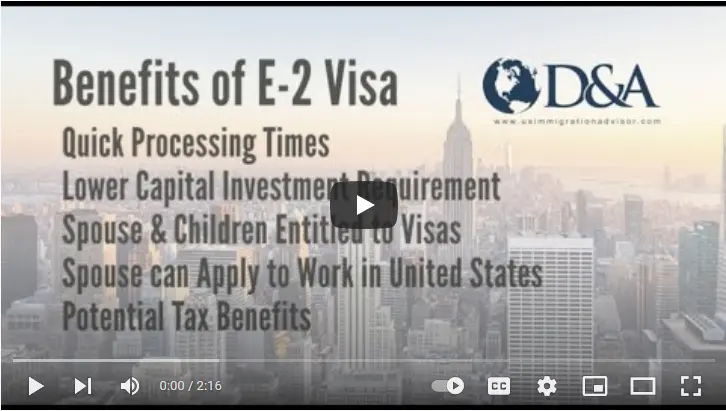
E-2 Visa Video: Key Takeaways
- 0:07 - Fast processing times for E-2 applications.
- 0:26 - Spousal work authorization (EAD) details.
- 1:38 - The Grenada Citizenship "Bridge" to E-2.
Click to view the full video transcript.
[00:00] Having the E-2 treaty investor visa is the next best thing to having a green card. Let me explain why the E-2 investor visa is such a good option.
[00:12] First, it offers quick processing times.
[00:18] Second, it requires a lower capital investment compared to many other immigration pathways.
[00:26] The spouse and dependent children of the principal applicant are entitled to receive E-2 derivative visas.
[00:34] With the E-2 derivative visa, the spouse may apply for an Employment Authorization Document (EAD). If approved, they are permitted to work for any employer in the United States.
[00:45] Depending on the duration of stay in the U.S., the treaty investor may qualify as a non-resident for tax purposes and may not be liable for taxes on worldwide income.
[00:57] The treaty investor is also free to travel in and out of the United States for as long as the E-2 visa remains valid.
[01:04] This is a major advantage for individuals who operate businesses in different parts of the world.
[01:09] Most importantly, you need to have a strong team behind you. With Davies and the team, you are absolutely in safe hands.
[01:20] It’s also important to work with people who can provide support on the ground level, and again, I believe you will be very well taken care of by Davies, the team, and their channel partners.
[01:38] I would definitely remain a strong advocate for the rest of my life for anyone interested in exploring the Grenada citizenship-by-investment program, which can lead to access to the E-2 investor treaty visa.
[01:53] If you wish to live and reside in the United States through Grenada citizenship, this can be an excellent pathway.
[02:00] [Music]
E-2 Treaty Investor Visa: features, what each allows, and why it matters
| Feature |
What it allows |
Why it matters |
| Own and run a business |
Ability to own, operate, and work in a business in the United States |
Direct access to the U.S. market while actively managing day-to-day operations |
| No fixed investment |
No set minimum investment amount |
Capital can be aligned with the size and type of the business rather than an arbitrary threshold |
| Renewals |
Indefinite renewals possible |
E-2 status can be renewed indefinitely as long as the business remains active and compliant. L-1A visas have a maximum validity of 7 years. |
| Spouse work |
Automatic employment authorization |
Spouses may work for any employer or start a business without a separate permit. |
| Green Card Pathway |
Allows pursuit of permanent residence through separate immigrant visa categories |
Enables long-term planning for investors who later qualify under EB-5, L-1, EB-1, NIW, or family-based options. E-2 visa holders who meet the statutory and evidentiary requirements for managerial or executive roles may also qualify for EB-1C. |
| Faster processing |
E-2 visas are processed solely at a U.S. consulate |
E-2 visa applicants skip USCIS processing (required for L-1A) and proceed directly to consular processing. |
| Essential employees |
Bring qualified foreign employees with the same nationality |
Enables founders to build and scale operations with trusted personnel. |
| Investor profile |
Active business owners and operators |
Suited to founders involved in day-to-day management. |
| Family residency |
Dependents may live and study in the United States |
Children can attend school while the business operates. |
| OBBBA integrity fee |
$250 |
Fee imposed by the One Big Beautiful Bill Act. |
Key Benefits of the E-2 Visa
The E-2 Treaty Investor Visa offers:
- entrepreneurs a fast and flexible way to live and work in the United States
- no fixed investment threshold
- consular processing
- automatic spousal work authorization
- unlimited renewals while the business remains compliant
The E-2 visa is a practical option for business owners seeking long-term presence in the U.S.
Although it does not directly lead to lawful permanent residence, E-2 status allows qualified investors to plan strategically and pursue permanent residence through other available pathways.
E-2 Visa Requirements: Who Qualifies?
To qualify you need treaty nationality (one of 80+ E-2 treaty countries), a substantial at-risk investment that's irrevocably committed and proportional to the business's cost — there's no fixed minimum — a real operating business, and non-marginality: the business must do more than support your family.
Read the Full Guide: E-2 Visa Requirements →
Not sure you meet the E-2 requirements?
Get a free eligibility assessment against the actual visa criteria — no obligation.
Check if you qualify
The E-2 Visa Application Process
Applying follows a clear sequence: identify a qualifying business, irrevocably commit your capital, draft a 5-year business plan, put the legal structure and funding in place, file Form DS-160 and pay the MRV fee, submit your evidence binder, and attend the consular interview — applicants aged 14–79 must attend in person.
Read the Full Guide: E-2 Visa Process →
Choosing Your E-2 Business
Your business must be a real, active, for-profit enterprise you own at least 50% of or control through a managerial position — passive investments like rental property or a stock portfolio don't qualify. Franchises, IP-heavy tech startups, consultancies and professional-services firms are the models that succeed most often, from roughly $75,000 to $250,000+ depending on the model.
Read the Full Guide: Qualifying E-2 Businesses →
The E-2 Visa Business Plan
Your business plan must prove the enterprise isn't "marginal" — that it will grow and create U.S. jobs — typically through credible 5-year financial projections tested against the Matter of Ho standard: verifiable market analysis, a granular hiring timetable, and explained projection math.
Read the Full Guide: E-2 Visa Business Plan →
How Much Do You Need to Invest? Funding Your E-2 Business
Your funds must be irrevocably committed and "at risk" before the visa is issued — money you could still withdraw doesn't count. A properly structured escrow agreement, accepted under 9 FAM 402.9-6(B) and Matter of Walsh and Pollard, solves this by releasing funds to the seller only on E-2 approval.
Read the Full Guide: At-Risk Rules & Escrow →
E-2 Visa vs. E-2 Status: Consular Processing or USCIS Change of Status?
One of the most critical strategic decisions you will make is where to apply. The wrong choice can severely restrict your international travel flexibility and business operations.
The E-2 visa is a non-immigrant status, meaning it is intended for temporary stays and does not directly lead to permanent residency.
E-2 Visa Status
E status refers to the legal standing of the visa holder while in the U.S., and maintaining or ending this status is essential for compliance with U.S. immigration law. Visa validity, on the other hand, refers to the duration of the visa stamp in your passport, which may differ from the period of authorized stay granted upon entry and can vary by country.
There are two distinct legal pathways to obtain E-2 classification. While both allow you to work, they offer vastly different rights regarding international travel.
Option 1: E Visa Consular Processing (The "Gold Standard")
This involves applying for an E-2 Visa Stamp at a U.S. Embassy or Consulate in your home country (e.g., London, Toronto, Tokyo).
- The Benefit: If approved, you receive a visa foil in your passport (typically valid for 5 years). This allows you to travel freely in and out of the U.S..
- The Process: You file Form DS-160, submit your binder to the Embassy, and attend an in-person interview.
- Why Experts Prefer It: It aligns with the reality of international business. You cannot "develop and direct" a global trade enterprise if you are restricted from traveling abroad.
Option 2: Change of Status to E-2 Status (The "Domestic" Route)
This involves filing Form I-129 with USCIS while you are physically present in the United States.
The Benefit:
- Speed: You can use Premium Processing to get a decision in 15 business days for an extra fee ($2,965).
- No Interview: You typically do not need to attend an in-person interview.
The Critical Downside: Travel Restrictions.
A Change of Status grants you "E-2 Status" (valid on your I-94), but it does NOT give you an E-2 Visa (the sticker in your passport).
Consequence: If you leave the U.S. for any reason (business, wedding, funeral), you lose your status immediately. To re-enter, you must schedule a consular interview abroad and start the application process effectively from scratch.
E-2 Visa and E-2 Change of Status Comparison: Which Path is Right for You?
E-2 consular processing vs. change of status — which route fits you?
| Feature |
Consular Processing (Embassy) |
Change of Status (USCIS) |
| Primary Outcome |
Visa Stamp (Travel Permitted) |
I-94 Status (Travel = Abandonment) |
| Validity Period |
Up to 5 Years (Renewable) |
2 Years (Strict limit per approval) |
| Processing time |
2–4 Months (Varies by Post) |
15 Days (With Premium Processing) |
| Interview? |
Yes (Mandatory In-Person) |
No (Paper-based adjudication) |
| Risk Profile |
High Stakes (Denial = Stuck abroad) |
Safe Haven (Denial = Remain in current status) |
🔥 E-2 Visa Tip: Beware the "Domestic Renewal" Rumor
You may have heard of a "Stateside Visa Renewal" pilot program. As of 2026, this program was limited to H-1B visas. It does not apply to E-2 investors. Do not plan your strategy assuming you can get a visa stamp inside the U.S.—you cannot.
E-2 Essential Employees: Bringing Your Team to the U.S.
The E-2 visa is not just for the primary investor. E-2 visa holders can bring their spouses and unmarried children under 21 to the U.S. as dependents. These dependents may accompany the principal investor.
Maximum Duration of Dependent E-2 Status
The maximum validity of derivative E-2 visas for spouses and children is determined by reciprocal agreement between the United States and the treaty country; if there is no such agreement, the visa duration defaults to that of the principal applicant.
1. Strict Nationality Requirement: The "Same Nationality" Rule
Before assessing the job role, you must first satisfy the strict nationality rule.
- The Rule: The employee must share the same nationality as the principal treaty investor (or the entity majority owners).
- Ownership Test: If the business is owned by a company, at least 50% of that parent company must be owned by nationals of the treaty country.
- Note: Permanent Residents (Green Card holders) of the treaty country do not qualify; they must be citizens.
2. E-2 Executive & Supervisory Roles: The "Ultimate Control" Test
- The Authority Test: The employee must have "ultimate control and responsibility" for the organization's overall operation or a major component of it.
- Key Adjudication Factors: Consular officers will scrutinize:
- The number of employees supervised.
- The level of pay (executives command higher salaries).
- Position in the organizational hierarchy.
Legal Authority:
3. E-2 Visa Specialized Qualifications: The "Essential Skills" Test
This category allows for non-executive staff who possess specialized knowledge vital to the company's success.
- The "Specialization" Test: The skills must be specialized and unique—not commonplace or readily available in the U.S. labor market.
- Duration of Status: "Essential skills" are often treated as temporary (strictly for the period needed to train U.S. workers), whereas executive roles can be permanent.
Legal Authority:
9 FAM 402.9: The Rules Consular Officers Apply to E-2 Visas
An E-2 visa is processed entirely at a U.S. Consulate outside the United States. USCIS is not involved in an E-2 visa adjudication. The United States Department of State is responsible for determining E-2 visa policies and processing standards.
To succeed, you must understand the specific manual your reviewing non-immigrant visa consular officer is using:
1. Consular vs. USCIS Jurisdiction: Know Your Adjudicator
- The Distinction: Consular Officers do not report to the Department of Homeland Security (USCIS); they report to the Department of State. The USCIS policy manual is therefore not binding in E-2 visa adjudication cases.
- The Consequence: Therefore, they do not follow the USCIS Adjudicator Field Manual. Instead, they strictly follow the Foreign Affairs Manual (FAM). If your legal team quotes USCIS memos to a Consular Officer, they are citing rules that do not apply to your case.
2. The "Hidden" Math: How FAM Definitions Differ
- Proportionality Examples: The FAM definition of "substantial investment" includes specific mathematical examples for the "proportionality test" (e.g., investing 100 percent of the cost for a low-budget business) that USCIS guidance often lacks.
- Marginality Calculations: The FAM provides distinct instructions on how to calculate "projected future income" to avoid the "marginality" denial trap.
- Risk: If your business plan is written for USCIS standards but read by a Consular Officer using the FAM, you risk a technical denial.
3. Interview Strategy: Master 9 FAM 402.9 to Win
E-2 visa interview preparation, 9 FAM 402.9 guide. Knowledge of the FAM is your strongest weapon during the consular interview.
- The Strategy: The officer behind the glass is using 9 FAM 402.9 as their checklist. If you know their manual better than they do, you can structure your answers to trigger their specific approval requirements.
- Action Item: Read the specific FAM sections related to your weak points (e.g., "Source of Funds" or "Intent to Depart") before your interview.
🔥 E-2 Visa Tip: Read the Manual Before Your Interview
Do not fly blind. Access the official 9 FAM 402.9 here. It is the exact instruction manual the officer will be referencing while asking you questions.
February 2026 E-2 Visa Updates to FAM
“Intent to depart” standard reaffirmed
The FAM reiterates that:
- E-visa applicants do not need a foreign residence they intend to maintain.
- They only need to show intent to depart when E status ends.
Physical office not strictly required
The updated guidance clarifies:
- A physical office is not strictly required for E classification.
- However, it may still be considered when assessing whether the business is real and operating.
Consular Processing Rules: Embassy-Specific Pitfalls
Every U.S. Embassy has unique "Local Rules" that supersede general USCIS guidelines. Ignoring these leads to instant rejection. Examples of local requirements include:
- U.S. Embassy London: Strictly enforces a "Tab A – Tab J" format. Applications must be submitted as a single PDF under a specific file size limit (often 10MB).
- U.S. Consulate Toronto: Often bifurcates "New Cases" vs. "Renewals." They may reject files sent via zip folders or cloud links.
- U.S. Embassy Paris: Has historically enforced a strict 50-page limit for the core legal brief and evidence.
Core forms for consular filings
- DS 160 (all applicants) Travel.gov
- DS 156E often requested for E classifications and many posts require it as part of the E visa application package. eForms. U.S. Embassy Canada
- Each consulate has its own E visa submission instructions, for example: U.S. Embassy and Consulates in the United Kingdom
🔥 Davies & Associates E-2 Visa Tip: Read the Local Rules First
Ignoring local rules is one of the fastest paths to denial. Every consulate has different procedures for E-2 visa adjudication which have to be followed precisely. It is critical to read the relevant consular website before applying for an E-2 visa.
E-2 Visa Costs and Fees
Costs split into sunk costs — the DS-160/MRV fee, reciprocity fee, legal fees, and optional $2,965 premium processing — and investment capital, which isn't lost but must be substantial and fully at risk before your interview. The reciprocity fee alone ranges from $0 for UK and Canadian nationals to $5,592 for Australians.
Read the Full Guide: E-2 Visa Costs and Fees →
E-2 Visa Processing Time: How to Speed It Up
Filing a Change of Status inside the US? Premium Processing guarantees a decision in 15 business days for $2,965 — but grants status only, not a visa stamp. Filing at a consulate abroad, Premium Processing isn't available, but a documented expedite request or watching for cancelled appointment slots can move your interview up.
Read the Full Guide: E-2 Visa Processing Time →
E-2 Visa Renewal
The E-2 can be renewed indefinitely as long as the business stays active and non-marginal — but each renewal is a full re-adjudication, not a formality, and the most common denial reason is failing to show the business grew enough to support US workers.
Read the Full Guide: E-2 Visa Renewal →
E-2 Visa to Green Card: Your Options
The E-2 is a non-immigrant visa — it does not convert automatically into permanent residence. But as a renewable status, it can work as a stepping stone toward a Green Card through other categories.
Can I Transition from E-2 to a Green Card?
A common misconception is that the E-2 is a "dead end" because it doesn't grant a Green Card directly. It can still lead there — you just need the right strategy in place before you file.
The EB-1C/L-1A Myth and the E-2 Visa
Some assume the EB-1C route is closed to E-2 holders and only open to L-1A holders. That's not correct. The L-1A has similar criteria to EB-1C, but no law or regulation favours an L-1A holder over an E-2 holder when it comes to qualifying.
The "Dual Intent" Doctrine
What is "Dual Intent"?
Dual intent means holding a non-immigrant visa while simultaneously pursuing lawful permanent residence — no visa holder is barred from later applying for a Green Card.
Does the E-2 Allow Dual Intent?
Not in the full sense that the H-1B or L-1 do. But the Foreign Affairs Manual (9 FAM 402.9-4(C)) carves out an exception:
- You can have a Green Card petition pending and still renew your E-2.
- The condition: you need to satisfy the consular officer that you intend to leave the U.S. if that Green Card application is denied.
2. The EB-5 Direct Transition
Many E-2 investors move to the EB-5 Immigrant Investor Visa once the business is established.
- How it works: if your investment grows to the EB-5 threshold (typically $800,000+) and the business creates 10 full-time jobs, you become eligible to apply.
- Why investors do it this way: the E-2 is faster to secure, so you can be operating in the U.S. while you build toward the capital and job-creation numbers EB-5 requires.
3. Other Indirect Pathways
The E-2 itself isn't a Green Card category, but it's a platform you can build from — spousal sponsorship or other employment-based routes stay open, provided you maintain intent to depart while your E-2 status is active.
Thinking past the E-2 — toward a green card?
The path from E-2 to permanent residency isn't automatic, and the wrong structure now can close doors later. Talk to us before you file, not after.
Plan my green card path
E-2 Visa Business Examples & Success Stories
- The Tech Pivot (AI Startup):
- Investment: $120,000 (software IP + cloud infrastructure).
- Outcome: Approved. The IP valuation was what got the investment over the threshold.
- The Franchisee (Fitness Studio):
- Investment: $250,000 (franchise fee + equipment).
- Outcome: Approved. Franchises tend to be lower-risk cases because the business model is already proven.
- The Consultant (Marketing Agency):
- Investment: $75,000 (100% of startup capital).
- Outcome: Approved. For lower-capital businesses, putting in the full amount of required funds is usually the strategy that works.
Official Legal Sources for the E-2 Visa
- The statute: INA § 101(a)(15)(E)(ii) – defines the E-2 category for those "solely to develop and direct" operations.
- The regulations: 8 CFR § 214.2(e) – covers "marginality" and "substantial" investment rules.
- The core reference for E-2 interviews: 9 FAM 402.9 – the manual consular officers use to adjudicate your case.
- Change of status: USCIS Policy Manual, Vol 2, Part G – for applicants filing Form I-129 from within the U.S.
E-2 Visa Benefits for Spouses and Children
The E-2 extends to immediate family, not just the principal investor — your spouse and unmarried children under 21 can join you in the U.S.
Who Qualifies as an E-2 Dependent?
- Spouse: a legally married spouse qualifies for E-2 dependent status — there's no requirement that they share the principal investor's nationality.
- Unmarried children: only children under 21 and unmarried qualify. Turning 21 or marrying ends dependent eligibility.
- Nationality: the principal investor must be a treaty-country national, but dependents don't need to be — they file as dependents of the principal E-2 holder regardless of their own nationality.
Family can travel with the principal applicant at the outset, or apply for E-2 dependent visas later at a consulate once the principal case is approved.
E-2 Visas Through Citizenship by Investment: Grenada CBI, Turkish CBI and The Amigos Act
If your home country isn't an E-2 treaty country, citizenship in one that is — commonly Grenada or Turkey — can create a lawful path to E-2 eligibility, since E-2 is nationality-based. A three-year domicile requirement can apply when that citizenship was acquired through investment (the AMIGOS Act rule), so this needs planning well before you file.
Read the Full Guide: Grenada & Turkey CBI to E-2 →
Who Advises on E-2 Investor Visa Cases
Our E-2 practice is led by a U.S. immigration team working across the United Kingdom, United States, Europe, and Asia.
Key members of our investor visa team include:
If you are considering an E-2 visa, we can advise on business selection, investment structuring, and application strategy before you commit funds. Contact our E-2 visa team to discuss your case.
Based in the UK? Our E-2 visa lawyer in London team can advise on your case directly.
Investing in Florida? Our Miami E-2 visa lawyers act for treaty investors across Florida from our office at 80 S.W. 8th Street, Miami.
Page revision history
- September 30, 2026: added a link to the Miami E-2 visa lawyers page for Florida investors.
E-2 Visa Frequently Asked Questions (2026)
The E-2 visa allows investors from treaty countries to live and work in the United States by investing in and operating a business. The answers below are based on current US immigration regulations under 8 CFR and guidance in the Foreign Affairs Manual used by US consulates.
What are the main requirements for an E-2 visa?
To qualify for an E-2 visa, you must be a national of an E-2 treaty country, invest a substantial amount of capital in a real and operating US business, show that the investment is at risk and committed, and prove that the business is not marginal. You must also own at least 50 percent of the business or have operational control of the enterprise.
For a full breakdown, see our detailed E-2 visa requirements guide and our main E-2 visa guide.
Legal sources: 8 CFR 214.2(e); 9 FAM 402.9
How much money do you need for an E-2 visa?
There is no fixed minimum investment for an E-2 visa. The investment must be substantial in relation to the total cost of the business and large enough to show that the investor is genuinely committed to making the business succeed.
In practice, many successful E-2 visa applications involve investments in the range of 100000 to 300000 USD, depending on the business model. For practical examples, see our E-2 visa costs guide.
Legal sources: 8 CFR 214.2(e)(12); 9 FAM 402.9-6(C)
How long does an E-2 visa take to process?
E-2 visa processing typically takes a few weeks after submission, depending on the consulate. Interview wait times and local processing procedures can affect the overall timeline.
The speed of an E-2 visa case often depends on the quality of the filing, the complexity of the business, and how clearly the investment and source of funds are documented. For more detail, see our E-2 visa processing time guide.
Legal sources: 9 FAM 403; consular procedures vary by post
Does the investment need to be spent before applying for an E-2 visa?
Usually, yes. E-2 visa funds must be at risk and irrevocably committed before approval. Funds sitting in a bank account without being committed to the business are generally not sufficient.
Strong E-2 visa cases often include signed leases, equipment purchases, inventory orders, escrow arrangements tied to visa approval, or other committed business expenses. Learn more in our E-2 visa investor guide.
Legal sources: 8 CFR 214.2(e); 9 FAM 402.9-6(B)
What does a real and operating business mean for E-2 visa purposes?
A real and operating business is an active commercial enterprise that produces goods or services for profit. Passive investments such as undeveloped land, stocks, or money held in an account do not qualify for an E-2 visa.
The business should be properly formed and supported by evidence such as leases, registrations, contracts, staffing plans, and a credible business plan. See our E-2 business plan guide.
Legal sources: 8 CFR 214.2(e)(13); 9 FAM 402.9-6(D)
What does marginal mean in an E-2 visa case?
A marginal business is one that only generates enough income to support the investor. To qualify for an E-2 visa, the business must have the present or future capacity to generate more than a minimal living.
In practice, officers look for realistic revenue projections and a plan to hire US workers within around five years. See our E-2 visa requirements guide.
Legal sources: 8 CFR 214.2(e)(15); 9 FAM 402.9-6(E)
How long does an E-2 visa last?
E-2 visa validity depends on nationality, but admission to the United States is typically granted in up to two-year periods at a time.
The visa can be renewed indefinitely as long as the business remains active and compliant. Each renewal is a fresh review of the case. See our E-2 visa renewal guide.
Legal sources: 8 CFR 214.2(e)(5); 9 FAM 402.9-4
Can an E-2 visa lead to a green card?
The E-2 visa does not directly lead to a green card. However, many investors use it as part of a longer-term immigration strategy.
Common routes include the EB-5 investor visa and, in some cases, the EB-1C category if the business grows to meet managerial or executive requirements.
Legal sources: INA 101(a)(15)(E); 9 FAM 402.9-4(B)
Can I bring my spouse and children on an E-2 visa?
Yes. Your spouse and unmarried children under 21 can apply as E-2 dependents. Your spouse may work in the United States, while children can attend school but cannot work.
Dependents do not need to share the same nationality as the principal applicant. See our E-2 visa guide.
Legal sources: 8 CFR 214.2(e)(23); 9 FAM 402.9-9
Can citizenship by investment make me eligible for an E-2 visa?
Yes, in some cases. Because E-2 eligibility is based on nationality, acquiring citizenship in a treaty country such as Grenada or Turkey may allow you to apply.
These cases often receive additional scrutiny, particularly around how citizenship was obtained and whether there are genuine ties to the treaty country. See our Grenada E-2 visa guide.
Legal sources: 8 CFR 214.2(e); 9 FAM 402.9-4
What is the three year domicile issue for some E-2 citizenship by investment cases?
In some cases, US law may require applicants who obtained treaty nationality through investment to demonstrate a period of residence in that country before applying for an E-2 visa.
This is a fact-specific issue and depends on the citizenship route, timing, and ties to the country. See our AMIGOS Act guidance.
Legal sources: 8 CFR 214.2(e); 9 FAM 402.9
How is the E-1 visa different from the E-2 visa?
The E-1 visa is for treaty traders engaged in substantial trade, while the E-2 visa is for investors developing and directing a US business.
If your business is based on trade between countries, the E-1 may be more appropriate. If it involves investment in a US business, the E-2 is usually the better option. Compare in our L-1 visa guide.
Legal sources: 8 CFR 214.2(e); 9 FAM 402.9
How does the E-2 visa compare with the L-1 visa?
The E-2 visa is used by investors from treaty countries, while the L-1 visa is used for transferring employees from a foreign company to a US company.
The best option depends on your business structure and long-term goals. Some E-2 investors may later qualify for EB-1C if they meet the requirements. See our L-1 visa guide.
Legal sources: 8 CFR 214.2(e); 8 CFR 214.2(l); 9 FAM 402.9
Ready to Build Your American Dream?
Do not guess with your future. Embassy rules, investment structure, and documentation strategy determine approval.
About the Authors
Mark I Davies, Esq.
Chairman of Davies & Associates; focused on E visa strategy and complex consular filings.
Mark I Davies, Esq. JD, University of Pennsylvania Law School, Licensed with the SRA (SRA ID: 384468) in the UK, Member Law Society of England & Wales, MBA, Wharton School of Business. Top 10 Investment Visa Lawyer, Licensed (USA), Georgia State Bar. AILA Member.
| Area |
Details |
| Education |
JD, University of Pennsylvania Carey Law School | MBA (Finance), The Wharton School, University of Pennsylvania | Chartered Accountant (ICAEW) |
| Financial Training |
Completed Analyst Training Program at a major international bank | Chartered Accountant background with professional training in financial analysis and reporting |
| Legal Practice |
Admitted to practice in Georgia (USA) | Registered Solicitor with the Law Society of England & Wales | Former CMBS lawyer at one of the world's largest international law firms |
| Immigration Track Record |
15+ years advising HNW investors | Zero denials for clients advised on source-of-funds compliance in EB-5 | Hundreds of successful EB-5 cases globally |
| Recognition |
Named a Top 25 EB-5 Immigration Attorney by EB5 Investors Magazine (2018–2023) |
| Professional Engagements |
Lecturer/trainer for other lawyers at AILA, ACA, University of Pennsylvania Law School | Frequent speaker at global investment immigration conferences |
Log of Updates
| Date |
Update |
| February 2026 |
Substantive Update |
| March 2026 |
Added changes to FAM |
| May 2026 |
Added “How to Speed Up Your E-2 Visa” section covering Premium Processing, consular expedites, and cancelled appointment strategy |
| August 2026 |
Added costs table; retitled and restructured the guide; expanded country-specific guide and lawyer links. |
Country-Specific E-2 Visa Guides and Lawyers
E-2 visa help by country: guides and local lawyers
Each guide covers the E-2 rules for that nationality. The lawyer pages connect you with the Davies & Associates team serving that market.

 English
 Italian
 Tiếng Việt
 Francais



















 E-2 Visas for UK Citizens
 E-2 Visas for Italians
 E-2 Visas for Australians
 E-2 Visas for Singaporeans
 E-2 Visas in New York City
 E-2 Visas for Canadians
 E-2 Visas from the UAE
 E-2 Visas for Argentinians
 E-2 Visas for Germans
 E-2 Visas for French
 E-2 Visas for Turkish
 E-2 Visas for Grenadians
 E-2 Visas for Taiwanese
 E-2 Visas for Thai Nationals