An E-2 visa lets a national of a treaty country, including the United Kingdom, live and work in the United States to develop and direct a business in which they have invested, or are actively investing, a substantial amount of capital (INA 101(a)(15)(E)(ii); 8 CFR 214.2(e)(2)). It is a non-immigrant visa and can be renewed while the business continues to qualify.
This guide walks UK nationals through the E-2 visa: eligibility, the U.S. Embassy London process, costs, the UK residence rule, and how the E-2 compares with other routes.
Not a UK national? Our main E-2 visa USA guide sets out the treaty investor rules for applicants from every treaty country.
State Department reciprocity schedule, United Kingdom
Visa integrity fee
At least USD 250 per person, adjusted for inflation, created by law; no implementing notice published and not listed by the State Department or the London Embassy (checked 20 October 2026)
Public Law 119-21
Initial review time
"over 90 working days"; no expedites
Embassy: How to Apply, read 20 October 2026
Interview window
Within 90 days of the invitation
Embassy: How to Apply
Admission
Up to 2 years per admission
8 CFR 214.2(e)(19)
Extensions
Up to 2 years at a time; no overall limit set
8 CFR 214.2(e)(20)
Family
Spouse and unmarried children under 21, any nationality
What Types of E-2 Visas Are Available to UK Nationals?
UK nationals are eligible for three types of E-2 visas:
E-2 Treaty Investor Visas for founders and business owners.
E-2 Employee Visas for executives, supervisors and essential employees of a qualifying E-2 business.
E-2 Dependant Visas for spouses and unmarried children under 21.
Can a British citizen get an E-2 visa?
Yes. The United Kingdom is an E-2 treaty country (9 FAM 402.9-10).
A British investor qualifies by owning at least 50% of, or controlling, a real U.S. business, investing a substantial amount of capital that is at risk, and coming to develop and direct it (8 CFR 214.2(e)(12) to (16)). Executives, supervisors and essential employees of a qualifying UK-owned business can also qualify (8 CFR 214.2(e)(3)).
The core standards, with their sources, are set out below.
Key Eligibility Criteria
Description
References
1. Treaty Nationality
The applicant must be a national of a country that maintains a qualifying treaty of commerce and navigation with the United States.
The investor must have made, or be actively making, a substantial investment in a bona fide U.S. enterprise. The investment must be significant in relation to the total cost of purchasing or establishing the business and sufficient to ensure its successful operation.
The investment funds must be at risk and subject to potential loss if the business fails. Loans secured by business assets generally do not qualify, as they do not expose the investor to true financial risk.
The enterprise must be a real, operating commercial undertaking that produces goods or services for profit. Speculative or idle investments such as undeveloped land or stock portfolios are not eligible.
The business must not be marginal: it must have the present or future capacity to provide more than a minimal living for the investor and family, or to make a significant economic contribution. Projected future capacity should generally be realisable within five years from the start of normal business activity (8 CFR 214.2(e)(15)).
The applicant must be entering the United States solely to develop and direct the enterprise, typically by owning at least 50 percent of the business or through a managerial or executive position with operational control.
Examples of E-2 Visa Approvals in 2026 at the U.S. Embassy in London
Our recent E-2 approvals in London cover a wide range of UK businesses, from fashion and food to recruitment, automotive, and biotech. Successful E-2 cases aren't tied to any one industry or business model.
Between January 2026 and April 2026, examples of successful E-2 matters in London included:
April 22, 2026:HeadLight Glasses: a zero-employee case at filing, with qualifying investment based on inventory and Facebook ads. It shows that a carefully prepared low-investment, low-headcount case can still meet London E-2 standards.
A men's footwear designer from Harrogate with an investment of USD 78,000.
A recruitment business from Scunthorpe expanding into Rome, Georgia.
A hat designer from Derby securing a third E-2 essential worker visa by using brand value through a licence agreement.
A biotechnology company from London with qualifying investment that included patents.
Three separate matters for car dealers, each establishing a U.S. business presence.
A fish and chip business expanding from Brighton into Pensacola, Florida.
Three separate E-2 matters for young, award-winning fashion designers from the London area.
Further reading on choosing the right legal partner for your E-2 application:
Who counts as UK for the E-2 visa? Isle of Man, Channel Islands and Gibraltar
For E-2 purposes the UK treaty covers the British Isles (except the Republic of Ireland), the Channel Islands and Gibraltar, so the Isle of Man is included. You must also actually and permanently reside, and be domiciled, in that territory when you apply (9 FAM 402.9-10, note 10). A British citizen living permanently in Spain or Dubai cannot rely on the UK treaty.
Can I qualify for the UK E-2 if I am living abroad temporarily?
Possibly. The test is that you actually and permanently reside, and are domiciled, in UK treaty territory (9 FAM 402.9-10, note 10).
A British citizen who is abroad only temporarily, and keeps a permanent residence and domicile in the UK, may still qualify. Expect the Embassy to ask for evidence of both.
The State Department defines the UK treaty territory as "the British Isles (except the Republic of Ireland), the Channel Islands, and Gibraltar". A British national relying on the treaty must be an inhabitant of that territory, meaning someone who "resides actually and permanently" there and "has his domicile there" (9 FAM 402.9-10, note 10). In practice:
residents of England, Scotland, Wales, Northern Ireland, the Isle of Man, Jersey, Guernsey and Gibraltar qualify;
a British citizen living permanently in Spain, Dubai or Hong Kong does not qualify under the UK treaty, but one living abroad only temporarily, who keeps a permanent residence and domicile in the UK, may still qualify;
a UK resident who is not a British national does not qualify unless they hold the nationality of another treaty country.
Spouses and children qualify through the principal and need not be British (8 CFR 214.2(e)(4)).
Do I have to live in the UK to apply for an E-2 visa in London?
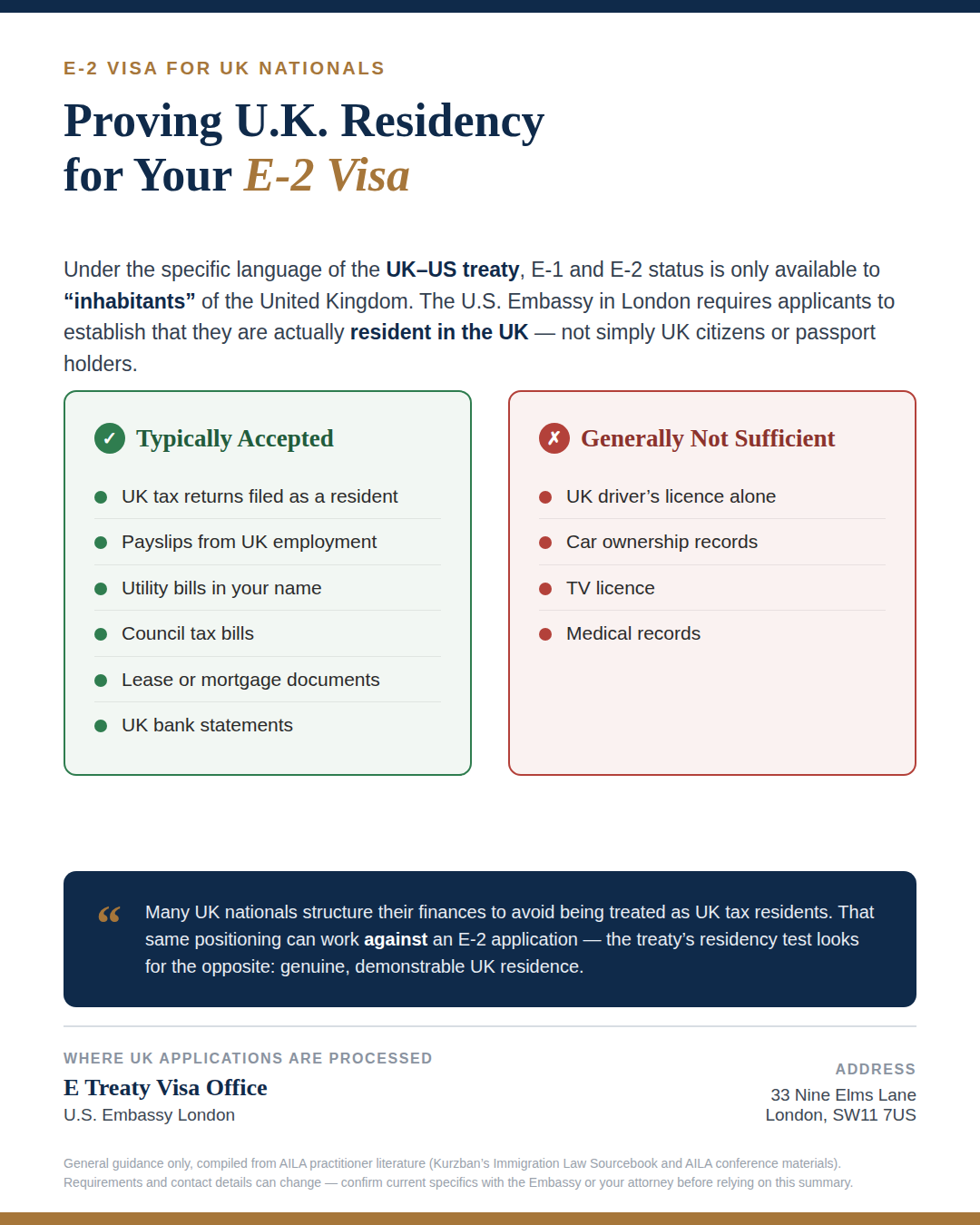
Yes. The Embassy asks for evidence of your ongoing UK residence, such as the current lease or mortgage for your main home and your most recent UK payslip, and a signed statement that you will leave the U.S. when E-2 status ends. Within the United Kingdom, E-2 applications are made at the U.S. Embassy in London, not Belfast.
The Embassy's checklist asks for "evidence of the applicant's ongoing residency in the UK (including, as appropriate, a copy of the current lease or mortgage for the applicant's primary residence in the UK; the applicant's most recent UK pay stub)", and "a signed statement of intent to depart the U.S. upon termination of E-2 status". The Embassy's list is not exhaustive.
In our experience these also help: HMRC tax returns or SA302 tax calculations; council tax bills; utility bills in your name at the same address. A UK driving licence, car records, a TV licence or medical records are weak evidence on their own.
The rule catches out some of the strongest applicants. A client who has arranged his affairs to be non-resident in the UK for tax may find that the same arrangements make it hard to show UK residence to the Embassy. Deal with it before filing.
The following video explains the UK special residency rule.
Video: Special Considerations for UK-based Applicants for the E-2 Treaty Investor Visa
What the video covers
[1:44] The speaker explains the UK treaty's residence condition; the legal test is set out above.
[2:26] Evidence includes utility bills, council tax records, payslips, and mortgage or lease agreements.
[3:05] The speaker's view that a UK driving licence or a mobile phone bill is not accepted; in our experience they are weak evidence on their own.
Transcript excerpts
[00:00:03] Hi everyone, my name is Verdi Atienza. I head the E-2 visa practice team at Davies & Associates. The E-2 visa is a popular option for entrepreneurs looking to develop a business in the U.S.
[00:01:58] There is one major exception for nationals of the United Kingdom: the treaty requires ongoing physical residency.
[00:02:26] Proof of residency includes local utility bills, council taxes, current lease/mortgage payments, and bank statements showing local transactions.
[00:03:05] Note: Driver licenses, car ownership, and phone bills are not acceptable evidence at the U.S. Embassy in London.
E-2 Treaty Investor Visas: Developing and Directing a U.S. Business
Can a British Citizen on an E-2 Visa Diversify into Other Businesses?
Yes, if correctly structured.
A British E-2 visa holder is only permitted to work for the E-2 entity for which the visa was approved[3]. However, if that entity is structured correctly and diversifies into multiple businesses, the investor may be eligible to work across those dependent businesses.
Management Companies and Holding Companies: Immigration Law vs. Corporate Law and Tax Planning
Placing several different businesses in one corporate entity can be optimal for immigration planning. However, from a liability protection and taxation planning perspective this can be a disaster.
Disagreements between E-2 immigration attorneys and U.S. corporate lawyers are commonplace. Generally E-2 immigration lawyers disfavour the use of holding companies, while corporate and tax lawyers insist on using them.
One solution is to use a holding company that employs staff who provide services to subsidiary businesses, which can work for E-2 visa purposes. In these circumstances, it is critical that corporate and immigration counsel work as a team.
Our lawyers sometimes restructure employment so staff move from the subsidiary to the holding company level, allowing the E-2 investor to remain tied to a management company or holding company with multiple subsidiaries. Obtaining an E-2 through a holding company is possible but involves special considerations and planning.
Have a question about the E-2 visa for UK nationals?
Why Every E-2 Visa Applicant in London Needs to Read the FAM
The Foreign Affairs Manual ("FAM") guides consular officers during the E-2 visa decision-making process. Reading the FAM is worthwhile for every E-2 visa applicant in London. See 9 FAM 402.9.
In addition to the guidance in the FAM, the U.S. Embassy in Nine Elms in London follows its own E-visa procedures and practical review style. While general E-2 procedures are posted on the U.S. Embassy's website, that guide is not complete. In London, working with a London-based E-2 lawyer with substantial experience presenting E-2 cases at the U.S. Embassy in London is highly beneficial.
Can I study while on an E-2 visa?
An E-2 investor or employee may study, part time or full time, provided the study is incidental to E-2 status: you must continue to develop and direct the business, and you cannot extend your stay to finish a course. The course need not relate to the business. E-2 dependants may also study.
How much do I need to invest for an E-2 visa from the UK?
There is no fixed minimum. The investment must be substantial for the business in question: generally, the lower the total cost of the business, the higher the proportion of that cost you must invest (9 FAM 402.9-6(D)).
USD 100,000 is a planning figure, not an approval threshold. In London we have had approvals at about USD 30,000.
Not every category of spend is automatically accepted by consular officers as counting toward the qualifying investment amount.
Professional and attorney fees, and vehicle costs, have in at least one documented case been questioned as to whether they count toward the total; this is not settled published guidance, so it is worth discussing with your attorney which categories of spend on your specific business plan are safely countable. On the funding side, dividend income can also be an acceptable source of E-2 investment funds, alongside savings or the proceeds of a business sale.
Applicants should also understand the wider E-2 visa costs and fees alongside the business investment itself.
What counts as a substantial investment for an E-2 visa?
A substantial investment depends on the nature and cost of the business. Lower cost businesses may qualify if most or all of the required funds are already committed, while larger or more operationally intensive businesses may require greater capital. The key question is whether the investment makes the enterprise credible, real, and capable of operating.
Where UK Applicants Apply
U.S. Embassy London: Primary Processing Post
Within the United Kingdom, E-2 Treaty Investor Visa applications for UK nationals are processed by the U.S. Embassy in London, not Belfast. The London Embassy has a dedicated E-Visa Unit that reviews applications for investors, employees and dependants under both the E-1 (Trader) and E-2 (Investor) categories.
Investors first register their company with the London E-Visa Unit. Employees of a registered company book their interview directly and bring the required employee documents, including Form DS-156E, to the interview (Embassy instructions; employee documents).
U.S. Consulate Belfast: Not Authorised for E-2 Visas
The U.S. Consulate General in Belfast does not process E-2 Treaty Investor Visa applications. Applicants residing in Northern Ireland apply through the U.S. Embassy in London.
The Embassy's E visa instructions route every registration to the London E Visa Unit: How to Apply.
E-2 Visa for Scotland and Edinburgh Applicants
Applicants based in Scotland, including Edinburgh and Glasgow, also apply for the E-2 visa through the U.S. Embassy in London; there is no separate E-2 processing post in Scotland. For Scottish clients, Davies & Associates has an Edinburgh office, so the case can be prepared locally before the London E-Visa Unit filing.
Your spouse may work for any U.S. employer once admitted in E-2 status. We recommend they also apply to USCIS for an employment authorisation document (EAD), because many employers will not hire without one.
Unmarried children under 21 may accompany you; they may study but cannot work (INA 101(b)(1); 8 CFR 214.2(e)(4)).
Within the United Kingdom, E-2 applications are made at the U.S. Embassy in London, not Belfast. The Embassy sets out the process on its E visa how-to-apply page. Who counts as UK is explained above.
How do I apply for an E-2 visa at the US Embassy in London?
Investors first register their company with the London E-Visa Unit: complete the DS-160, open a visa appointment account and pay the fee, upload the supporting documents, wait for the review and attend the interview; you then travel within the visa's validity. Employees of a registered company skip the advance submission and bring their documents to the interview.
Complete the online visa application form DS-160. Sign and submit it at least two business days before the interview.
Open an account on the Visa Appointment Service, answer "No" to both questions in the "Applicant Responses" section, and pay the MRV application fee.
Upload the supporting documents electronically, following the instructions given after step 2.
Review. The E-Visa Unit confirms receipt and reviews accepted cases in order of acceptance against 9 FAM 402.9. The current initial review time is "over 90 working days", cases cannot be expedited, and more documents may be requested.
Interview. You are emailed an invitation to book an interview and should attend within 90 days of it. Bring a printed DS-160 confirmation whose number matches your appointment account.
Travel. If the visa is issued, you are admitted for up to two years at each entry (8 CFR 214.2(e)(19)). Check the E-2 annotation and the expiry date on your I-94 after every entry.
The steps above are a summary. For the full step-by-step package, with the complete document checklist, the cover-letter structure and how the London E-Visa Unit expects the bundle to be organised and submitted, see our dedicated guide:
An E-2 employee may qualify through executive or supervisory duties, or through special qualifications that make the employee's services essential to the enterprise. The employee must have the same nationality as the treaty enterprise. See 9 FAM 402.9-7(B) and 9 FAM 402.9-7(C).
How long does an E-2 visa take in London?
The London E-2 process, as at 2 November 2026
Checked against the U.S. Embassy London E-Visa Unit guidance on 2 November 2026. Figures move; we update this box when they do.
Where. All UK E-2 cases are decided by the E-Visa Unit at the U.S. Embassy, 33 Nine Elms Lane, London SW11 7US. Belfast does not handle E visas. USCIS is not involved.
Step 1, company registration. The investor's company is registered with the E-Visa Unit first; employees of a registered company skip this and book an interview directly.
Step 2, the review. The Unit currently quotes over 90 working days to review a complete package, first in, first out. E cases cannot be expedited at this stage.
Step 3, the interview. Once invited, you must attend within 90 days. Interviews in 2026 run to about 30 minutes, with detailed questions on the business, the funds and your role. DS-160 must be submitted at least two working days before.
Step 4, the visa. Administrative processing of 2 to 8 weeks is common after the interview; passports are returned by courier in about a week.
End to end: typically 5 to 7 months from submission to visa. Plan on 7 to 9 months before your intended move.
Fees: MRV $315 per applicant; no issuance fee for UK nationals; a visa integrity fee is enacted but not yet collected.
The State Department application fee is USD 315 for each applicant, including your spouse and each child; the UK has no reciprocity fee. Public Law 119-21 also created a visa integrity fee of at least USD 250 per person, but no implementing notice has been published and the State Department fee page lists only the USD 315 fee (checked 20 October 2026).
Costs. Checked 20 October 2026
Item
Who pays
Amount
Source
E visa application (MRV) fee
Each applicant, including spouse and children
USD 315
State Department fees
Reciprocity issuance fee
Each applicant
None for UK nationals
State Department reciprocity schedule
Visa integrity fee
Each applicant issued a visa
At least USD 250, adjusted for inflation; not yet implemented by any published notice and not listed by the Embassy (checked 20 October 2026)
Public Law 119-21
Change of status inside the U.S. (Form I-129, E)
Petitioner
USD 1,015, or USD 510 for a small employer; plus the Asylum Program Fee of USD 600, or USD 300 for a small employer
USCIS G-1055; check again at filing
Premium processing (optional, USCIS only)
Petitioner
USD 2,965 from 1 March 2026
Federal Register, 12 January 2026
Application fees for a family. Checked 20 October 2026
Who is applying
People
Application (MRV) fees, USD 315 each
Investor only
1
$315
Investor + spouse
2
$630
Investor + spouse + two children
4
$1,260
Application fees only. British nationals pay no reciprocity fee; a dependant of another nationality may have a different fee. Legal fees and the business investment are separate.
Consular Processing vs. Change of Status to E-2 Status
Instead of applying for an E-2 visa through the U.S. Embassy in London, some applicants already in the United States may be able to request E-2 status from USCIS without obtaining a visa stamp. More details on Change of Status vs. Consular Processing.
Can I apply for an E-2 visa from outside the UK?
USCIS can grant E-2 status inside the United States, but it does not issue visas; the visa itself is issued by a U.S. embassy or consulate abroad, and applicants generally apply at the post in the country where they live.
For UK nationals resident in the UK, that is the U.S. Embassy in London, which runs a dedicated E-Visa Unit. After a change of status in the United States you still need an E-2 visa from a post abroad to re-enter after travel.
Applying at a U.S. post in a third country (outside your country of residence) is sometimes possible, but many posts prioritise, or restrict E cases to, applicants resident in their consular district, and some decline third-country-national E applications.
Because London is experienced with UK E-2 cases and applies the UK residence rule consistently, UK-resident applicants are usually best served filing there. If you are a UK national living outside the UK, take advice on which post will accept your case before you file.
Many UK investors start on the E-2 and later move to the EB-5 Immigrant Investor Program for permanent residence. The E-2 lets you build and run the U.S. business now; the EB-5 is a separate immigrant route to a green card for you, your spouse, and unmarried children under 21.
For example, a UK founder opens a U.S. business on an E-2 visa and runs it for several years. As the business grows and they decide to settle permanently, they invest the required EB-5 amount (often into a qualifying project or their own expanded business) and file for EB-5, converting a temporary E-2 position into a path to a green card without giving up the company they already built.
London E-2 Visa Interviews in 2026: What to Expect
Interviews are now more demanding
E-2 visa interviews at the U.S. Embassy in London are no longer as quick or predictable as they once were. According to a March 2025 AILA practice alert, applicants should now expect longer interviews and closer scrutiny.
What has changed
AILA reported that E visa interviews in London are now handled by a rotating group of consular officers rather than a dedicated E visa team. That means adjudications may be less consistent than in the past.
Practitioners have also reported interviews lasting up to 30 minutes, with much more detailed questioning for both business owners and employees.
What E-2 visa officers may ask
Applicants should be ready to answer detailed questions about the business and the investment. These may include revenue in the UK and the U.S., the business plan, startup costs, and the value of the investment.
For employee cases, officers may also ask why the company needs the applicant in the United States, whether the U.S. business is profitable, and whether the applicant understands that the E-2 visa is not a direct path to a green card.
AILA also reported unexpected refusals under INA 214(b), which requires an E-2 applicant to establish entitlement to non-immigrant status, including the intent to depart. We now prepare every London client for an interview of up to thirty minutes and for the possibility of a 214(b) refusal.
Read AILA's update on longer E-2 interviews and increased scrutiny at the U.S. Embassy in London. Download the PDF
What Is the Most Important Part of an E-2 Visa Application?
A credible business plan explains how this business will operate, use the committed investment and meet the E-2 requirements, with its financial and staffing assumptions supported by evidence. It cannot cure an investment that is not substantial.
How long can I stay in the US on an E-2 visa?
Each admission is for up to two years (8 CFR 214.2(e)(19)). Extensions are granted in increments of up to two years, and the regulation sets no overall limit, for as long as you and the business keep qualifying (8 CFR 214.2(e)(20)). A UK E-2 visa can be valid for up to five years; validity and length of stay are different things.
Maximum Possible Visa Term
Total Maximum E-2 Validity for UK Nationals is Unrestricted
There is no restriction on the total number of years for which a U.K. national can hold an E-2 visa. (9 FAM 402.9)
UK Nationals Usually Receive Five Year Multiple Re-Entry E-2 Visas
E-2 visas are typically issued to UK nationals in increments of up to a maximum of five years.
Note that this is a maximum, and while rare, E-2 investor visas can be issued for a shorter validity period.[6]
Our Practical Experience with E-2 Validity Periods
In our own UK E-2 practice, nearly all approved UK investor cases have received an initial five-year E-2 visa term, although validity is discretionary and case-specific.
E-2 Status or E-2 Visa Validity Period
Each time a UK national enters the U.S. on an E-2 visa they are usually admitted in E-2 status for up to two years. Before the authorised stay on Form I-94 expires, file a timely extension or leave. Check each family member's I-94 separately.
Can my spouse work and my children go to school on an E-2 visa?
Your spouse and unmarried children under 21 can come as E-2 dependants, whatever their nationality (INA 101(b)(1); 8 CFR 214.2(e)(4)). Your spouse may work for any employer (INA 214(e)(2)): an unexpired I-94 marked E-2S is acceptable List C evidence for Form I-9, used with a List B identity document. Children may attend school, but E-2 status gives them no work authorisation.
E-2 spouses are authorised to work incident to status (INA § 214(e)(2), formerly § 214(e)(6)) and may work for any U.S. employer; no separate permit is legally required. We still recommend applying for an EAD, because many employers will not hire a foreign national without one. USCIS policy on E and L spouse employment.
Our office is centrally located in London's City business district, serving clients throughout London, Scotland (including our Edinburgh office), and Central and Southern England, with direct liaison to our U.S. offices in New York, Miami, Los Angeles, and Houston.
Basic Corporate Setup and Choice of Business Entity
The business must meet its state's registration and registered-agent rules. Whether it needs separate premises depends on the business; the E-2 rules do not require every investor to lease an office (9 FAM 402.9-4(D)).
What type of Business for E-2?
Many business types are used in E-2 visa cases. The right entity depends on the specifics of the business, but a limited liability company (LLC) is very common. You should also have a properly written employment agreement and basic corporate documentation.
A registered agent is a state-law requirement for the company, not an E-2 requirement.
Registering your Business
Having established a U.S. business, you will need to open a bank account and obtain a tax registration with the U.S. Internal Revenue Service.
D&A's immigration lawyers are also supported by our firm's corporate and tax lawyers who are able to assist clients with important business set-up and documentation issues.
Yes, if you hold an eligible non-immigrant status and meet the change-of-status rules, a petition on Form I-129 can ask USCIS to change you to E-2 without a London interview (INA 248; 8 CFR 214.2(e)(21)). You cannot change to E-2 after entering on ESTA. A change of status gives you E-2 status but not an E-2 visa: once you travel abroad, you normally need an E-2 visa from the Embassy in London to return.
If you are relying on a change to E-2 status, do not start E-2 work before USCIS approves the change and it takes effect (8 CFR 214.1(e)).
Investigating your U.S. Business on a B1/B2 Visa
Travelling to the United States to investigate business options is common. This raises the possibility of transitioning to "E-2 Status" from within the United States.[11]
Change of Status to E-2 from Within the U.S.
It is possible to "change status" from another visa status to E-2 "status" from within the United States. For example, an applicant who enters the United States on a B-1 visa to investigate setting up a business might later be able to "change status" to E-2 status and lawfully operate a business that has been formed.
A change of status is filed with USCIS on Form I-129. Where available, premium processing can be requested to obtain a faster decision on the I-129, though it does not itself grant an E-2 visa for travel.
Can an E-2 visa lead to a green card?
It can, but not automatically; the same is true of the L-1. Every route needs an immigrant petition, followed by adjustment of status in the U.S. (INA 245(a)) or an immigrant visa in London. UK clients mostly use EB-1C (INA 203(b)(1)(C)), EB-5 (INA 203(b)(5)), or EB-2 and EB-3 (INA 203(b)(2) and (3)). Holding E-2 rather than L-1 status makes no difference to EB-1C eligibility.
EB-1C requires that your employer abroad (it need not be British) and your U.S. company are related as parent, subsidiary or affiliate; that you worked for that employer abroad for at least a year as a manager or executive in the three years before the petition is filed or, if you are already in the U.S. working for the same employer or a related company, the three years before you entered as a non-immigrant (8 CFR 204.5(j)(3)(i)(A) and (B)); that the U.S. company and at least one qualifying organisation abroad continue doing business until the green card is granted, and the U.S. company has been doing business for at least a year when the petition is filed; and that your U.S. role is primarily managerial or executive (8 CFR 204.5(j)).
Your E-2 investment can count towards EB-5 if it meets the EB-5 rules. If you are eligible to adjust status and a visa is available for your category, priority date and country of chargeability (usually your country of birth, INA 202(b)), the immigrant petition and the green card application can be filed together (8 CFR 245.2(a)(2)(i)(B); for EB-5, INA 245(n)).
Your E-2 extension cannot be refused solely because the petition has been filed (8 CFR 214.2(e)(5)), and the regulation sets no overall limit on E-2 extensions (8 CFR 214.2(e)(20)). Two points need planning: get advance parole before travelling while the green card application is pending (8 CFR 245.2(a)(4)(ii)), and if you need a new E-2 visa in London after a petition has been filed, you must satisfy the officer that you intend to leave at the end of your stay (9 FAM 402.9-4(C)).
USCIS reminds officers that adjustment of status is discretionary as well as a matter of eligibility, and each case is assessed on its facts (USCIS Policy Memorandum PM-602-0199, 21 May 2026).
Can E-2 visa holders get an EB-1C green card, or do you need an L-1?
Yes, E-2 holders can use EB-1C; an L-1 is not required.
Nothing in INA 203(b)(1)(C), 8 CFR 204.5(j) or the USCIS Policy Manual limits EB-1C to L-1 holders. The test is one year as a manager or executive with a related company abroad in the three years before the petition is filed or, if you are already in the U.S. working for the same employer or a related company, the three years before you entered as a non-immigrant (8 CFR 204.5(j)(3)(i)(A) and (B)).
The other conditions are:
the U.S. employer is the same company as the foreign employer, or its parent, subsidiary or affiliate (8 CFR 204.5(j)(3)(i)(C));
the U.S. employer has been doing business for at least one year when the petition is filed (8 CFR 204.5(j)(3)(i)(D));
the U.S. employer and at least one qualifying organisation abroad continue doing business until the green card is granted (USCIS Policy Manual, Volume 6, Part F, Chapter 4); it need not be the company that employed you;
the U.S. employer can pay the offered wage (8 CFR 204.5(g)(2));
the U.S. job is primarily managerial or executive (8 CFR 204.5(j)(2) and (j)(5)).
The employer abroad need not be British. A UK investor who owns both the UK company and the U.S. company can meet the affiliate test, because an affiliate includes one of two subsidiaries owned and controlled by the same individual (8 CFR 204.5(j)(2)).
Neither visa converts automatically: USCIS says that eligibility as an L-1A "does not automatically establish eligibility" for EB-1C (USCIS Policy Manual, Volume 6, Part F, Chapter 4). The differences lie elsewhere.
The L-1 is a dual-intent visa (INA 214(b) and (h); 8 CFR 214.2(l)(16)), and L-1 holders who meet 8 CFR 245.2(a)(4)(ii)(C) may travel while a green card application is pending without advance parole. E-2 holders need advance parole to travel, and must satisfy the officer of their intent to leave if they renew the visa abroad after filing (9 FAM 402.9-4(C)).
E-2 vs L-1 vs EB-5: which is best for a UK business owner?
For most UK owners the E-2 is the natural start: no fixed minimum investment, no required employment abroad and no overall time limit in the regulation. The L-1 suits a UK company transferring a manager who has worked for it for a year. EB-5 is itself a green card and needs USD 800,000 or USD 1,050,000, both adjusted for petitions filed from 1 January 2027 (INA 203(b)(5)(C)).
Material changes to this guide, most recent first. Dates show when the guidance was reviewed or revised.
October 2026: Answers restructured by question; UK territory and residence rule corrected (9 FAM 402.9-10, note 10); London review time, fees and integrity fee updated; EB-1C and comparison sections added; citations corrected to 8 CFR and FAM.
July 2026: Added detail on the new U.S. visa integrity fee of at least $250 per applicant (and per dependent), charged at visa issuance; implementation is pending a future DHS publication. See references for Public Law 119-21 and the Federal Register notice.
July 2026: Updated internal cost links to the E-2 visa cost guide and corrected the USCIS spouse work-authorization citation to Policy Manual Vol. 10, Part B, Ch. 2.
June 2026: Reflected 2025 U.S. Department of State country-of-residence guidance and the USCIS PM-602-0199 (21 May 2026) memo on adjustment-of-status discretion.
About the Author
Mark I. Davies, Esq.
Managing Partner of Davies & Associates; focused on E visa strategy and complex consular filings.
Mark I. Davies, Esq., J.D., University of Pennsylvania Law School, licensed by the
SRA (SRA ID: 384468) in the UK, and a member of The Law Society of England & Wales,
MBA, Wharton School of Business. Named a Top 25 EB-5 Immigration Attorney by EB5 Investors Magazine.
Ranked Band 1 for E-2 visas in Singapore by Global Citizenship Services (2026). Admitted to practice in Georgia (USA).
Georgia State Bar member. AILA member.
Area
Details
Education:
JD, University of Pennsylvania Carey Law School | MBA (Finance), The Wharton School, University of Pennsylvania | Chartered Accountant (ICAEW)
Financial Training:
Completed the Analyst Training Program at a major international bank | Chartered Accountant background with professional training in financial analysis and reporting
Legal Practice:
Admitted to practice in Georgia (USA) | Registered Solicitor with the Law Society of England and Wales | Former CMBS lawyer at one of the world's largest international law firms
Immigration Track Record:
15+ years advising HNW investors | While, as of October 21, 2026, the firm has never had an EB-5 case denied on the basis of its source-of-funds work, there can never be a guarantee of future success. | Hundreds of successful EB-5 cases globally
Several lawyers told me I would not be able to get a TN visa. Two weeks after contacting Davies & Associates I was working in New York, visa in hand.
Individual seeking 'Impossible' TN Visa
D&A was very detail-oriented and very thorough in what they did. They worked on my case 24/7 and were very patient in answering all my questions.
E-2 Visa Client
My case felt complex but D&A managed the whole process carefully and helped me move seamlessly from one stage to the next.
E2 + CBI Client
D&A was my guiding light through the entire EB-5 process.
EB-5 Visa Client
I would definitely be a big advocate for the rest of my life for anyone wanting to explore the Grenada Citizenship by Investment Programme leading to the E-2 visa. The most important thing is a good team behind you.
With Davies & Associates, you're in safe hands... you need someone who can support you on the ground and, again, you are well taken care of by D&A. The people are really warm, very helpful and quite open-minded when it comes to business... Not to mention as a passport it's great from a travel perspective... It's just 4 to 5 hours from New York.
Grenada CBI + E2 Visa Client
The entire process of getting an EB-5 visa is handled in a professional way by Mark Davies and his team. EB-5 is a wonderful option for anyone considering moving to the United States if you have the means. I was hoping to use the H-1B route for my children, but it became unreliable and so I looked to the EB-5 visa instead.
It is great for anyone who has the resources. Mark gives you the first meetings himself which gives you great comfort. Both Mark and Sanjay are abundantly available and I even had the pleasure of hosting them at my house.
Parent of 2 EB-5 visa holders
I'm in the process of extending my L-1 visa. I submitted a few questions regarding my case, and he contacted me back almost immediately, both by email and telephone. Unlike other attorneys I met before, he gave me the impression of knowing off the top of his head what kind of visa I have, and what actions had to be taken to extend it.
He is very thorough and clear regarding the process and what to expect in terms of timelines and issues that may arise. He is constantly in contact, so you definitely know he's working on your case.
L-1B Visa Holder
Mark Davies is a joy to work with. His extensive knowledge, speedy response and attentive service took away all my fears of dealing with immigration and visa applications. He is very generous with his time in explaining every step along the way and I have already and will in the future recommend him to anybody who is looking for an immigration lawyer.
E2 Visa for Small Professional Business With International Offices
Davies & Associates assisted us with an immigration emergency involving my brother's fiancée who was outside the United States. They assisted us in a highly professional manner, working with the relevant US embassy, US immigration and the governments of two other countries.
As a result of their efforts the individual involved is now working in the United States. While their knowledge of the law is exemplary what really distinguishes this firm and attorney Davies from any other firm we have worked with is their dedication to customer service and their unrivaled level of professionalism.
Complex Fiancée Visa Need Involving Multiple International Jurisdictions
Several lawyers told me I would not be able to get a TN visa. Two weeks after contacting Davies & Associates I was working in New York, visa in hand. I have recommended this firm to several friends and colleagues, they do an excellent job every time.
Individual Seeking 'Impossible' TN Visa
I was qualified as a physician in a foreign country. Being on a J1 visa I was facing having to leave the United States and return to my home country. Davies & Associates secured one of only 30 J1 visa waivers available in my State, allowing me to work for a US hospital and remain in the United States.
Doctor Seeking J1 Visa Waiver
I am very satisfied with the services Mark Davies has provided me. He has a very extensive knowledge in immigration laws and has a thorough approach to any case.
Looking to relocate or having trouble with a visa application?
We are known for our creative solutions that obtain "impossible" visas. We solve the most complex immigration problems for business, investors, individuals and families.