

Mark I. Davies, Esq., J.D., University of Pennsylvania Law School, licensed by the SRA (SRA ID: 384468) in the UK, and a member of The Law Society of England & Wales, MBA, Wharton School of Business. Top 10 Investment Visa Lawyer. Licensed in the USA. Georgia State Bar member. AILA member.
E-2 as an Emergency Business Visa for UAE Residents
E-2 Visa GuideE-2 Visa CostsE-2 Visa Business PlanL-1 Visa GuideImmigration Options for UAE ResidentsEB-5 Lawyer in Dubai
Table of Contents
- ► Why UAE residents look at the E-2 when speed matters
- ► Why this issue is especially important in Dubai and the UAE
- ► Major UAE Nationalities That Qualify for the U.S. E-2 Investor Visa
- ► Key E-2 Requirements UAE Residents Must Understand
- ► Why the FAM matters more than the USCIS Policy Manual
- ► Visiting the United States to explore a business opportunity
- ► Why UAE residents call E-2 an emergency business visa
- ► Current March 2026 consular reality for UAE residents
- ► Where a UAE resident can apply under the current rules
- ► Immediate Travel to the U.S. to Investigate a Business, Followed by Change of Status
- ► Conclusion
- ► Speak with an E-2 lawyer familiar with Dubai and UAE cases
- ► FAQ: Visa Options for Dubai and UAE Residents
Key Takeaways
- Immediate travel on a B-1 visit visa or ESTA to investigate your US business.
- E-2 visas involve consular processing only so are faster than L-1 and other visas.
- Change of status to E-2 status is possible from within the US.
- UAE has a very large population of E-2 eligible nationals.
- E-2 can be converted to a Green Card using EB1-C and EB-5.
Award-Winning E-2 Lawyer
Davies & Associates is recognised by Global Citizenship Services as a Top Tier investment-visa law firm in London, Paris, New York and Dubai. Our Dubai team advises U.A.E.-based entrepreneurs on E-2 treaty investor cases, from qualifying nationality and business structuring through to the consular interview.
We are also proud to have been recognised as a Global Top 25 Investment Visa Law Firm for seven years by EB5 Investors Magazine.
Why UAE residents look at the E-2 when speed matters
The E-2 Visa: The “Emergency” US Business Visa
For many entrepreneurs living in Dubai and across the UAE, the E-2 visa is the most practical way to move quickly to the United States to buy, build, or run a business.
Unlike most other visas, an E-2 visa does not involve an application with USCIS. E-2 applications are made directly at US consulates.
For a consular E-2 case, the key legal framework is the State Department’s Foreign Affairs Manual, especially 9 FAM 402.9. 9 FAM 402.9 is the guidance consular officers use when deciding E-2 visas abroad.
Looking at permanent residence? Many Dubai investors pair the E-2 with EB-5. See our EB-5 lawyer in Dubai page for the green-card route.
E-2 Change of Status: Travelling to the US Immediately as a Business Visitor
It is possible to avoid the consular step and come directly to the United States using a B-1 visa or ESTA to explore opening a business in the US.
If, after having explored businesses, a B-1 holder changes their mind and decides to remain in the US to acquire and operate that business then it may be possible to "change status" to E-2 status from within the country.
Urgency in March 2026
This urgency is especially real in March 2026 because the U.S. Mission to the UAE announced that routine visa and U.S. citizen services appointments scheduled from March 2 through March 4 were postponed because of the security situation, and applicants were told not to come to the embassy or consulate during that period.
How Can I start my E-2 Process in the U.S. Today?
US law allows holders of a B-1 visit visa to come to the United States for the limited purpose of finding and exploring businesses to either set-up or acquire. You can literally board a flight today.
Why this issue is especially important in Dubai and the UAE
Dubai is one of the most international business markets in the world. Official Dubai data estimates the emirate’s 2024 population at 4,248,200, including 299,600 Emiratis and 3,948,600 non-Emiratis. That makes immigration planning in Dubai less about "residing in the UAE" in the abstract and more about passport nationality plus lawful residence.
⚖️ Expert Tip: For comprehensive advice on selecting the right legal partner for your E-2 application, consult our specialist resource:
Major UAE Nationalities That Qualify for the U.S. E-2 Investor Visa
UAE residents come from more than 200 nationalities. The largest expatriate community is Indian (India is not an E-2 Visa Treaty country). Several other large communities, including Pakistan, Bangladesh, Egypt, the Philippines, Turkey, and the United Kingdom, are from countries that have E-2 treaty relationships with the United States. The chart below illustrates the estimated distribution of nationalities among UAE residents and highlights those from E-2 treaty countries.
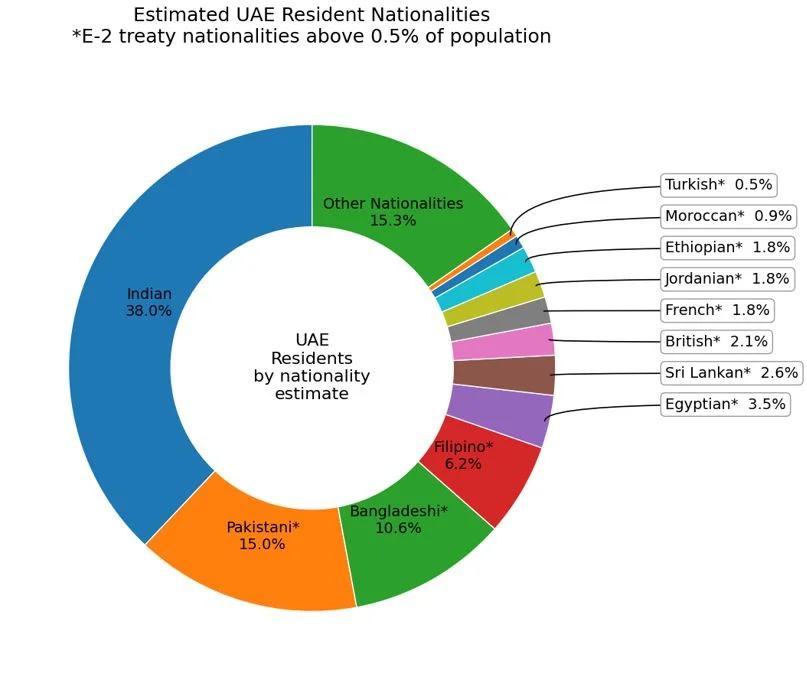
Source: UAE demographic estimates compiled from Dubai Statistics Center population data and public migration statistics. E-2 treaty eligibility based on the U.S. Department of State treaty country list.
Key E-2 Requirements UAE Residents Must Understand
The legal basis for the E-2 visa comes from the Immigration and Nationality Act and the federal regulations, including 8 CFR 214.2(e). UAE residents considering this option should understand the core requirements before investing. For a full explanation see our complete E-2 visa guide.
To qualify, an E-2 applicant must generally:
- hold the nationality of a treaty country
- invest, or be actively in the process of investing, a substantial amount of capital
- place that investment in a real operating commercial enterprise
- come to the United States to develop and direct that enterprise
The business must also be more than marginal, meaning it must have the capacity to generate more than a minimal living for the investor and family. USCIS describes the E-2 classification in similar terms, and the FAM provides the framework consular officers use when applying those rules in visa cases abroad.
📖 2026 D&A Complete E-2 Visa Guide
Nationality
The treaty relationship must exist, and the individual and/or business must possess the nationality of the treaty country under the E visa rules.
📖 March 2026 List of E-1 and E-2 Visa Countries
Substantial investment
The investment must be real, substantial, and committed, not merely speculative or theoretical.
Real operating enterprise
The business must be an actual operating commercial enterprise, not a passive holding arrangement.
Not marginal
The business must have present or future capacity to generate more than just a minimal living for the investor and family.
Develop and direct
The applicant must be coming to develop and direct the enterprise, which usually means ownership and control or another qualifying leadership role recognized by the E rules.
Why the FAM matters more than the USCIS Policy Manual for a normal E-2 visa application abroad
For a standard E-2 visa application at a U.S. embassy or consulate, the most important operating authority is the Foreign Affairs Manual, because the decision is being made by the Department of State. The FAM is the Department’s visa manual, and 9 FAM is the visa volume. By contrast, the USCIS Policy Manual matters most when USCIS is deciding an in-country matter such as a change of status or extension of stay.
Visiting the United States to explore a business opportunity
A UAE resident may be able to come to the United States in the appropriate temporary visitor status for limited lawful business-visitor activity, such as meeting advisers, consulting with business associates, negotiating terms, or exploring a possible investment or acquisition. The governing visitor framework is in 9 FAM 402.2, which covers temporary visitors for business.
Later applying for an E-2 visa
If the opportunity later becomes real and the investor qualifies, the person may then pursue the proper immigration route, including an E-2 visa if eligible.
The investor must stay within the limits of visitor status while in the United States and must not engage in unauthorized employment or misstate the purpose of travel. The legal framework for the later E-2 application is then governed by 9 FAM 402.9.
An important legal distinction
It is important not to confuse lawful exploratory business travel with the right to run the business in the United States. Visiting temporarily to evaluate an opportunity can be lawful. Actually directing and operating the business in the United States requires the correct immigration status.
The key limit: E-2 is still a nonimmigrant visa
The E-2 is not a green card. Under 9 FAM 402.9, an applicant’s expression of an unequivocal intent to depart the United States upon termination of E status is normally sufficient. The legally safe way to frame the issue is this: it can be lawful to explore a business first and later pursue E-2 status, but an E-2 case should not be presented as an intention to enter the United States and remain permanently regardless of status.
Why UAE residents call E-2 an emergency business visa
The E-2 often becomes the practical answer when a founder needs speed. It can work for someone who needs to relocate quickly to open a U.S. office, acquire an existing operating business, or move management to the United States. For UAE residents in March 2026, that urgency is even sharper because current regional instability has disrupted routine consular processing inside the UAE.
Current March 2026 consular reality for UAE residents
As of early March 2026, the U.S. Mission to the UAE publicly stated that routine services were postponed because of the security situation. The mission’s March 1 and March 2 notices said routine appointments from March 2 through March 4 at the U.S. Embassy in Abu Dhabi and Consulate General in Dubai were postponed, and applicants were told not to come while the disruption was in effect.
What this means in practice
If you are a UAE resident and need an E-2 quickly, you cannot assume that Dubai or Abu Dhabi will process on your preferred timetable while routine services are paused. Your strategy has to account for current post operations, your lawful residence, and your nationality.
Where a UAE resident can apply under the current rules
The relevant place-of-application guidance is in 9 FAM 403.2. That guidance states that, except for limited exceptions, a nonimmigrant visa application cannot be accepted or processed when the applicant is neither a resident of nor physically present in the consular district at the time of application.
Immediate Travel to the U.S. to Investigate a Business, Followed by Change of Status
A Pakistani entrepreneur living in Dubai had built a successful logistics and procurement company serving clients across the Gulf. Over the course of the last few years, several of those clients began expanding into the United States. He therefore travelled to the U.S. in B-1 business visitor status to explore whether opening a warehousing and distribution business in Miami would make commercial sense.
Investigating the U.S. market
While in the United States, he met brokers, reviewed small warehousing businesses for sale, explored possible warehouse locations, evaluated logistics partners, and assessed whether acquisition or a new launch made more commercial sense. He also put in place preliminary launch infrastructure, including a website and Amazon seller setup, so that the business would be immediately capable of entering into operation once the correct status was approved.
Changing Strategy While in the United States
During the trip, he decided that buying an existing warehousing business was less cost effective than securing his own facility and starting a new company. That decision was made while he was still in the U.S. after a lawful exploratory visit.
Filing for E-2 Change of Status
Because he was a Pakistani national, he was eligible to pursue E-2 classification. He then filed for E-2 change of status with USCIS before his authorized stay expired. The filing showed that the investment was committed, the business was real, and the company was ready to begin operations.
Change of status is applied for using form I-129.
📖 D&A Guide to Completing Form I-129
Launching the Business in E-2 Status
Once the change of status was approved, the client began directing the U.S. business in E-2 status. While in the United States, he secured the facility, launched operations, and hired two employees to support the warehousing business.
Returning to Dubai for E-2 visa issuance
While still in the U.S. in E-2 status, he later applied for an E-2 visa in Dubai so that he could travel internationally and re-enter the United States in E-2 visa status. He returned to Dubai in time for his E-2 visa interview, and the visa was approved.
Why this case worked
This case shows how a Dubai based entrepreneur can lawfully enter the U.S. to investigate a business opportunity, change plans while in the country, and move from B-1 exploration to E-2 status when the business is real and ready to operate.
Conclusion
For the right passport holder, the E-2 can genuinely function as an emergency business visa for UAE residents. That is especially true in Dubai, where most residents are non-Emirati and where several major expatriate nationalities, including Pakistanis, Bangladeshis, Egyptians, Omanis, and Turks, come from E-2 treaty countries. The legal keys are straightforward: use the correct nationality analysis, follow 9 FAM 402.9, respect the limits of temporary business visitor activity under 9 FAM 402.2, and build your place-of-application strategy around 9 FAM 403.2 and current post operations.
Speak with an E-2 lawyer familiar with Dubai and UAE cases
If you live in the UAE and need to move quickly, the real question is not just whether you qualify for E-2 in theory. The real question is whether your nationality, investment timing, visitor activity, and current consular routing all line up cleanly under the FAM and current March 2026 conditions.
FAQ: Visa Options for Dubai and UAE Residents
What visa options are available for Dubai residents who want to move to the United States?
Residents of Dubai and the UAE may qualify for several U.S. visa categories depending on their nationality, employment situation, and investment plans. Some of the most common include:
- L-1 intracompany transfer visa for executives and managers transferring to a U.S. office
- E-2 treaty investor visa for citizens of treaty countries who invest in and operate a U.S. business
- EB-5 immigrant investor visa for investors seeking U.S. permanent residence
- H-1B employment visa for certain specialized professionals
The appropriate pathway depends on factors such as business ownership, nationality, investment capital, and whether the move is intended to be temporary or permanent.
Can UAE residents apply for U.S. visas in Dubai?
Generally, yes. Individuals who are lawfully resident in the UAE may normally apply for nonimmigrant visas at the U.S. Consulate General in Dubai or the U.S. Embassy in Abu Dhabi.
However, at times consulates may close for security and other reasons. In some situations applicants may instead apply in their country of nationality, particularly if appointment availability or consular policies make that a more practical option.
What is the fastest U.S. visa option for entrepreneurs in Dubai?
For entrepreneurs and business owners, two of the most commonly used visa options are the L-1 intracompany transfer visa and the E-2 treaty investor visa.
The processes are different:
- L-1 visas generally require a petition to be filed with U.S. Citizenship and Immigration Services (USCIS) before the applicant applies for a visa at a consulate.
- E-2 visas are typically applied for directly at a U.S. consulate without a prior USCIS petition.
Because the E-2 process may skip the USCIS stage, it can sometimes move more quickly when the investment and business are already prepared.
Can Emirati citizens apply for the E-2 investor visa?
An Emirati cannot be a primary E-2 visa applicant. The United Arab Emirates is not currently an E-2 treaty country with the United States.
However, the spouse and children of an E-2 principal may qualify for derivative E-2 status regardless of nationality. That means an Emirati spouse of a qualifying E-2 investor may still obtain E-2 dependent status.
Can a Dubai entrepreneur open a company in the United States?
Yes. Many entrepreneurs in Dubai establish U.S. businesses as part of international expansion.
Common approaches include:
- launching a new U.S. startup
- opening a subsidiary or branch of an existing foreign company
- acquiring an existing U.S. business
- expanding a consulting or technology company internationally
Depending on the structure of the business and the investor’s nationality, this expansion may support visa pathways such as L-1 or E-2.
Can I come to the United States to investigate setting up a business?
Yes. In many cases it is lawful to travel to the United States to investigate, research, and evaluate a possible business opportunity.
A person may be able to enter the United States in B-1 business visitor status, or through ESTA under the Visa Waiver Program if they are from an eligible country, for limited business visitor activities.
This means that in the right circumstances a person may be able to board a plane immediately and travel to the United States to investigate a business opportunity.
Is it possible to move from Dubai to the United States through investment?
Yes. The United States offers several investment-related immigration pathways.
Two commonly discussed options are:
- E-2 treaty investor visa – a temporary visa allowing an investor to develop and direct a U.S. business
- EB-5 immigrant investor visa – an immigrant visa that can lead to U.S. permanent residence if the program requirements are met
These two options differ significantly in terms of investment size, processing time, and long-term immigration outcomes.
Can a Dubai company expand into the United States?
Yes. Many companies based in Dubai expand internationally by creating a U.S. subsidiary, branch, or affiliate company.
If the required corporate relationship exists, the company may be able to transfer executives or managers to the United States under the L-1 intracompany transfer visa category. This is a common pathway for companies opening their first U.S. office.
How long do U.S. business visas usually last?
The duration depends on the visa category.
- L-1 visas are usually granted for several years and may be extended depending on the employee’s role and the company structure.
- E-2 visas are typically issued for several years depending on the treaty country, with two-year periods of stay granted upon entry to the United States.
- EB-5 visas are immigrant visas that can lead to permanent residence.
The appropriate visa depends on the applicant’s business structure, nationality, and long-term plans.
Do Dubai residents need an immigration lawyer to apply for U.S. business visas?
It is not legally required to use an immigration lawyer, but many entrepreneurs and companies choose to work with one because business immigration cases often involve:
- corporate structuring
- investment documentation
- business plans
- consular processing strategy
Professional advice can help ensure the case is prepared correctly under U.S. immigration law.
Why do many entrepreneurs in Dubai explore international visa options?
Dubai is one of the most international cities in the world, with residents from more than 200 nationalities. Entrepreneurs and investors often expand internationally to access larger markets, open additional offices, or establish long-term residence options for themselves and their families.
As a result, many Dubai-based professionals explore visa pathways in destinations such as the United States, the United Kingdom, Italy, and the European Union as part of broader global mobility planning.
About the Authors
Mark I. Davies, Esq.
Chairman of Davies & Associates; focused on E visa strategy and complex consular filings.
Contact Davies & Associates Offices in United Arab Emirates
Check all of our locations around the world.
 E-2 Visas for UK Citizens
 E-2 Visas for Italians
 E-2 Visas for Australians
 E-2 Visas for Singaporeans
 E-2 Visas in New York City
 E-2 Visas for Canadians
 E-2 Visas for Argentinians
 E-2 Visas for Germans
 E-2 Visas for French
 E-2 Visas for Turkish
 E-2 Visas for Grenadians
 E-2 Visas for Taiwanese

Looking to acquire an E-2 as an Emergency Business Visa for UAE Residents?
We are known for our creative solutions that obtain "impossible" visas. We solve the most complex immigration problems for businesses, investors, individuals, and families.
E-2 as an Emergency Business Visa for UAE Residents Immigration lawyer near meSeveral lawyers told me I would not be able to get a TN visa. Two weeks after contacting Davies & Associates I was working in New York, visa in hand.
Individual seeking 'Impossible' TN VisaD&A was very detail-oriented and very thorough in what they did. They worked on my case 24/7 and were very patient in answering all my questions.
E-2 Visa ClientMy case felt complex but D&A managed the whole process carefully and helped me move seamlessly from one stage to the next.
E2 + CBI ClientD&A was my guiding light through the entire EB-5 process.
EB-5 Visa ClientI would definitely be a big advocate for the rest of my life for anyone wanting to explore the Grenada Citizenship by Investment Programme leading to the E-2 visa. The most important thing is a good team behind you. With Davies & Associates, you're in safe hands... you need someone who can support you on the ground and, again, you are well taken care of by D&A. The people are really warm, very helpful and quite open-minded when it comes to business... Not to mention as a passport it's great from a travel perspective... It's just 4 to 5 hours from New York.
Grenada CBI + E2 Visa ClientThe entire process of getting an EB-5 visa is handled in a professional way by Mark Davies and his team. EB-5 is a wonderful option for anyone considering moving to the United States if you have the means. I was hoping to use the H-1B route for my children, but it became unreliable and so I looked to the EB-5 visa instead. It is great for anyone who has the resources. Mark gives you the first meetings himself which gives you great comfort. Both Mark and Sanjay are abundantly available and I even had the pleasure of hosting them at my house.
Parent of 2 EB-5 visa holdersI'm in the process of extending my L-1 visa. I submitted a few questions regarding my case, and he contacted me back almost immediately, both by email and telephone. Unlike other attorneys I met before, he gave me the impression of knowing off the top of his head what kind of visa I have, and what actions had to be taken to extend it. He is very thorough and clear regarding the process and what to expect in terms of timelines and issues that may arise. He is constantly in contact, so you definitely know he's working on your case.
L-1B Visa HolderMark Davies is a joy to work with. His extensive knowledge, speedy response and attentive service took away all my fears of dealing with immigration and visa applications. He is very generous with his time in explaining every step along the way and I have already and will in the future recommend him to anybody who is looking for an immigration lawyer.
E2 Visa for Small Professional Business With International OfficesDavies & Associates assisted us with an immigration emergency involving my brother's fiancée who was outside the United States. They assisted us in a highly professional manner, working with the relevant US embassy, US immigration and the governments of two other countries. As a result of their efforts the individual involved is now working in the United States. While their knowledge of the law is exemplary what really distinguishes this firm and attorney Davies from any other firm we have worked with is their dedication to customer service and their unrivaled level of professionalism.
Complex Fiancée Visa Need Involving Multiple International JurisdictionsSeveral lawyers told me I would not be able to get a TN visa. Two weeks after contacting Davies & Associates I was working in New York, visa in hand. I have recommended this firm to several friends and colleagues, they do an excellent job every time.
Individual Seeking 'Impossible' TN VisaI was qualified as a physician in a foreign country. Being on a J1 visa I was facing having to leave the United States and return to my home country. Davies & Associates secured one of only 30 J1 visa waivers available in my State, allowing me to work for a US hospital and remain in the United States.
Doctor Seeking J1 Visa WaiverI am very satisfied with the services Mark Davies has provided me. He has a very extensive knowledge in immigration laws and has a thorough approach to any case.
U Visa Applicant, A Victim of CrimeLooking to relocate or having trouble with a visa application?
We are known for our creative solutions that obtain "impossible" visas. We solve the most complex immigration problems for business, investors, individuals and families.
Request Free Consultation
New York Office World Trade Center:
1 World Trade Center, Suite 8500, New York, NY 10007
+1 212 537 9196
Map and Driving Directions
New York Office E69th Street:
200 E 69th Street, 2N, New York, NY 10022
+1 212 537 9196
Map and Driving Directions
California Office:
555 Anton Blvd, Suite 150, Costa Mesa, CA 92626
+1 949 620 1811
Map and Driving Directions
Philadelphia Office:
1500 John F Kennedy Blvd, Suite 450, PMB 41, Philadelphia, PA 19102
+1 215 525 1881
Map and Driving Directions
London Office:
69 Old Broad Street, Dashwood House, London EC2M 1QS, United Kingdom
+44 20 3884 1812
Map and Driving Directions
London Office Beaufort Court:
Beaufort Court, Admiral Way, London E14 9XL, United Kingdom
+44 20 3884 1812
Map and Driving Directions
Edinburgh Office:
28 Rutland Square, Edinburgh, Scotland, EH1 2BW
+44 (20) 38841812
Map and Driving Directions
Milton Keynes Office:
The Pinnacle, 170 Midsummer Blvd, Milton Keynes MK9 1FE, United Kingdom
+44 7740 000769
Map and Driving Directions
Glasgow Office:
+44 131 392 0686
Map and Driving Directions
Vietnam Office:
46th Floor, Bitexco Financial Tower, 2 Hai Trieu, Ben Nghe Ward, District 1, Ho Chi Minh City, Vietnam
+84 28 44582309
Map and Driving Directions
India Office:
Enam Sambhav C-20, G Block, Bandra-Kurla Complex, Mumbai 400051, Maharashtra
+91 720 856 4057
Map and Driving Directions
Italy Office:
Via Bonifacio Lupi 29, 50129 Firenze FI, Italy
+39 055 076 3054
Map and Driving Directions
Manila Office:
Unit 107, AIC Burgundy Empire Tower, ADB Ave. cor Garnet and Sapphire Streets, Ortigas Center, Pasig City 1605, Metro Manila, Philippines
+63 2 7215 7878
Map and Driving Directions
Sydney Office:
Level 12, 210 George Street, Sydney NSW 2000, Australia
+61 2 9156 1032
Map and Driving Directions
Perth Office:
Davies & Associates LLC, Level 1, 12 St Georges Terrace, Perth WA 6000, Australia
+61 2 9156 1032
Map and Driving Directions
Singapore Office:
160 Robinson Road, #14-04, Singapore Business Federation Centre, Singapore 068914
+65-9615-0528
Map and Driving Directions
Looking for an Immigration attorney?
Immigration lawyer near meList of US Embassies, Consulates and USCIS
List of Italian Embassies, Consulates and USCIS
Copyright ©2026 by Davies & Associates LLC.