The Most Complete, Practical Guide to the EB-2 NIW Green Card
This guide is designed to be clear, deep, and practical. It explains not just what the NIW is, but how USCIS actually evaluates cases, who really qualifies, how to structure a winning petition, and how NIW works for founders, entrepreneurs, and interdisciplinary profiles.
If you want certainty, strategy, and realism rather than vague promises, you are in the right place.
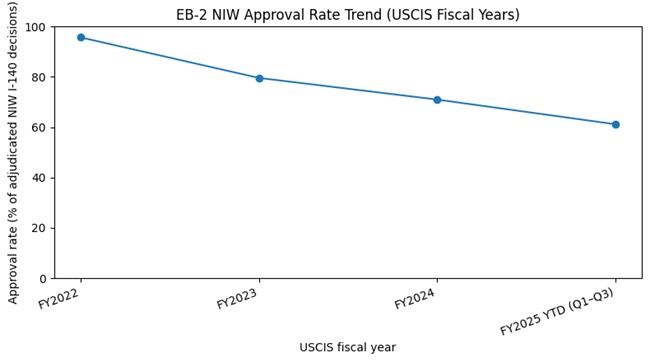
Decline in EB-2 NIW Based on Petition Quality
Overall EB-2 NIW approval rates have declined significantly. While as of February 2026, our firm has maintained a 100% approval rate with EB-2 NIW Petitions we have noticed a large number of EB-2 NIW Petitions from Asia which clearly do not meet the requirements of the law. Our offices in India and Vietnam especially report a large number of poorly qualified NIW Petitions being filed.
There is no reason for a properly prepared EB-2 NIW Petition that meets the requirements of the law to be denied.
What Is the EB-2 NIW Visa?
The EB-2 NIW is a second-preference employment-based immigrant visa category that grants U.S. permanent residence. The "National Interest Waiver" allows USCIS to waive two normally required elements:
❌A permanent job offer
❌Labor certification
✔You may self-petition for an EB-2 "Green Card" without an employer if you can demonstrate that your work benefits the United States at a national level.
✔Unlike many visas, the NIW focuses on future impact, not just past achievements.
Typical successful founder NIW cases involve applicants who already have customers, pilots, contracts, revenue, or institutional adoption, and whose role cannot be easily replaced by a standard U.S. hire.
If your work solves a real U.S. problem and you can show traction, NIW may be viable.
NIW is one of the best green card options for founders because:
No employer sponsorship required
You may own your company
No minimum investment amount
No job creation quota
No labor certification
What USCIS Looks for in Founder Cases
A clearly defined business or venture
Evidence of real-world traction
Market need tied to U.S. priorities
Revenue, pilots, contracts, or funding
Your central role and unique expertise
Founders must frame their work as a nationally relevant endeavor, not just a personal business.
Founder Evidence Checklist (EB-2 NIW)
Building a winning case for a founder or entrepreneur requires shifting the focus from "what the company does" to "how the founder's specific role drives national importance". Below is a checklist of high-impact evidence to bridge the gap between a business idea and a nationally relevant endeavor:
1. Evidence of Market Validation & Traction
Customer/User Metrics: Active user growth, retention rates, or pipeline data demonstrating that there is a real-world demand for your solution.
Revenue & Financials: Profit and loss statements, sales receipts, or executed contracts that prove the venture is operational and economically viable.
Letters of Intent (LOIs): Non-binding agreements or pilot program contracts from U.S. entities showing interest in adopting your technology or service.
Venture Funding: Term sheets or bank statements showing investment from VCs, angel investors, or government grants (e.g., SBIR/STTR), which serves as third-party validation of your potential.
2. Proof of "National Importance" (Prong 1)
Strategic Alignment: Documentation showing how your venture addresses specific U.S. priorities such as national security, public health, supply chain resilience, or environmental sustainability.
Scalability Reports: Expert opinions or business plans explaining how local or regional success will scale to have broader implications for the U.S. economy or a specific industry.
White Papers/Policy Impact: Proof that your work has been cited by policy makers or industry bodies as a solution to a widespread problem.
3. Proof of Your Unique "Positioning" (Prong 2)
Intellectual Property: Filed patents, trademarks, or proprietary algorithms that you developed, demonstrating your "well-positioned" status to advance the work.
Critical Role Documentation: Evidence that you are the primary driver of the endeavor, such as organizational charts, founder agreements, or lead developer logs.
Institutional Adoption: Letters or contracts showing that your specific system or methodology has been integrated into the operations of larger, established organizations.
4. Expert & Independent Support
Independent Expert Letters: Testimonials from industry leaders who have no personal stake in your company but can attest to the significance of your work to the United States.
Media Coverage: Features in reputable industry journals, tech blogs, or mainstream news that discuss your venture's impact or your role as a leader in the field.
Key Strategy Reminders
Execution over Ideas: USCIS rarely approves "future plans" without proof of execution; traction is your strongest ally.
Avoid "Ordinary Employment" Framing: Do not frame your role as one that a U.S. employer could fill through standard hiring; emphasize your unique expertise and the "self-starting" nature of the endeavor.
Consistent Narrative: Ensure your business plan, personal statement, and recommendation letters all define your "proposed endeavor" in exactly the same way.
Strategic EB-2 NIW for High-Impact Founders (2026 Update)
Under the 2022 and 2024 USCIS Policy Updates, the National Interest Waiver (NIW) has evolved into a primary pathway for startup founders, especially those in STEM-designated fields. Unlike traditional employment-based visas, a founder’s petition does not require a job offer or a labor certification (PERM), provided the Proposed Endeavor aligns with current U.S. strategic priorities.
Leveraging the 2026 Critical and Emerging Technologies List
To satisfy Prong 1 (Substantial Merit and National Importance), your endeavor must address specific "National Security" or "Economic Competitiveness" targets. For 2026, USCIS adjudicators are giving "strong, positive consideration" to founders working in the following stated White House-designated priority sectors:
Satisfying the "Well-Positioned" Standard (Prong 2)
For founders, proving you are "well-positioned" to advance your endeavor goes beyond a CV. In light of recent USCIS guidance, we utilize a "Proof-First" approach by documenting:
Venture Capital & Institutional Validation: Investment from U.S. VC firms or angel groups serves as a high-authority signal of your endeavor’s merit.
Incubator & Accelerator Participation: Acceptance into top-tier programs (e.g., Y-Combinator, Techstars) is now explicitly cited in the USCIS Policy Manual as favorable evidence for entrepreneurs.
Government Grants (SBIR/STTR): Federal funding is the "gold standard" for satisfying Prong 2.
Critical Intellectual Property: Filed patents or proprietary algorithms that demonstrate a "unique positioning" to advance the U.S. technological edge.
Evidence That Strengthens an NIW Petition
USCIS evaluates the totality of evidence, not any single factor.
Common Evidence Types
Detailed personal statement and endeavor description
Expert recommendation letters
Publications, patents, or citations (if applicable)
Media coverage or industry recognition
Contracts, revenue, or funding documents
Government or institutional collaborations
Metrics showing adoption or impact
Proof of leadership or critical role
Quality, coherence, and narrative alignment matter more than volume.
Recommendation Letters Explained
Letters are persuasive, but not all letters are equal.
Strong letters:
Come from independent experts
Explain why your work matters to the U.S.
Address one or more Dhanasar prongs
Are detailed and specific
Weak letters:
Are generic praise
Come only from colleagues or supervisors
Repeat your resume
A well-structured NIW case does not rely solely on letters.
NIW Without Publications or Citations
Yes, NIW is possible without academic publications.
USCIS has approved cases based on:
Industry innovation
Commercial success
Applied technology
Policy impact
Operational leadership
The key is demonstrated influence and future benefit, not academic metrics.
EB-2 NIW Processing Time
After I-140 approval, many applicants proceed via adjustment of status with USCIS or immigrant visa processing through a U.S. consulate. Consular processing practices and documentary expectations are frequently described in the Foreign Affairs Manual (9 FAM), which practitioners often consult for process and interview context.
Adjustment of status or consular processing follows approval
Premium processing speeds review but does not increase approval chances.
What is EB-2 NIW Premium Processing?
EB-2 NIW Premium Processing is an optional service to request expedited processing of Form I-140. For petitions postmarked after March 2026, the premium processing fee is USD 2,965, in return for which USCIS endeavors to process the I-140 within 45 business days.
How it Works
Common Misconception
A common misconception is that Premium Processing guarantees processing in 45 business days. It does not. In the event the I-140 is not processed in 45 business days, the processing fee is refunded.
File Form I-907: Submit Form I-907, Request for Premium Processing Service, with or after your EB-2 NIW Form I-140.
Pay the Fee: The premium processing fee of USD 2,965 must be included.
45-Day Commitment: USCIS commits to taking action (approval, RFE, NOID, or denial) within 45 business days of receiving the request.
RFE/NOID: If a Request for Evidence (RFE) or Notice of Intent to Deny (NOID) is issued, USCIS gets another 45 days to respond.
When to Consider EB-2 NIW Premium Processing
Status Expiration: If your current non-immigrant status (like an H-1B) is ending and you need an approved I-140 to support an extension or status adjustment.
Time Sensitivity: When you need a quick decision on the I-140 for personal or family reasons, such as family adjustment.
What Premium Processing Does Not Do
No Visa Bulletin Impact: It does not advance your priority date or affect the Visa Bulletin, so it won't shorten the wait for a visa number if your priority date isn't current.
Guarantee visa approval.
Expedite visa backlog delays.
Guarantee processing in the 45 business days window.
Considerations
Cost vs. Benefit: Weigh the significant fee against your personal timeline and the standard processing times (which can be many months).
NIW Approval Rates and Reality Check
NIW is not guaranteed.
Approval depends on:
Case framing
Evidence coherence
Alignment with USCIS policy trends
Quality of legal strategy
Strong cases focus on logic and national benefit, not buzzwords.
EB-2 NIW vs Other Visa Options
If you are choosing between NIW, O-1, EB-1A, or PERM based strategies, anchor the comparison in the governing regulation (8 CFR) and how USCIS officers apply it in practice (see the USCIS Policy Manual). For consular pathways and post-specific processing norms, practitioners often cross reference the 9 FAM.
Feature
EB-2 NIW
EB-1A
O-1 (Nonimmigrant)
Standard
National Importance & Positioning
Sustained National/Int'l Acclaim
Extraordinary Ability
Employer Needed?
No (Self-petition)
No (Self-petition)
Yes – or an agent
Labor Cert (PERM)
Waived
Not Required
N/A
Path to Green Card
Direct
Direct
Non-immigrant status only
NIW vs EB-1A
EB-1A requires sustained national or international acclaim
NIW has a lower evidentiary threshold but requires strategic framing
NIW vs O-1
O-1 is nonimmigrant and temporary
NIW leads directly to a green card
NIW vs PERM EB-2
NIW avoids recruitment and employer dependency
Many professionals pursue NIW as part of a long-term immigration strategy.
Common Problems in EB-2 NIW Petitions
Proposed endeavor is vague: USCIS can't evaluate national importance or your positioning if the endeavor reads like a job title or a generic "consulting" plan.
National importance is asserted, not proven: Lots of petitions say "this helps the U.S." but don't connect the work to measurable U.S. level outcomes, scaling, or broader implications.
Evidence shows you are talented, but not that the endeavor matters nationally: Strong resume evidence alone often misses Prong 1.
You look qualified generally, but not "well positioned" for this specific plan: Prong 2 fails when evidence doesn't show traction in the exact direction claimed (pilots, users, contracts, funding, deployments, policy uptake, etc.).
Letters are generic or overly dependent on interested parties: Letters that repeat the CV, lack detail, or come mainly from direct collaborators often don't move the needle.
No clear causal link between your work and impact: USCIS wants "because of X, Y happened" not "I worked at Z company."
Endeavor looks like ordinary employment: If the endeavor can be reframed as "a U.S. employer could just hire someone for this," Prong 3 gets harder.
Entrepreneur cases lack real traction: Too much "future plan," not enough proof of execution (market validation, revenue, pilots, LOIs, IP, customer metrics).
Over reliance on publications or citations without relevance: Academic metrics help only if tied to the endeavor's U.S. benefit and your ability to advance it.
Weak petition narrative and organization: NIW is a legal argument under Dhanasar. When evidence isn't mapped cleanly to each prong, strong facts get lost.
Inconsistent story across documents: Personal statement, business plan, letters, and exhibits must tell the same story with the same endeavor framing.
RFE response strategy is reactive: If an RFE arrives, many responses restate claims instead of surgically filling evidentiary gaps prong by prong.
How to Build a Winning NIW Petition
A strong petition answers three questions clearly:
What problem does your work solve for the U.S.?
Why are you uniquely positioned to solve it?
Why should the U.S. waive normal hiring requirements?
When these answers align, approval becomes logical.
Frequently Asked Questions About EB-2 NIW
Do I need a job offer or employer sponsor for NIW?
No. NIW allows self-petition. This is one of its core benefits.
Can my current employer file NIW for me?
Yes, but it is not required. The petition can be filed by you (self-petition) or by an employer, but in either case, the NIW framework does not require the employer's involvement in a traditional labor certification process.
Do I need a minimum investment to qualify?
No. Unlike EB-5, NIW has no capital requirement. You qualify through your work and expertise, not money.
Do I need publications or citations to be approved?
No. Academic metrics help when relevant, but many successful NIW cases are built on industry impact, commercial success, or applied innovation without any academic footprint.
Can founders and entrepreneurs qualify for NIW?
Yes. Founders are among the strongest NIW candidates when they can demonstrate real traction: customers, revenue, funding, pilots, contracts, or institutional adoption linked to a nationally relevant endeavor.
What does "national importance" really mean?
"National importance" does not require your endeavor to benefit every state or be federally funded. It means the endeavor has implications that extend beyond a local employer or narrow setting, and contributes to broader U.S. priorities such as economic growth, technological competitiveness, healthcare, infrastructure, or sustainability. Localized work that scales nationally or addresses a systemic U.S. need can qualify.
How long does NIW take to process?
I-140 standard processing typically takes 8 to 14 months. Premium processing (45 business days) is available for an additional fee. After I-140 approval, adjustment of status or consular processing timelines vary.
What is the Dhanasar test?
The Dhanasar test is the three-prong framework USCIS uses to evaluate NIW petitions. It asks: (1) Does the endeavor have substantial merit and national importance? (2) Are you well-positioned to advance it? (3) On balance, would the U.S. benefit from waiving the job offer and labor certification requirement?
What is the current NIW approval rate?
Aggregate approval rates fluctuate and are difficult to interpret because USCIS does not publish breakdowns by petition quality. A well-structured, legally sound petition aligned with the Dhanasar framework has a strong likelihood of approval. Weak filings drive overall denial statistics.
What are the most common mistakes in NIW petitions?
Vague endeavor descriptions, unsubstantiated claims of national importance, generic letters, inconsistent narratives, and lack of traction evidence. Many denied cases simply fail to connect specific evidence to the three Dhanasar prongs.
How is NIW different from EB-1A?
EB-1A requires sustained national or international acclaim and is evaluated under a stricter standard (extraordinary ability). NIW evaluates future national benefit and your positioning to deliver it. NIW has a lower threshold, but requires strong strategic framing.
How is NIW different from O-1?
O-1 is a nonimmigrant (temporary) visa for individuals with extraordinary ability or achievement. NIW is an immigrant petition that leads directly to a green card. O-1 requires a U.S. employer or agent; NIW does not.
Can I apply for NIW while on another visa (H-1B, L-1, F-1, etc.)?
Yes. Filing an NIW petition does not affect your current nonimmigrant status. However, consult with an immigration attorney about timing, dual intent, and adjustment of status strategy.
Do I need a lawyer for NIW?
Technically, no. Practically, yes. NIW petitions succeed or fail based on legal framing, evidence strategy, and alignment with adjudicator expectations. A qualified immigration attorney significantly improves the odds of approval, especially for complex or interdisciplinary profiles.
Final Thoughts
The EB-2 NIW is one of the most flexible and future-facing green card options available. When done correctly, it rewards substance, vision, and contribution rather than pedigree alone.
This guide was written to be clearer, deeper, and more honest than anything else online. If your work creates meaningful value for the United States, the NIW may be your path to permanent residence.
9 FAM 402.10 – Foreign Affairs Manual guidance on immigrant visa processing
About the Authors
Mark I Davies, Esq.
Chairman of Davies & Associates; focused on EB-2 NIW strategy and complex immigration filings.
Mark I Davies, Esq. JD, University of Pennsylvania Law School, Licensed with the SRA (SRA ID: 384468) in the UK, Member Law Society of England & Wales, MBA, Wharton School of Business. Top 10 Investment Visa Lawyer, Licensed (USA), Georgia State Bar.AILA Member.
Area
Details
Education
JD, University of Pennsylvania Carey Law School | MBA (Finance), The Wharton School, University of Pennsylvania | Chartered Accountant (ICAEW)
Financial Training
Completed Analyst Training Program at a major international bank | Chartered Accountant background with professional training in financial analysis and reporting
Legal Practice
Admitted to practice in Georgia (USA) | Registered Solicitor with the Law Society of England & Wales | Former CMBS lawyer at one of the world's largest international law firms
Immigration Track Record
15+ years advising professionals and entrepreneurs | Zero denials for properly prepared EB-2 NIW petitions | Hundreds of successful cases globally
Recognition
Named a Top 25 EB-5 Immigration Attorney by EB5 Investors Magazine (2018–2023)
Professional Engagements
Lecturer/trainer for other lawyers at AILA, ACA, University of Pennsylvania Law School | Frequent speaker at global investment immigration conferences
Contact Davies & Associates Offices in United States
We are known for our creative solutions that obtain "impossible" visas. We solve the most complex immigration problems for businesses, investors, individuals, and families.
Several lawyers told me I would not be able to get a TN visa. Two weeks after contacting Davies & Associates I was working in New York, visa in hand.
Individual seeking 'Impossible' TN Visa
D&A was very detail-oriented and very thorough in what they did. They worked on my case 24/7 and were very patient in answering all my questions.
E-2 Visa Client
My case felt complex but D&A managed the whole process carefully and helped me move seamlessly from one stage to the next.
E2 + CBI Client
D&A was my guiding light through the entire EB-5 process.
EB-5 Visa Client
I would definitely be a big advocate for the rest of my life for anyone wanting to explore the Grenada Citizenship by Investment Programme leading to the E-2 visa. The most important thing is a good team behind you. With Davies & Associates, you're in safe hands... you need someone who can support you on the ground and, again, you are well taken care of by D&A. The people are really warm, very helpful and quite open-minded when it comes to business... Not to mention as a passport it's great from a travel perspective... It's just 4 to 5 hours from New York.
Grenada CBI + E2 Visa Client
The entire process of getting an EB-5 visa is handled in a professional way by Mark Davies and his team. EB-5 is a wonderful option for anyone considering moving to the United States if you have the means. I was hoping to use the H-1B route for my children, but it became unreliable and so I looked to the EB-5 visa instead. It is great for anyone who has the resources. Mark gives you the first meetings himself which gives you great comfort. Both Mark and Sanjay are abundantly available and I even had the pleasure of hosting them at my house.
Parent of 2 EB-5 visa holders
I'm in the process of extending my L-1 visa. I submitted a few questions regarding my case, and he contacted me back almost immediately, both by email and telephone. Unlike other attorneys I met before, he gave me the impression of knowing off the top of his head what kind of visa I have, and what actions had to be taken to extend it. He is very thorough and clear regarding the process and what to expect in terms of timelines and issues that may arise. He is constantly in contact, so you definitely know he's working on your case.
L-1B Visa Holder
Mark Davies is a joy to work with. His extensive knowledge, speedy response and attentive service took away all my fears of dealing with immigration and visa applications. He is very generous with his time in explaining every step along the way and I have already and will in the future recommend him to anybody who is looking for an immigration lawyer.
E2 Visa for Small Professional Business With International Offices
Davies & Associates assisted us with an immigration emergency involving my brother's fiancée who was outside the United States. They assisted us in a highly professional manner, working with the relevant US embassy, US immigration and the governments of two other countries. As a result of their efforts the individual involved is now working in the United States. While their knowledge of the law is exemplary what really distinguishes this firm and attorney Davies from any other firm we have worked with is their dedication to customer service and their unrivaled level of professionalism.
Complex Fiancée Visa Need Involving Multiple International Jurisdictions
Several lawyers told me I would not be able to get a TN visa. Two weeks after contacting Davies & Associates I was working in New York, visa in hand. I have recommended this firm to several friends and colleagues, they do an excellent job every time.
Individual Seeking 'Impossible' TN Visa
I was qualified as a physician in a foreign country. Being on a J1 visa I was facing having to leave the United States and return to my home country. Davies & Associates secured one of only 30 J1 visa waivers available in my State, allowing me to work for a US hospital and remain in the United States.
Doctor Seeking J1 Visa Waiver
I am very satisfied with the services Mark Davies has provided me. He has a very extensive knowledge in immigration laws and has a thorough approach to any case.
Looking to relocate or having trouble with a visa application?
We are known for our creative solutions that obtain
"impossible" visas. We solve the most
complex immigration problems for business, investors, individuals and families.
Note: It is not mandatory to complete all questions, but the more questions you can complete enables us to give you a more accurate analysis of your case.

 English
 Tiếng Việt