USCIS Policy Manual: Form I-526 and Form I-526E are forms issued by USCIS and are subject to adjudication by USCIS. The USCIS Policy Manual is the US Government’s “handbook” for officers adjudicating Form I-526 and Form I-526E. USCIS Policy Manual guidance for Form I-526 (Immigrant Petition by Standalone Investor or Regional Center Investor) is primarily located in
Volume 6, Part G of the Policy Manual.
Watch: Complete Form I-526E Correctly
A part by part video walkthrough of Form I-526E, the Immigrant Petition by Regional Center Investor, from the team at Davies & Associates.
Executive Summary: Form I-526 and Form I-526E
Overview
Form I-526 and Form I-526E are the main EB-5 petitions used to show you qualify as an immigrant investor. The key question USCIS focuses on is whether your investment funds are lawful and fully traceable into the EB-5 project, along with the job-creation framework required by EB-5. Use this page to confirm which form you should file, what evidence is typically required, and what happens after approval.
| What is form I526 and I526E: |
Form I-526 and Form I-526E are part of an EB-5 petition and, with supporting documents, show you qualify as an immigrant investor. |
| Who files form I-526: |
An EB-5 investor. |
| Which version applies to me: |
New Regional Center filings generally use Form I-526E, while Form I-526 is used for standalone direct EB-5 filings and for many pre March 15, 2022 Regional Center cases. |
| How much does it cost: |
As of January 2026, the filing fee is $3,675 for Form I-526 and Form I-526E, and Form I-526E also requires a $1,000 Integrity Fund fee (fees have changed in litigation, so we confirm the amount at filing). |
| How long does it take: |
A well prepared I-526E case typically takes 3 months to 1.5 years based on our filings and IIUSA data (the CIS Ombudsman notes the USCIS processing time figure does not predict when your case will move). |
| What documents do I need: |
You typically submit source and path of funds evidence, job creation evidence for at least 10 qualifying jobs, and personal civil documents such as passport and birth certificate. |
| What causes RFEs and denials: |
The most common issue is weak or inconsistent source and path-of-funds documentation. |
| What happens after approval: |
After approval, you apply for conditional permanent residence through Form I-485 or DS-260 for consular processing, and later you file Form I-829 to remove conditions. |
What are Form I-526 and Form I-526E?
Form I-526 ("Immigrant Petition by Standalone Investor") and Form I-526E ("Immigrant Petition by Regional Center Investor") are filed by immigrant investors who seek USCIS approval to apply for an immigrant visa under the EB-5 Immigrant Investor Program. Form I-526E is used by Alien Investors using the Regional Center Program. EB-5 requires a defined investment which has been documented to have created ten new jobs. For standalone direct EB-5 filings, a compliant business plan meeting Matter of Ho requirements is essential.
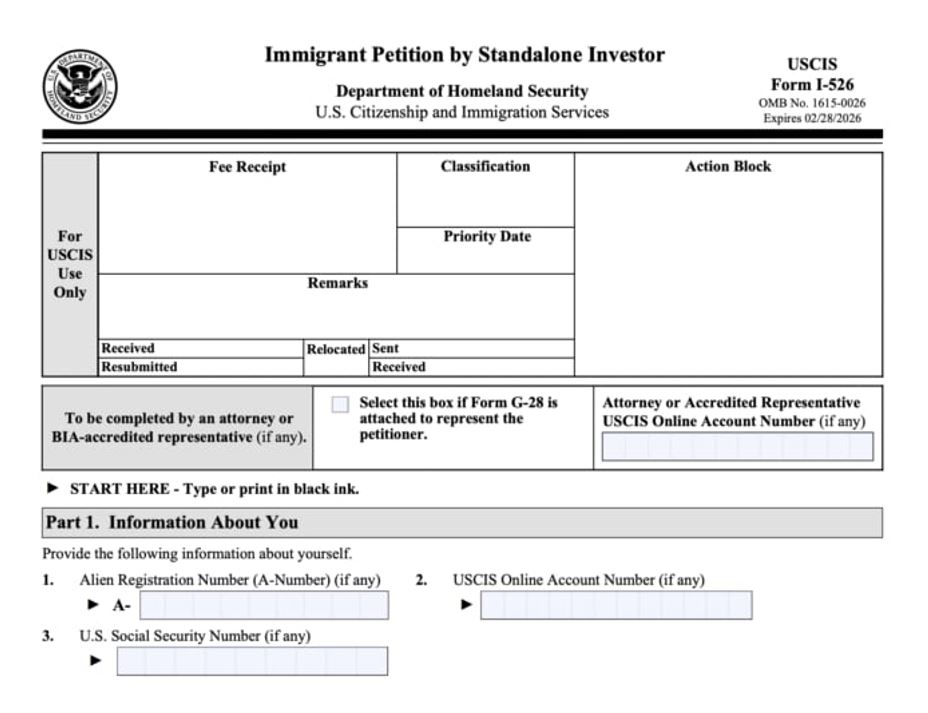 Form Expiry date
I-526/I-526E Eligibility: Can you file an I-526?
Eligibility to file Form I-526 is based on:
- Required Investment: For petitions filed after March 15, 2022, the required investment is $1,050,000 or $800,000 if the investment is in a Targeted Employment Area (TEA), which includes rural or high-unemployment areas.
- New Commercial Enterprise (NCE): The investment must be in an NCE established after November 29, 1990. It is also possible to restructure or expand an existing business.
- Job Creation: Create or preserve at least 10 full-time jobs for U.S. workers within two years of your admission to the U.S. as a conditional permanent resident.
- Management Role: Be involved in the day-to-day management or policy formulation of the business.
How Much Does Form I-526 Cost to file in 2026?
In 2025 USCIS were forced to reverse a price increase by court order. While the current I-526 application fee is $3,675 USCIS has already instituted the process to increase this fee. Form I-526E has the same fee except that an additional Integrity fee of $1,000. We have prepared a detailed guide on the EB-5 visa costs which explains this in detail.
Processing Time for Form I-526
The CIS Ombudsman has found the processing time cited by USCIS to be unusable when trying to predict I-526 processing times. We suggest potential EB-5 investors read our guide to EB-5 processing timelines.
What Documents need to be filed with form I-526 and I-526E?
Full document checklists are available for download:
What Is Form I-526E?
Form I-526E — Immigrant Petition by Regional Center Investor is the principal petition an investor files to begin the EB-5 green card process through a Regional Center project. It confirms to U.S. Citizenship and Immigration Services (USCIS) that:
- You have invested (or are actively in the process of investing) the required capital into an EB-5 project associated with a USCIS-designated Regional Center; and
- That your investment will help create at least 10 full-time jobs for U.S. workers through that project.
This form is specific to the Regional Center pathway of the EB-5 program, which pools capital from multiple investors and counts both direct and indirect job creation. It differs from Form I-526, which is used for standalone (direct) EB-5 investments.
Key points about I-526E:
- It is filed by the individual investor.
- Its approval is a critical first step toward a conditional green card for you and eligible family members (through adjustment of status or immigrant visa processing).
- It requires careful documentation of investment funds, source/path of funds, job creation methodology, and personal eligibility.
What Is Form I-956F?
Form I-956F — Application for Approval of an Investment in a Commercial Enterprise is the project-level petition filed by the Regional Center, not by individual investors. It serves as the foundational approval for a specific EB-5 project under the Regional Center Program.
The purpose of I-956F is to provide USCIS with comprehensive information about a proposed EB-5 project, including:
- Business structure and plans;
- Compliance with securities and EB-5 rules;
- Economic modeling for job creation; and
- Disclosures under the EB-5 Reform and Integrity Act of 2022 (RIA).
Why Form I-956F is Critical
Once USCIS approves an I-956F, it means the project has met USCIS requirements as a suitable EB-5 investment vehicle. Without this approval, individual investors cannot have their I-526E petitions adjudicated on that project. In other words:
Even if you file your I-526E, USCIS will not approve it until the associated I-956F for your project has been approved.
How I-956F and I-526E Work Together
Under current EB-5 rules, I-526E and I-956F are interdependent:
- I-956F must be filed (and ideally approved) before USCIS will make a final decision on your I-526E.
- Many Regional Centers file I-956F first, and investors wait until receipt or approval of that filing before submitting their I-526E.
- If I-956F is denied, any investor petition tied to that project will likely be denied too — even if the investor’s personal documentation was strong.
- Data from recent EB-5 industry analysis suggests that I-956F approval status significantly affects I-526E processing times. Investors tied to approved project filings tend to see faster adjudications.
Why This Matters to You
- Project risk: Selecting a project that already has I-956F approval (or offers transparent evidence of its progress) can reduce uncertainty in your EB-5 journey.
- Timing: Filing your I-526E before I-956F is approved may result in longer wait times or delays while USCIS completes the project review.
- Strategy: Understanding how these forms interact lets you and your advisors plan the best filing strategy for your situation.
Top Ten Tips for Completing Forms I-526 and I-526E
Start with checking the "edition" of the form
A very common cause of rejection across USCIS filings is using the wrong edition or missing an intake requirement. The date is clearly marked on the form. Many firms explicitly advise checking the edition date and requirements right before filing.
Type or print clearly and use the expected formatting
USCIS style instructions emphasize completing the form legibly and in the prescribed way. If you are handwriting anything, do it clearly and consistently.
Do not leave fields blank
Across USCIS processes, blank fields can trigger "incomplete" handling at intake. If something does not apply, write N/A. If the answer is zero, write None or 0 as appropriate.
If you need more space, use the Additional Information section the right way
USCIS instructions for additional information are consistent:
- Put your name and A-Number (if any) at the top of each continuation sheet
- Reference the exact Page Number, Part Number, and Item Number
- Sign and date each continuation sheet
Treat "Yes" answers as triggers for required explanations
The form instructions state that a "Yes" answer to some questions requires explanation. For example, the form notes that if you answer "Yes" to the troubled business question, you must explain how the NCE qualifies.
Keep identity and biographic answers consistent across documents and prior filings
Ensure that names, dates of birth, passport details, A-Number, and prior receipt numbers match prior USCIS submissions and identity documents. Small inconsistencies create delays.
Use one date format and one address standard everywhere
RFEs often start as simple inconsistencies. Pick a format and stick to it across the whole form (dates, apartment or unit conventions, province vs state, postal codes).
Avoid timeline gaps in history sections
Where the form asks for employment or residence history, make sure month to month coverage is clear. If there is a gap, label it plainly (unemployed, student, etc.).
Prepare the information before you start filling boxes
Gather the key facts first (entity names, addresses, dates, ownership percentages, investment dates and amounts, identifiers), then fill the form in one consistent pass.
Final "form-only" quality check before filing
Before you assemble exhibits double check the final PDF version of the form itself. Ensure:
- Every required field has an entry (or N/A or None)
- Every continuation item references page, part, item and is signed and dated
- All signature blocks are completed correctly (petitioner, preparer, interpreter if applicable)
- Nothing in the form contradicts basic identity documents
What Is the Difference Between I-526 and I-526E
| Topic |
Form I-526 |
Form I-526E |
| Who files it |
EB-5 investors making a standalone investment (not through a regional center) |
EB-5 investors investing through a USCIS-designated regional center (after Form I-956F project application is filed) |
| What it is |
Immigrant Petition by Standalone Investor |
Immigrant Petition by Regional Center Investor |
| Typical project type |
Direct or standalone EB-5 investment |
Regional center EB-5 project |
| What USCIS focuses on |
Lawful source of funds, path of funds, bona fides of the project and eligibility plus the job creation framework for the case type |
Lawful source of funds, path of funds and eligibility plus the job creation framework for the case type and regional center structure |
| When you use it |
When your EB-5 investment is not sponsored through a regional center |
When your EB-5 investment is made through a regional center offering |
Frequently Asked Questions
What are Form I-526 and Form I-526E?
Form I-526 and Form I-526E are the EB-5 petition forms used to request classification as an immigrant investor, and they are filed with a supporting evidence package.
Source: USCIS I-526 and USCIS I-526E
What law creates the EB-5 immigrant investor category?
The EB-5 immigrant investor category is in INA 203(b)(5) (8 U.S.C. 1153(b)(5)).
Source: U.S. Code 8 U.S.C. 1153
What regulation governs the I-526 petition requirements?
The principal regulation governing EB-5 immigrant petitions is 8 CFR 204.6.
Source: eCFR 8 CFR 204.6
Where does USCIS explain EB-5 policy in plain English?
USCIS compiles EB-5 adjudication policy in the USCIS Policy Manual, Volume 6, Part G (Investors).
Source: USCIS Policy Manual V6 Part G
What is the difference between Form I-526 and Form I-526E?
Form I-526E is generally used for new Regional Center filings, while Form I-526 is generally used for standalone direct EB-5 filings, and Form I-526 was also used for many Regional Center cases filed before March 15, 2022.
Source: USCIS I-526E and USCIS I-526
Does filing or approval of I-526 or I-526E give me a green card?
No. Approval is a prerequisite step, but conditional permanent residence is obtained later through adjustment of status in the United States (Form I-485) or by receiving an immigrant visa abroad and being admitted to the United States.
Source: USCIS Policy Manual V6 Part G Chapter 3
What evidence is usually required with I-526 or I-526E?
A complete filing includes evidence of the required capital investment, lawful source and path of funds, and job creation documentation appropriate to the case type.
Source: USCIS Policy Manual V6 Part G Chapter 2 (eligibility) and 8 CFR 204.6
What does lawful source and path of funds mean?
You must show the investment capital was obtained lawfully, and you must document how the funds moved from the lawful source to the EB-5 investment.
Source: USCIS Policy Manual V6 Part G Chapter 2
What is the job creation requirement?
EB-5 generally requires creation of at least 10 qualifying full time U.S. jobs, with the evidence depending on whether the case is standalone direct or Regional Center based.
Source: INA 203(b)(5) in 8 U.S.C. 1153 and USCIS Policy Manual V6 Part G Chapter 2
What are common reasons for RFEs and denials?
Common issues include gaps or inconsistencies in lawful source and path of funds, weak tracing, and inconsistencies between the narrative and the financial records.
Source: USCIS Policy Manual V6 Part G Chapter 2 and Chapter 3
How long does I-526E take and can I rely on the USCIS processing time tool?
Timelines vary widely; the CIS Ombudsman notes the USCIS processing time figure does not indicate how soon USCIS will take action on your case.
Source: CIS Ombudsman case inquiry date tip sheet PDF
What happens after I-526 or I-526E approval?
After approval, you generally proceed through adjustment of status or consular processing, and later you file Form I-829 to remove conditions.
Source: USCIS Policy Manual V6 Part G Chapter 7 and eCFR 8 CFR 216.6
When do I file Form I-829?
You generally file Form I-829 during the 90 day period immediately before the second anniversary of the date you obtained conditional permanent residence (the sustainment period).
Source: 8 CFR 216.6 and USCIS Policy Manual V6 Part G Chapter 7
Xem bản tiếng Việt: Hướng dẫn mẫu I-526 & I-526E
Summary
Forms I-526 and I-526E are the initial petitions required for EB-5 investors to demonstrate their eligibility and the source of their investment funds.
About the Authors
Mark I Davies, Esq.
Chairman of Davies & Associates; focused on E visa strategy and complex consular filings.
Mark I Davies, Esq. JD, University of Pennsylvania Law School, Licensed with the SRA (SRA ID: 384468) in the UK, Member Law Society of England & Wales, MBA, Wharton School of Business. Top 10 Investment Visa Lawyer, Licensed (USA), Georgia State Bar. AILA Member.
| Area |
Details |
|
Education
|
JD, University of Pennsylvania Carey Law School | MBA (Finance), The Wharton School, University of Pennsylvania | Chartered Accountant (ICAEW) |
|
Financial Training
|
Completed Analyst Training Program at a major international bank | Chartered Accountant background with professional training in financial analysis and reporting |
|
Legal Practice
|
Admitted to practice in Georgia (USA) | Registered Solicitor with the Law Society of England and Wales | Former CMBS lawyer at one of the worlds largest international law firms |
|
Immigration Track Record
|
15+ years advising HNW investors |
Zero denials for clients advised on source-of-funds compliance in EB-5 | Hundreds of successful EB-5 cases globally
|
|
Recognition
|
Named a
Top 25 EB-5 Immigration Attorney by EB5 Investors Magazine (2018–2023)
|
|
Professional Engagements
|
Lecturer/trainer for other lawyers at AILA, ACA, University of Pennsylvania Law School | Frequent speaker at global investment immigration conferences |

 Work with an experienced EB-5 lawyer
 Applying for an EB-5 Visa in the UK
 Applying for an EB-5 Visa in Dubai
 Applying for an EB-5 Visa in Singapore
 Applying for an EB-5 Visa in India
 Applying for an EB-5 Visa in Vietnam