EB-5 Grandfathering Deadline:
file Form I-526E by September 30, 2026 to lock in current terms under the EB-5 Reform & Integrity Act.
See what's protected →
EB5 Visa Processing Time: Full Timeline From Start to Finish
EB-5 Grandfathering Deadline: September 30, 2026
Investors who file Form I-526E on or before this date lock in current terms under the EB-5 Reform & Integrity Act.
See what's protected →
The EB-5 visa timeline typically takes 2 to 5+ years, depending on the investor’s country of birth, project type, and USCIS processing times.
For Indian investors, the EB-5 timeline can be shorter for rural or high-unemployment projects (priority processing), while standard projects may take longer due to visa demand.
The process includes: I-526E petition, conditional green card (2 years), and I-829 approval for permanent residency.
Indian families planning around a child reaching 21 should read our EB-5 guide for Surat and Gujarat investors, which covers CSPA age-out timing alongside the India backlog.
EB-5 Timeline: How Long Does It Take to Get a green Card?
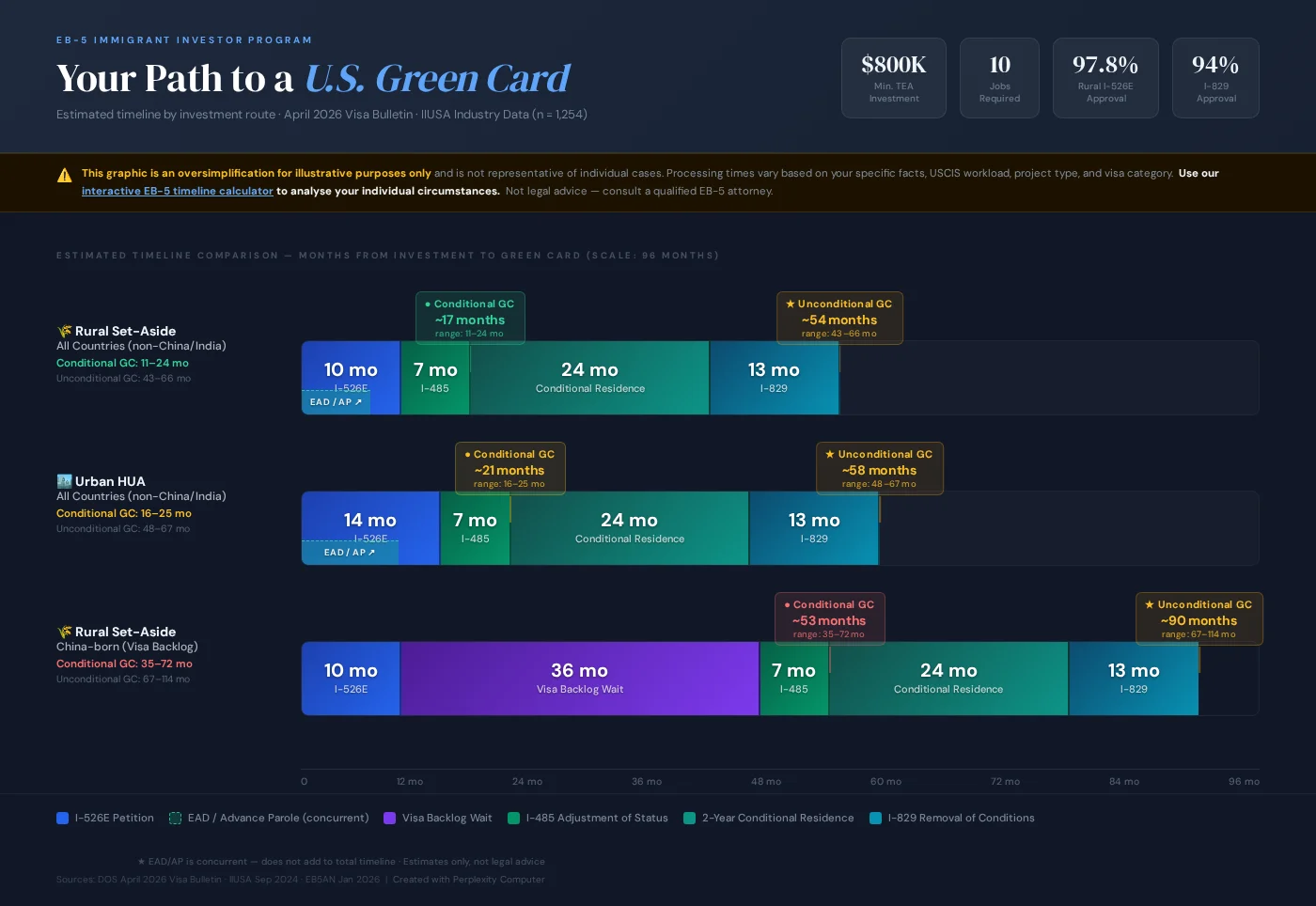
EB-5 visa processing typically takes 2 to 5+ years from investment to a permanent green card. Most investors without a visa backlog reach a conditional green card in 17–21 months and full permanent residency in 54–58 months; investors from backlogged countries such as China can take up to 90 months in total.
This chart is a representative summary of typical EB-5 processing times and may not be accurate in individual cases. For an individualized timeline please use the timeline calculator on this page.
EB-5 visa timeline comparison chart showing processing times for rural and urban projects, including months to conditional green card, I-829 approval, and visa backlog delays.
Estimated EB-5 timeline comparison by investment type, showing faster processing for rural set-aside projects and longer wait times where visa backlogs apply. (Click image to enlarge)
Investment Type
Time to Conditional Green Card
Total Time to Permanent Green Card
🌾 Rural Set-Aside (Non-India/China)
~17 months
~54 months
🏙️ Urban HUA (Non-India/China)
~21 months
~58 months
🇨🇳 Backlogged Cases (e.g. China-born)
~53 months
~90 months
EB-5 timeline comparison by investment type • July 2026 Data
What Is the EB‑5 Visa? Requirements, Investment, and How It Works (2026)
An EB-5 Visa is an immigrant visa allowing foreign investors to qualify for a "green card" when they make a qualifying investment in the United States. As of January 2026, the required qualifying investment is $1,050,000 USD investment, which is reduced to $800,000 for projects located in a Target Employment Area (TEA).
An EB-5 lawyer is an immigration lawyer who specializes in EB-5 cases. EB-5 law is complex, and many EB-5 lawyers restrict their practice to EB-5 matters only.
EB-5 processing timelines have varied significantly over the years. In 2026, outcomes are largely driven by four factors:
Whether you pursue Adjustment of Status in the US or consular processing abroad;
Your country of birth and the resulting visa availability;
The quality of the filing to minimize avoidable RFEs and NOIDs; and
Your project selection, including whether you invest through a regional center or a direct EB-5 structure.
USCIS Policy Manual Vol. 7, Part A, Ch. 3
Getting these fundamentals right at the start is often the difference between a smooth, predictable timeline and months of preventable delay.
EB-5 Timeline Calculator: Estimate Your Processing Time
Use this EB-5 timeline calculator to estimate how long it may take to receive your conditional and permanent green card based on your investment type, country of birth, and processing category.
EB-5 processing times vary depending on whether you invest in a rural or urban project and whether visa backlogs apply to your country.
Your Selection
Your Personal Timeline
Total Est. Time to Permanent Residency
—
What This Calculator Shows
This calculator provides an estimated EB-5 timeline based on:
Investment type (rural or urban)
Country of birth (backlog vs current)
USCIS processing trends
It estimates:
Time to conditional green card
Duration of conditional residence
Total time to permanent green card (I-829 approval)
For example:a rural EB-5 investment with no visa backlog may reach a conditional green card in approximately 17 months and permanent residency in about 54 months.
In contrast, cases affected by visa backlogs may take significantly longer, with timelines extending beyond 50 months.
EB‑5 Visa Timeline 2026: Step by Step Process and Timeframes
The EB-5 timeline can be broken down as follows:
Step 1. Source of Funds for EB‑5: Documentation, Compliance, and Approval Risks (2026)”
SOF Timeline
Timeline: 1 week to 2 months preparation time
SOF is a critical part of any EB-5 process and the timing varies depending on the complexity and number of sources of funds being used.
Pathway of Funds Documentation Timeline
Timeline (concurrent with SOF): 1 Day to 3 Months preparation time
In addition, for applicants remitting funds from countries with currency export controls, evidencing compliance with local law can avoid unnecessary RFEs, NOIDs, and denials. The most common countries in EB-5 with these controls are:
India
China
Vietnam
2026 note on Vietnam: At the current time, various Vietnamese banks and "visa agents" are endorsing direct bank transfers from Vietnam. Many of these transfers involve falsified documentation that will ultimately result in visa delays or denials.
Warning: D&A on USCIS Processing Times in 2026
The processing times of the United States Citizenship and Immigration Services change depending on staffing considerations and the number of applications filed every year for any visa category.
I-526 processing times can vary very significantly and seemingly without reason. In 2026 the use of ‘Mandamus’ lawsuits have become common where I-526 processing times exceed 1-2 years.
Step 2. Completion of Project Due Diligence and Documentation
Timeline (concurrent with SOF): 1 Month to 3 Months preparation time
Proper project due diligence is critical in Regional Center cases. This can involve checking real estate records, corporate records, bank loans, inter-creditor agreements, and other documentation. Clients are also advised to take advice from a licensed financial adviser before investing in a project.
Step 3. I-526/I-526E Preparation Time
Timeline (Regional Center Cases): 1 week (after SOF complete) Timeline (Direct Cases): 1 week – 3 Months (after SOF Complete)
Form I-526E is used by investors in Regional Center projects. Post RIA, Form I-526 is used by standalone investors in a Direct EB-5 project.
Direct EB-5 cases involve the preparation of a substantial amount of additional information. This information is provided by a Regional Center in a Regional Center EB-5 case.
I-526 processing times are significantly lengthened in the event that an RFE or NOID are issued. This delay can often be avoided through the presentation of thorough "source of funds" documentation.
Each country has a fixed number of visas allocated to their nationals each year. Once those visas have been used up, applicants have to wait for a visa to become available.
As of January 2026, the only countries that have ever been subject to these visa delays are:
India
Mainland China
Vietnam
These delays are posted in the US State Department Visa Bulletin. While all of the "reserved" visa categories are "current" and not subject to additional delays, it is anticipated that China and India will become visa backlogged over the course of the next 6-24 months.
Step 6. Adjustment of Status and Consular Processing Times
Timeline (Adjustment of Status form I-485): 2 months – 6 months Timeline (Consular Processing): 3 months – 12 months
Adjustment of Status is based on "concurrent filing" of the I-525/I-526E and I-485 Petitions; case processing times posted on the USCIS website are misleading for these cases. Applications not using concurrent filing will experience additional delays; for those cases, times are listed on the USCIS website.
Step 7. I-829 Removal of Conditions
Timeline (January 2026): 1 year – 2 years
Form I-829 can be filed 90 days prior to the second anniversary of the issuance of the "conditional green card." Updated processing times are available on the USCIS website.
USCIS Policy Manual Vol. 6, Part G, Ch. 7
Regional center must file Form I-956F before investor files I-526E.
Many Regional Centers have marketed "Priority Processing" as being significantly faster than urban TEA or infrastructure projects. Data obtained by IIUSA has found that to be false. Our firm suggests that clients focus on project quality first. A denied I-526E Petition, or a Petition subject to RFEs or capital losses, is not advantageous to most investors.
Priority Processing in Practice
It is not true that Rural Area projects are always adjudicated more quickly than High Unemployment or Infrastructure projects.
Limited data available obtained by IIUSA suggests a 3-month advantage for Rural Projects in some cases; this period is not material for most investors.
EB-5 Visa Timeline: Understanding USCIS Case Processing Times
Published USCIS case processing times for EB-5 are confusing and misleading. These can be found at this link.
Field Office
Form / Service
Processing Time (80% of cases)
Immigrant Investor Program Office
I-526E - Immigrant Petition by Regional Center Investor
18 Months
Processing time for Immigrant Petition by Regional Center Investor (I-526E) at Immigrant Investor Program Office
80% of cases are completed within 18 Months.
Check your case status to track the status of an immigration application, petition, or request.
What is Misleading about USCIS EB-5 Processing Times
The overwhelming majority of our firm’s Regional Center filings process more quickly than the number of months stated on the USCIS website.
This shows how long it takes USCIS to process 80% of cases filed. In our experience, I-526E cases involving set-aside categories (Rural, Urban, and Infrastructure) process more quickly. Rural offers "Priority Processing."
I-526E cases are not processed until the project has received approval.
The data is for cases filed in the past and may or may not be indicative of processing times for cases filed today or in the future.
Timings vary wildly for individual cases. In other words, the standard deviation of processing times is very large.
Within the same project, cases can be adjudicated unevenly, meaning that older cases may process more slowly than more recently filed cases.
What is NOT Misleading About USCIS I-526 Processing Times
The USCIS website shows a large difference in the adjudication time between I-526 (Direct) and I-526E (Regional Center) cases.
This is accurate; in our experience, EB-5 Direct cases commonly take double the time that Regional Center cases take to approve.
Frequently Asked Questions
Do EB-5 Direct Cases take longer than EB-5 Regional Center Cases?
Yes, a typical Direct case takes much longer to adjudicate than a Regional Center case. There can be exceptions to this where there are processing issues with a Regional Center case.
Why do EB-5 timelines vary so much between applicants?
Two people can file the same month and finish years apart because EB-5 timing is driven by three separate clocks: USCIS adjudication speed, visa number availability based on the Visa Bulletin, and the pace of the green card stage (adjustment in the US or consular processing abroad).
Even with everything the same, there are often irrational differences between case processing times of similarly qualified applicants. These differences are often accounted for by the officer who happens to be assigned to a case.
What is the biggest factor after Form I-526E is filed?
For many applicants, the biggest factor is whether a visa number is available when you are ready to move to the green card stage. A petition can be approved, but you may still have to wait to file or finalize the green card step if your category is not current.
How should I read the USCIS “processing time” estimate?
Processing time estimates are not a countdown for your specific case. They are a historical range for a service center or form type. Your case can be faster or slower depending on complexity, RFEs, staffing changes, and USCIS workload shifts. Use the estimate as a planning range, not a promise. You can view these estimates on the USCIS website.
What does “priority date” mean in an EB-5 context?
Your priority date is generally your place in line for an immigrant visa number. If the Visa Bulletin shows your category is current, you can usually move forward to the green card stage once you are eligible. If it is not current, you wait until the bulletin allows the next step.
What is the difference between “Dates for Filing” and “Final Action Dates”?
The Visa Bulletin typically has two charts. One is a planning chart that may allow earlier filing in some situations, and the other is the chart that controls final approval issuance. Which chart applies to adjustment of status can change by month based on USCIS instructions, so readers should check both on the U.S. State Department website.
USCIS Policy Manual Vol. 7, Part A, Ch. 3
Does filing from inside the US change the timeline?
It can. Adjustment of Status may let you file for work and travel permission while the green card application is pending, which can change the lived experience of the wait. Consular processing may move differently depending on National Visa Center (NVC) and interview scheduling.
Can I work or travel while waiting for the green card stage?
If you are eligible to file for Adjustment of Status, you can usually apply for work authorization and advance parole at the same time. If you are consular processing, you generally rely on your existing status abroad and travel plans until the immigrant visa is issued.
Do reserved categories like rural projects impact processing times?
They can. Reserved visa categories may reduce visa number wait time for some applicants compared with the unreserved EB-5 category, especially for high-demand countries. Availability still changes over time, so it should be treated as a strategy factor, not a guarantee.
What causes the most avoidable delays?
The most common preventable timeline issues usually come from documentation gaps, especially source of funds tracing, translations, missing civil documents, and inconsistent employment or tax records. Another major delay driver is a Request for Evidence (RFE) because it stops the clock and adds response time plus re-review time.
If I get an RFE, how much does it affect the timeline?
An RFE usually adds two chunks of time: the time you take to respond, and the time USCIS takes to review the response. These delays can total many months. A strong, well-organized response can reduce follow-up requests.
What should I be doing while my EB-5 case is pending?
Most investors focus on three things: keeping copies of all filings and receipts organized, tracking Visa Bulletin movement monthly, and maintaining lawful status if you are in the US and not yet able to file for Adjustment of Status.
Will my child age out while we are waiting?
This is a common timeline concern. Age-out risk depends on the child’s age at key filing milestones and how long petitions are pending under the Child Status Protection Act (CSPA) rules. Families close to the age limit should plan early with counsel, because timing decisions can matter.
Is there premium processing for EB-5?
As of now, EB-5 generally does not have the kind of premium processing option that exists for some other petition types. Readers should treat any “faster” timeline claims with caution and focus on what is controllable: completeness, consistency, and eligibility.
Can I expedite an EB-5 case?
Expedite requests exist in limited situations, but they are granted rarely and require strong evidence of qualifying criteria. It is better positioned as an exception tool, not a normal timeline strategy.
How long does the EB-5 process take from start to finish?
EB-5 processing takes 2 to 5+ years from investment to a permanent green card, depending on your country of birth and project type. The process covers Form I-526 or I-526E filing, USCIS adjudication, visa availability, consular processing or adjustment of status, two years of conditional residence, and Form I-829 adjudication. Investors whose visa category is Current move fastest; those affected by a country backlog take longer. See the legal authorities below (INA §203(b)(5); 8 CFR §§204.6, 216.6).
Is EB-5 backlogged for Indian nationals?
Partly. In the August 2026 Visa Bulletin, the India unreserved EB-5 Final Action Date is listed as "Unavailable," so the Department of State is not authorising unreserved EB-5 visa numbers for India during that month, regardless of priority date. The reserved set-aside categories - Rural, High-Unemployment and Infrastructure - remain Current. Priority dates move monthly; see the U.S. Department of State Visa Bulletin linked below.
Does the EB-5 Regional Center Program end in 2027?
The EB-5 Regional Center Program is currently authorised through 30 September 2027. Direct EB-5 does not depend on that temporary programme authority and does not sunset. Congress may extend or amend the Regional Center Program, but no reauthorisation is guaranteed. The EB-5 Reform and Integrity Act of 2022 contains transitional protections for certain regional-center petitions filed on or before 30 September 2026.
Chairman of Davies & Associates; focused on E visa strategy and complex consular filings.
Mark I Davies, Esq. JD, University of Pennsylvania Law School, Licensed with the SRA (SRA ID: 384468) in the UK, Member Law Society of England & Wales, MBA, Wharton School of Business. Top 10 Investment Visa Lawyer, Licensed (USA), Georgia State Bar.AILA Member.
Area
Details
Education
JD, University of Pennsylvania Carey Law School | MBA (Finance), The Wharton School, University of Pennsylvania | Chartered Accountant (ICAEW)
Financial Training
Completed Analyst Training Program at a major international bank | Chartered Accountant background with professional training in financial analysis and reporting
Legal Practice
Admitted to practice in Georgia (USA) | Registered Solicitor with the Law Society of England & Wales | Former CMBS lawyer at one of the world’s largest international law firms
Immigration Track Record
15+ years advising HNW investors |
Zero denials for clients advised on source-of-funds compliance in EB-5 | Hundreds of successful EB-5 cases globally
Recognition
Named a
Top 25 EB-5 Immigration Attorney by EB5 Investors Magazine (2018–2023)
Professional Engagements
Lecturer/trainer for other lawyers at AILA, ACA, University of Pennsylvania Law School | Frequent speaker at global investment immigration conferences
We are known for our creative solutions that obtain "impossible" visas. We solve the most complex immigration problems for businesses, investors, individuals, and families.
Several lawyers told me I would not be able to get a TN visa. Two weeks after contacting Davies & Associates I was working in New York, visa in hand.
Individual seeking 'Impossible' TN Visa
D&A was very detail-oriented and very thorough in what they did. They worked on my case 24/7 and were very patient in answering all my questions.
E-2 Visa Client
My case felt complex but D&A managed the whole process carefully and helped me move seamlessly from one stage to the next.
E2 + CBI Client
D&A was my guiding light through the entire EB-5 process.
EB-5 Visa Client
I would definitely be a big advocate for the rest of my life for anyone wanting to explore the Grenada Citizenship by Investment Programme leading to the E-2 visa. The most important thing is a good team behind you. With Davies & Associates, you're in safe hands... you need someone who can support you on the ground and, again, you are well taken care of by D&A. The people are really warm, very helpful and quite open-minded when it comes to business... Not to mention as a passport it's great from a travel perspective... It's just 4 to 5 hours from New York.
Grenada CBI + E2 Visa Client
The entire process of getting an EB-5 visa is handled in a professional way by Mark Davies and his team. EB-5 is a wonderful option for anyone considering moving to the United States if you have the means. I was hoping to use the H-1B route for my children, but it became unreliable and so I looked to the EB-5 visa instead. It is great for anyone who has the resources. Mark gives you the first meetings himself which gives you great comfort. Both Mark and Sanjay are abundantly available and I even had the pleasure of hosting them at my house.
Parent of 2 EB-5 visa holders
I'm in the process of extending my L-1 visa. I submitted a few questions regarding my case, and he contacted me back almost immediately, both by email and telephone. Unlike other attorneys I met before, he gave me the impression of knowing off the top of his head what kind of visa I have, and what actions had to be taken to extend it. He is very thorough and clear regarding the process and what to expect in terms of timelines and issues that may arise. He is constantly in contact, so you definitely know he's working on your case.
L-1B Visa Holder
Mark Davies is a joy to work with. His extensive knowledge, speedy response and attentive service took away all my fears of dealing with immigration and visa applications. He is very generous with his time in explaining every step along the way and I have already and will in the future recommend him to anybody who is looking for an immigration lawyer.
E2 Visa for Small Professional Business With International Offices
Davies & Associates assisted us with an immigration emergency involving my brother's fiancée who was outside the United States. They assisted us in a highly professional manner, working with the relevant US embassy, US immigration and the governments of two other countries. As a result of their efforts the individual involved is now working in the United States. While their knowledge of the law is exemplary what really distinguishes this firm and attorney Davies from any other firm we have worked with is their dedication to customer service and their unrivaled level of professionalism.
Complex Fiancée Visa Need Involving Multiple International Jurisdictions
Several lawyers told me I would not be able to get a TN visa. Two weeks after contacting Davies & Associates I was working in New York, visa in hand. I have recommended this firm to several friends and colleagues, they do an excellent job every time.
Individual Seeking 'Impossible' TN Visa
I was qualified as a physician in a foreign country. Being on a J1 visa I was facing having to leave the United States and return to my home country. Davies & Associates secured one of only 30 J1 visa waivers available in my State, allowing me to work for a US hospital and remain in the United States.
Doctor Seeking J1 Visa Waiver
I am very satisfied with the services Mark Davies has provided me. He has a very extensive knowledge in immigration laws and has a thorough approach to any case.
Looking to relocate or having trouble with a visa application?
We are known for our creative solutions that obtain
"impossible" visas. We solve the most
complex immigration problems for business, investors, individuals and families.
EB-5 Priority Dates by Country: How Visa Availability Affects Your Timeline
Direct EB-5 authority: permanent (does not sunset)
Regional Center Program authorised through: 30 September 2027
India set-aside categories (Rural / High-Unemployment / Infrastructure): Current
India unreserved category: Unavailable on the August 2026 Visa Bulletin
USCIS petition processing is only one part of the EB-5 timeline. For investors from oversubscribed countries, waiting for an available visa number can be equally important. Visa availability is generally determined by the investor's country of chargeability, which is usually the country of birth. The EB-5 category is set out in INA §203(b)(5) (8 U.S.C. §1153(b)(5)); petition and removal-of-conditions requirements appear at 8 CFR §§204.6 and 216.6; consular processing follows 9 FAM 502.4. Sources are linked at the foot of this page.
The Visa Bulletin publishes two charts each month: Final Action Dates (when a green card can actually be issued) and Dates for Filing (when the final paperwork may be submitted). USCIS specifies which chart adjustment-of-status applicants may use in a given month.
August 2026 EB-5 Visa Bulletin dates for selected chargeability areas
C / Current: a visa number is available to qualified applicants that month - this does not mean instant approval, as USCIS and consular adjudication still take time. U / Unavailable: no numbers are authorised for issuance in that category during the month. A listed date means the priority date generally must be earlier than that date. Source: U.S. Department of State Visa Bulletin (August 2026) and USCIS EB-5. Figures change monthly.
As a result, the set-aside categories may offer a materially different visa-availability position for qualifying investors born in India or mainland China. Project eligibility, immigration timing and investment risk should be evaluated separately, with advice specific to the investor.
A pending EB-5 case can also affect a child’s eligibility: under the Child Status Protection Act, a child’s age may be “frozen” while the petition is pending, and long visa waits can put a child at risk of aging out. Families should model this alongside the timeline — use our EB-5 age-out (CSPA) calculator to estimate a child’s CSPA age.
By Mark I. Davies, Esq. - verified against the U.S. Department of State Visa Bulletin (August 2026). Last reviewed .
USCIS EB-5 Immigrant Investor Program (incl. EB-5 Reform and Integrity Act of 2022): USCIS EB-5
Recent updates
: Link to the Surat EB-5 guide added.
- Added the August 2026 EB-5 Visa Bulletin table by country, updated answers on total processing time, the India backlog and the 2027 Regional Center authorisation, and added government legal-source citations (INA, 8 CFR, 9 FAM, USCIS, Department of State).

 English
 Tiếng Việt
 How to Select an EB-5 Lawyer
Choosing the Right EB-5 Visa Attorney for your EB-5 Case →
How to Select an EB-5 Lawyer
Choosing the Right EB-5 Visa Attorney for your EB-5 Case →


 Applying for an EB-5 Visa in the UK
 Applying for an EB-5 Visa in Dubai
 Applying for an EB-5 Visa in Singapore
 Applying for an EB-5 Visa in India
 Applying for an EB-5 Visa in Vietnam