Targeted Employment Areas (TEA) & Reserved Visas
The RIA created three "Set-Aside" categories. Each Set-Aside category corresponds to the geographic area in which a project is located. Each year 10,000 immigrant visas across all EB-5 visa categories reserved for specific project types to prevent backlogs for new investors.
| Category |
Set-Aside % |
2026 Status |
Benefits |
| Rural |
20% |
Current |
Priority processing; some cases may move faster than non-reserved categories |
| High Unemployment |
10% |
Current |
$800k Entry point in urban areas |
| Infrastructure |
2% |
Current |
Direct government-linked projects |
Strategic Note: For investors from China or India, the "Unreserved" (standard) category remains backlogged. Filing in a Rural TEA is currently the main way to avoid that backlog wait, which can run for several years. See our dedicated guide on
EB-5 Visas for Indians for country-specific strategy.
The Two EB-5 Pathways: Regional Center vs. Direct
- Job Creation: Can use "Indirect" and "Induced" jobs (economic modeling). You don't need to hire 10 people yourself.
- Role: Limited Partner/Member status.
- Risk: High reliance on the developer's ability to complete the project.
- Job Creation: Must be 10 direct, W-2, full-time employees.
- Role: Active management (day-to-day or policy-making).
- Risk: High operational risk; you are responsible for the business's success.
The "Source of Funds" (SOF) & Path of Funds
Per 8 CFR 204.6(j)(3), the burden of proof is on the investor to show capital was obtained through "lawful means."
The "Seven-Year Rule"
In 2026, USCIS typically expects a minimum of five to seven years of historical financial records.
- Salary: Tax returns, employment contracts, and bank statements showing the accumulation.
- Gifts/Inheritance: The donor must also prove their SOF.
- Property Sale: Trace the funds used to buy the property originally, even if it was decades ago.
- Crypto: While accepted, you must trace the original fiat-to-crypto purchase and all subsequent trades.
The 2026 Multi Step Process
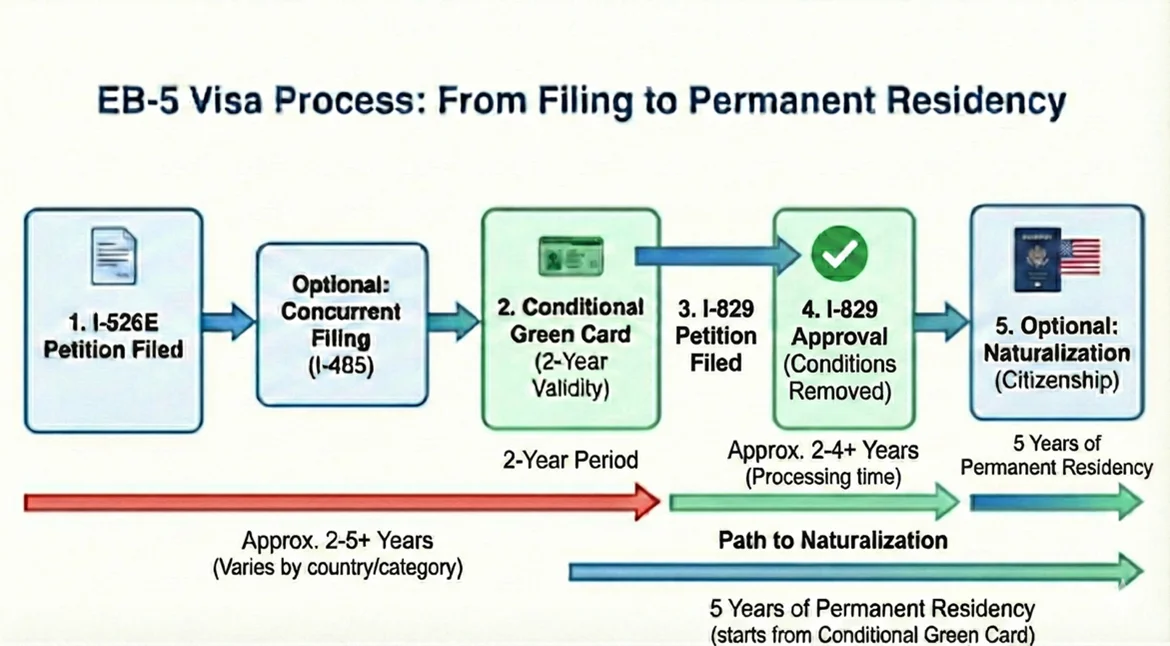
Step 1: File the immigrant petition (I-526E or I-526)
This is the formal start of the EB-5 process.
If you invest through a Regional Center, you file Form I-526E (Immigrant Petition by Regional Center Investor). If you invest through a direct standalone business, you generally file Form I-526 (Immigrant Petition by Standalone Investor).
If you want a full overview first, see EB-5 Visa or the longer guide EB-5 Visa Guide.
If you are doing your own business investment, see EB-5 Direct.
For the eligibility requirements and evidence list, see EB-5 Visa Requirements.
Core regulatory baseline for petition requirements is 8 CFR 204.6.
Step 2: Understand visa availability and choose your processing route
After filing, what you can do next depends on visa availability and whether you are inside or outside the U.S.
USCIS updates which Visa Bulletin chart applies for adjustment filings each month in Adjustment of Status Filing Charts from the Visa Bulletin.
If you are outside the U.S., the immigrant visa stage is generally handled through consular processing, and EB-5 classification guidance is described in the State Department's Foreign Affairs Manual section on EB-5 investor cases.
For a plain English walkthrough of the overall roadmap, see your detailed page EB-5 Process.
Step 3a: Concurrent filing (the living in the U.S. advantage)
If you are already in the United States in lawful status, are otherwise eligible to adjust status, and your EB-5 category is current under the Visa Bulletin chart USCIS permits for adjustment filings that month, you may be able to file Form I-485 at the same time as your I-526E or I-526.
USCIS explains this concept in Concurrent Filing of Form I-485.
This is the key reason EB-5 can be so valuable for founders, executives, and families already in the United States: the I-485 stage is what can allow you to request work authorization and travel permission while the EB-5 petition continues through adjudication.
If you want an investor friendly timeline view of how this plays out in real life, see EB-5 Visa Processing Time.
Step 3b: Consular Processing (if you are living outside the U.S.)
If you are outside the United States when your EB-5 immigrant petition (Form I-526 or I-526E) is approved and a visa number is available, you cannot file Form I-485 for Adjustment of Status. Instead, you use consular processing to obtain your immigrant visa abroad.
Step 3b-1: National Visa Center (NVC) Processing
Once USCIS approves your I-526/I-526E and a visa number becomes current for your category, your case is forwarded to the National Visa Center (NVC). The NVC will:
- Assign a Case Number and send you (and any dependents) a welcome letter explaining next steps.
- Request submission of Form DS-260 (Immigrant Visa Electronic Application) online for each family member applying for the EB-5 visa.
- Read our guide to Form DS-260.
- Ask you to pay the immigrant visa fee and provide supporting civil and financial documents (passport photos, birth/marriage certificates, police certificates, etc.).
Step 3b-2: Submit Required Documentation
You must compile and submit the documents NVC requests, such as:
- Valid passport(s) for you and dependents
- Birth and marriage certificates
- Police clearance certificates from every country you have lived in
- Evidence of your approved EB-5 petition and investment documentation
- Any additional forms or affidavits required by the specific U.S. consulate
Careful and complete submission decreases the risk of delays.
Step 3b-3: Consular Interview
After reviewing your DS-260 and supporting documents, the NVC will schedule your immigrant visa interview at the appropriate U.S. embassy or consulate in your home country or country of residence. Before the interview:
- Attend a medical examination with an approved physician.
- Prepare originals of all submitted documents.
- Review your investment evidence and job-creation proofs in case consular officers request clarification.
At the interview, a consular officer will verify your eligibility and documentation. If approved, you receive an EB-5 immigrant visa stamp in your passport.
For comprehensive interview preparation: Review our Immigrant Visa Interview Preparation Guide to learn what to expect, required documents, common questions, and how consular officers apply the INA, 8 CFR, and Foreign Affairs Manual in immigrant visa adjudications.
Step 3b-4: Entry to the United States
After your visa is issued:
- You must enter the U.S. before the visa expiration date listed on the visa.
- Upon entry, you become a conditional permanent resident with a 2-year conditional Green Card.
- Use the date of U.S. entry as the start of your conditional residence period, which will determine when you must file Form I-829 to remove conditions.
Step 4: Conditional permanent residence (2 years)
If your immigrant visa or adjustment is approved, you receive conditional lawful permanent resident status for two years.
USCIS provides a high level summary of the flow on EB-5 Immigrant Investor Process.
This is also where you can link internally to cost planning, because readers always ask at this point what total spend looks like. See EB-5 Visa Costs and Fees (2026).
Step 5: Maintain the investment through the sustainment period
During the conditional period, the investment must remain consistent with EB-5 rules and remain at risk. The foundational regulatory framework is still 8 CFR 204.6.
For readers who want the USCIS authored deep dive, see USCIS Policy Manual Volume 6 Part G (Investors).
If you want to keep users on your site before sending them to USCIS, use internal links to explain due diligence and structure:
Step 6: File Form I-829 to remove conditions
You file Form I-829 in the 90 day window immediately before the second anniversary of obtaining conditional permanent resident status. That timing and standard is set out in 8 CFR 216.6.
USCIS form guidance is here: Form I-829.
Again, for USCIS narrative guidance, see USCIS Policy Manual Volume 6 Part G (Investors).
Due Diligence: Protecting Your Capital
The "At Risk" requirement (8 CFR 204.6(j)(2)) means you cannot have a guaranteed redemption. However, you can minimize risk by checking:
- Job Cushion: Does the project plan to create 15+ jobs per investor? (This provides a safety margin if the project scales back).
- I-956F Status: Has USCIS already "pre-approved" the project's economic plan?
- The Capital Stack: Is the EB-5 loan senior to other debt, or is it in a "Mezzanine" position?
Summary of Costs (2026 Estimates)
| Item |
Cost (Estimated) |
| Capital Investment |
$800,000 or $1,050,000 |
| Administrative Fee |
$50,000 – $80,000 (Project dependent) |
| USCIS Filing Fees |
~$11,000+ (Including RIA Integrity Fee) |
| Legal Fees |
$25,000 – $40,000 (Standard for top-tier firms) |
| TOTAL INITIAL OUTLAY |
~$885,000 to $1,180,000 |
Use our EB-5 Fee Calculator
Read more about EB-5 Costs and Fees
This hub page summarizes the EB-5 program at a high level. For deep dives on each major topic, see our dedicated guides:

 English
 Tiếng Việt
 How to Select an EB-5 Lawyer

 Applying for an EB-5 Visa in the UK
 Applying for an EB-5 Visa in Dubai
 Applying for an EB-5 Visa in Singapore
 Applying for an EB-5 Visa in India
 Applying for an EB-5 Visa in Vietnam