Family Immigration to the United States
K-1 Fiancé Visa2026 I-130 GuideSame-Sex CouplesMarriage Adjustment of StatusEB-5 Visa Guide
Table of Contents
Because the family immigration system includes both permanent and temporary pathways, numerical limits, priority dates, derivative beneficiaries, age protections, and procedural differences between consular processing and adjustment of status, selecting the correct strategy at the outset is critical.
This page explains the complete family immigration framework and how we guide families through it.
Part I: Permanent Residence Through Family Sponsorship
 Family based permanent residence falls into two legal structures:
- Immediate Relative categories (not numerically limited)
- Family Sponsored Preference categories (numerically limited and governed by the Visa Bulletin)
Immediate Relatives of U.S. Citizens
Immediate Relatives are not subject to annual visa caps. This means there is no quota backlog in the way there is for preference categories. Once the petition is approved and the case is documentarily complete, the applicant may proceed to final processing.1. Spouse of a U.S. Citizen (IR1 / CR1)
A U.S. citizen may petition for a foreign national spouse. Key considerations include:- Validity of the marriage
- Evidence of bona fide relationship
- Prior marriages and termination documentation
- Adjustment of status eligibility if inside the U.S.
- Consular processing if abroad
- Affidavit of support requirements
- Inadmissibility screening
2. Unmarried Child Under 21 of a U.S. Citizen (IR2)
This includes biological children and, in certain circumstances, stepchildren if the qualifying marriage occurred before the child turned 18. Issues frequently arise involving legitimation requirements, custody documentation, prior immigration filings, age out concerns, and consular processing logistics.3. Parent of a U.S. Citizen (IR5)
A U.S. citizen must be at least 21 years old to sponsor a parent. These cases require proof of the parent child relationship, financial sponsorship documentation, careful review of inadmissibility issues, and planning for travel, healthcare, and long term residence implications.Family Sponsored Preference Categories
Unlike Immediate Relatives, Family Preference categories are numerically limited each fiscal year. This system uses priority dates and the monthly Visa Bulletin to regulate when a green card may be issued.What is a Priority Date?
The priority date is generally the date USCIS receives the Form I-130 immigrant petition. It functions as the applicant's place in line. Because preference categories are capped annually, applicants must wait until a visa number becomes available before final approval.What is the Visa Bulletin?
The Department of State publishes a monthly Visa Bulletin listing cutoff dates for each preference category and country of chargeability. A case may proceed to final processing only when the priority date becomes current. Understanding Visa Bulletin movement is essential for long term planning.| Preference Category | Description & Key Considerations |
|---|---|
| First Preference (F1) | Unmarried sons and daughters (21 or older) of U.S. citizens. Covers derivative beneficiaries and CSPA protections. |
| Second Preference (F2A) | Spouses and unmarried children under 21 of permanent residents. May convert to Immediate Relative upon petitioner's naturalization. |
| Second Preference (F2B) | Unmarried sons and daughters (21 or older) of permanent residents. Marriage removes eligibility under this category. |
| Third Preference (F3) | Married sons and daughters of U.S. citizens. Includes derivative spouses and children; involves complex structures. |
| Fourth Preference (F4) | Brothers and sisters of U.S. citizens (21+). Requires long-term document preservation due to extended waits. |
Adjustment of Status vs Consular Processing
Family based permanent residence is completed in one of two ways:Adjustment of Status (Inside the U.S.)
Available to certain applicants physically present in the U.S. It requires lawful entry (with limited exceptions), visa availability, filing of Form I-485, biometrics, and an interview in most marriage cases. Benefits can include employment authorization and advance parole during processing.Consular Processing (Outside the U.S.)
Involves I-130 approval, National Visa Center (NVC) processing, Affidavit of Support submission, civil document collection, and a consular interview abroad. Consular cases require careful inadmissibility analysis before interview scheduling.Inadmissibility and Waivers
Family cases frequently involve potential inadmissibility issues such as unlawful presence, misrepresentation, prior removal orders, or criminal history. Waiver strategy must be evaluated before proceeding, particularly in consular processing cases.Part II: Temporary Immigration Options for Families
Not every family case begins with a green card. Temporary visa strategies often allow families to live together while planning permanent residence.K-1 Fiancé Visa
Allows entry to marry a U.S. citizen within 90 days, followed by adjustment of status. Requires proof of meeting requirements and bona fide intent to marry.Dependent Status Through Work or Study
Families frequently enter or remain together through dependent classifications tied to a principal visa holder: H-4, L-2, F-2, J-2, O-3, and E derivatives. These statuses can provide interim solutions during Visa Bulletin waiting periods.Can I visit the U.S. while an immigrant petition is pending?
Visitor visas may be used for temporary purposes, but intent must be carefully evaluated. While it is possible, the applicant must demonstrate they do not intend to circumvent the immigrant visa process.Our Approach
Family immigration cases are rarely "forms only" matters. We provide category selection, evidentiary planning, and inadmissibility analysis to ensure durable immigration stability for your family.Schedule a Consultation
Every family situation is unique. Whether you are sponsoring a spouse, fiancé, child, parent, or sibling — or evaluating temporary options while planning permanent residence — we will help you map the safest and most efficient path forward.Contact U.S. Immigration Advisor to begin your family immigration strategy.
Attorney Credentials (Mark I Davies, Esq.)
Mark I Davies, Esq. JD, University of Pennsylvania Law School, Licensed with the SRA (SRA ID: 384468) in the UK, Member Law Society of England & Wales, MBA, Wharton School of Business. Top 10 Investment Visa Lawyer, Licensed (USA), Georgia State Bar. AILA Member.| Area | Details |
|---|---|
| Education | JD, University of Pennsylvania Carey Law School | MBA (Finance), The Wharton School, University of Pennsylvania | Chartered Accountant (ICAEW) |
| Financial Training | Completed Analyst Training Program at a major international bank | Chartered Accountant background with professional training in financial analysis and reporting |
| Legal Practice | Admitted to practice in Georgia (USA) | Registered Solicitor with the Law Society of England & Wales | Former CMBS lawyer at one of the world's largest international law firms |
| Immigration Track Record | 15+ years advising HNW investors | Zero denials for clients advised on source-of-funds compliance in EB-5 | Hundreds of successful EB-5 cases globally |
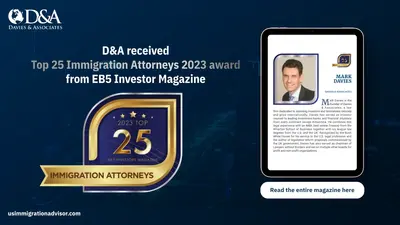
| Recognition | Named a Top 25 EB-5 Immigration Attorney by EB5 Investors Magazine (2018–2023) |
| Professional Engagements | Lecturer/trainer for other lawyers at AILA, ACA, University of Pennsylvania Law School | Frequent speaker at global investment immigration conferences |
Awards
Contact Davies & Associates Offices in United States
Check all of our locations around the world.
Company location
New York Office World Trade Center
1 World Trade Center, Suite 8500, New York, NY 10007
Map and Driving Directions
New York Office E69th Street
200 E 69th Street, 2N, New York, NY 10022
Map and Driving Directions
California Office
555 Anton Blvd, Suite 150, Costa Mesa, CA 92626
Map and Driving Directions
Philadelphia Office
1500 John F Kennedy Blvd, Suite 450, PMB 41, Philadelphia, PA 19102
Map and Driving Directions
Los Angeles Office
601 South Figueroa Street, Suite 4050, Los Angeles, CA 90017
Map and Driving Directions
Chicago Office
155 N. Upper Wacker Dr., Suite 4250, Chicago, IL 60606
Map and Driving Directions
Miami Office
80 S.W. 8th St., Suite 2000, Miami, FL 33130
Map and Driving Directions
Atlanta Office
1075 Peachtree Street NE, Suite 3650, Atlanta, GA 30309
Map and Driving Directions
Telephone number
New York Office World Trade Center
+1 212 537 9196
Fax: +1 949 396 1371
New York Office E69th Street
+1 212 537 9196
Fax: +1 949 396 1371
California Office
+1 949 620 1811
Fax: +1 949 396 1371
Philadelphia Office
+1 215 525 1881
Fax: +1 949 396 1371
Chicago Office
+1 312 261 8560
Fax: +1 949 396 1371
Miami Office
786 490 2661
Fax: +1 949 396 1371
Contact us by email


Looking to acquire an Family Immigration?
We are known for our creative solutions that obtain "impossible" visas. We solve the most complex immigration problems for businesses, investors, individuals, and families.
Family Immigration Immigration lawyer near meSeveral lawyers told me I would not be able to get a TN visa. Two weeks after contacting Davies & Associates I was working in New York, visa in hand.
Individual seeking 'Impossible' TN VisaD&A was very detail-oriented and very thorough in what they did. They worked on my case 24/7 and were very patient in answering all my questions.
E-2 Visa ClientMy case felt complex but D&A managed the whole process carefully and helped me move seamlessly from one stage to the next.
E2 + CBI ClientD&A was my guiding light through the entire EB-5 process.
EB-5 Visa ClientI would definitely be a big advocate for the rest of my life for anyone wanting to explore the Grenada Citizenship by Investment Programme leading to the E-2 visa. The most important thing is a good team behind you. With Davies & Associates, you're in safe hands... you need someone who can support you on the ground and, again, you are well taken care of by D&A. The people are really warm, very helpful and quite open-minded when it comes to business... Not to mention as a passport it's great from a travel perspective... It's just 4 to 5 hours from New York.
Grenada CBI + E2 Visa ClientThe entire process of getting an EB-5 visa is handled in a professional way by Mark Davies and his team. EB-5 is a wonderful option for anyone considering moving to the United States if you have the means. I was hoping to use the H-1B route for my children, but it became unreliable and so I looked to the EB-5 visa instead. It is great for anyone who has the resources. Mark gives you the first meetings himself which gives you great comfort. Both Mark and Sanjay are abundantly available and I even had the pleasure of hosting them at my house.
Parent of 2 EB-5 visa holdersI'm in the process of extending my L-1 visa. I submitted a few questions regarding my case, and he contacted me back almost immediately, both by email and telephone. Unlike other attorneys I met before, he gave me the impression of knowing off the top of his head what kind of visa I have, and what actions had to be taken to extend it. He is very thorough and clear regarding the process and what to expect in terms of timelines and issues that may arise. He is constantly in contact, so you definitely know he's working on your case.
L-1B Visa HolderMark Davies is a joy to work with. His extensive knowledge, speedy response and attentive service took away all my fears of dealing with immigration and visa applications. He is very generous with his time in explaining every step along the way and I have already and will in the future recommend him to anybody who is looking for an immigration lawyer.
E2 Visa for Small Professional Business With International OfficesDavies & Associates assisted us with an immigration emergency involving my brother's fiancée who was outside the United States. They assisted us in a highly professional manner, working with the relevant US embassy, US immigration and the governments of two other countries. As a result of their efforts the individual involved is now working in the United States. While their knowledge of the law is exemplary what really distinguishes this firm and attorney Davies from any other firm we have worked with is their dedication to customer service and their unrivaled level of professionalism.
Complex Fiancée Visa Need Involving Multiple International JurisdictionsSeveral lawyers told me I would not be able to get a TN visa. Two weeks after contacting Davies & Associates I was working in New York, visa in hand. I have recommended this firm to several friends and colleagues, they do an excellent job every time.
Individual Seeking 'Impossible' TN VisaI was qualified as a physician in a foreign country. Being on a J1 visa I was facing having to leave the United States and return to my home country. Davies & Associates secured one of only 30 J1 visa waivers available in my State, allowing me to work for a US hospital and remain in the United States.
Doctor Seeking J1 Visa WaiverI am very satisfied with the services Mark Davies has provided me. He has a very extensive knowledge in immigration laws and has a thorough approach to any case.
U Visa Applicant, A Victim of CrimeLooking to relocate or having trouble with a visa application?
We are known for our creative solutions that obtain "impossible" visas. We solve the most complex immigration problems for business, investors, individuals and families.
Request Free Consultation
New York Office World Trade Center:
1 World Trade Center, Suite 8500, New York, NY 10007
+1 212 537 9196
Map and Driving Directions
New York Office E69th Street:
200 E 69th Street, 2N, New York, NY 10022
+1 212 537 9196
Map and Driving Directions
California Office:
555 Anton Blvd, Suite 150, Costa Mesa, CA 92626
+1 949 620 1811
Map and Driving Directions
Philadelphia Office:
1500 John F Kennedy Blvd, Suite 450, PMB 41, Philadelphia, PA 19102
+1 215 525 1881
Map and Driving Directions
London Office:
69 Old Broad Street, Dashwood House, London EC2M 1QS, United Kingdom
+44 20 3884 1812
Map and Driving Directions
London Office Beaufort Court:
Beaufort Court, Admiral Way, London E14 9XL, United Kingdom
+44 20 3884 1812
Map and Driving Directions
Edinburgh Office:
28 Rutland Square, Edinburgh, Scotland, EH1 2BW
+44 (20) 38841812
Map and Driving Directions
Milton Keynes Office:
The Pinnacle, 170 Midsummer Blvd, Milton Keynes MK9 1FE, United Kingdom
+44 7740 000769
Map and Driving Directions
Glasgow Office:
+44 131 392 0686
Map and Driving Directions
Vietnam Office:
46th Floor, Bitexco Financial Tower, 2 Hai Trieu, Ben Nghe Ward, District 1, Ho Chi Minh City, Vietnam
+84 28 44582309
Map and Driving Directions
India Office:
Enam Sambhav C-20, G Block, Bandra-Kurla Complex, Mumbai 400051, Maharashtra
+91 720 856 4057
Map and Driving Directions
Italy Office:
Via Bonifacio Lupi 29, 50129 Firenze FI, Italy
+39 055 076 3054
Map and Driving Directions
Manila Office:
Unit 107, AIC Burgundy Empire Tower, ADB Ave. cor Garnet and Sapphire Streets, Ortigas Center, Pasig City 1605, Metro Manila, Philippines
+63 2 7215 7878
Map and Driving Directions
Sydney Office:
Level 12, 210 George Street, Sydney NSW 2000, Australia
+61 2 9156 1032
Map and Driving Directions
Perth Office:
Davies & Associates LLC, Level 1, 12 St Georges Terrace, Perth WA 6000, Australia
+61 2 9156 1032
Map and Driving Directions
Singapore Office:
160 Robinson Road, #14-04, Singapore Business Federation Centre, Singapore 068914
+65-9615-0528
Map and Driving Directions
Looking for an Immigration attorney?
Immigration lawyer near meList of US Embassies, Consulates and USCIS
List of Italian Embassies, Consulates and USCIS
Copyright ©2026 by Davies & Associates LLC.