Executive Summary: Form I-829
Overview
Form I-829 is the form used to show you have met the conditions required to have the two year residency removed from your Green Card. The key question USCIS focuses on is whether your investment created the required jobs and has been sustained for the applicable period. Under the RIA, USCIS can also re-visit the lawful source of funds decision made at the time of I-526 adjudication.
| What is Form I-829: |
Form I-829 is the form filed with USCIS to petition USCIS to remove the two-year conditional residency placed on the Petitioner’s Permanent Residency. |
| Who files Form I-829: |
An EB-5 investor. |
| How much does it cost: |
As of January 2026, the filing fee is $3,675 for Form I-829 (fees have changed in litigation, so we confirm the amount at filing). |
| How long does it take to adjudicate: |
A well prepared I-829 typically takes 1-2 years based on our filings and IIUSA data (the CIS Ombudsman notes the USCIS processing time figure does not predict when your case will move). |
| What documents do I need: |
You typically submit source and path of funds evidence, job creation evidence for at least 10 qualifying jobs, and personal civil documents such as passport and birth certificate. |
| What causes RFEs and denials: |
The most common issue is weak or inconsistent source and path-of-funds documentation. |
| What happens after approval: |
After approval, you apply for conditional permanent residence through Form I-485 or DS-260 for consular processing, and later you file Form I-829 to remove conditions. |
What is Form I-829?
Form I-829 is the official petition immigrant investors use to remove the two-year condition on their U.S. permanent resident status obtained through the EB-5 Immigrant Investor Program. Once approved, USCIS grants you a 10-year permanent Green Card.
Think of the I-829 as the final step in your EB-5 journey — the “final inspection” that shows you fulfilled your investment and job creation commitments.
Form I-829
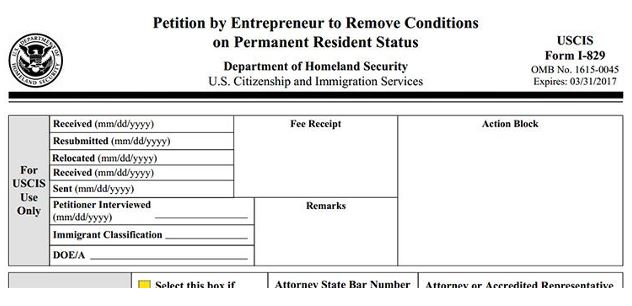 Form Expiry date
Who Must File Form I-829
You must file I-829 if:
- ✅ You received a conditional Green Card through the EB-5 investor program
- ✅ Your conditional status is about to expire (two years have passed)
- ✅ You want to make your residency permanent
You may include your spouse and children if they were included in your original EB-5 petition. If they weren’t included, they may need separate I-829 filings.
When Should You File Form I-829
You must file your I-829 within the 90-day period immediately before your conditional Green Card expires . Filing too early or too late can result in denial or loss of status.
Important: If you file on time and USCIS accepts your petition, your conditional residency is automatically extended while the case is pending.
The EB-5 Processing Timeline
For more information on EB-5 processing times read our EB-5 Processing Timeline Guide.
What Happens After You File
After USCIS receives your I-829:
- You’ll get a receipt notice (Form I-797) that extends your residency and work authorization during processing.
- You may need to attend a biometrics appointment (fingerprints/photos).
- USCIS may issue a Request for Evidence (RFE) asking for more documentation.
- USCIS will issue a written decision when the petition is approved or denied.
Filing Fees
The I-829 fee and associated costs include:
- I-829 filing fee: varies (check current USCIS fee schedule)
- Biometric fee for each applicant (commonly required)
- No fee waiver is typically available for I-829 petitions.
For more information on the overall costs of Eb5 read our EB-5 Costs and Fees Guide.
Be aware that published official USCIS filing fees have been incorrect in the past and should not be relied upon conclusively. Check with an Immigration Lawyer specializing in Eb5.
Eligibility Requirements
To successfully file Form I-829, you must prove:
- ✔ Sustained Investment
You maintained your required “at-risk” capital investment for the entire conditional period.
- ✔ Job Creation (EB-5 requirement)
Your investment created at least 10 full-time jobs for qualifying U.S. workers (the investor, your spouse, or dependent children generally do not count).
- ✔ Ongoing Commercial Enterprise
Your investment was in a legitimate new commercial enterprise and remained operational.
Supporting Documents Checklist
A strong I-829 petition typically includes:
- Copy of your current (conditional) Green Card
- Proof investment funds were at risk and maintained
- Corporate documents (formation papers, agreements)
- Tax returns or financials showing business activity
- Job creation documentation (payroll records, tax forms)
- Evidence that all USCIS conditions are met
- Copies of spouse/children’s Green Cards (if included)
I-829 Step-by-Step Filing Process
- Gather documentation showing you satisfied EB-5 requirements.
- Fill out Form I-829 (complete and accurate).
- Pay filing fees and include payment with your packet.
- Mail the package to the USCIS lockbox or file online (if available).
- Attend biometrics if required.
- Respond promptly to any USCIS Requests for Evidence.
- Wait for decision.
Timing & Strategy Tips
- ⏱️ File as soon as the 90-day window opens — many applications are approved faster when submitted early.
- ✈️ Travel while pending? You may travel outside the U.S. while your I-829 is pending, but carry both your conditional Green Card and your I-829 receipt notice when returning.
- ⚖️ Legal help is highly recommended due to the complexity of the evidence requirements.
Consequences of Not Filing
If you do not file I-829 on time and your conditional status expires:
- ❌ Your conditional status will end
- ❌ You risk deportation or removal
- ❌ You lose eligibility
Top Mistakes When Completing Form I-829
❌ Filing outside the required 90 day window
USCIS expects Form I-829 to be filed within the 90 days immediately before the 2 year anniversary of when conditional permanent residence was granted.
USCIS Policy Manual reference: USCIS Policy Manual Vol. 6, Part G, Ch. 7
❌ Not including eligible derivative family members correctly
If your spouse and children obtained conditional residence through the EB-5 process, the I-829 package typically needs to account for them properly so USCIS can adjudicate removal of conditions for the family unit.
USCIS Policy Manual reference: USCIS Policy Manual Vol. 6, Part G, Ch. 7
❌ Not proving you sustained the investment through the conditional period
A common problem is submitting a thin or confusing paper trail that does not clearly show the capital remained invested and at risk through the required sustainment period.
USCIS Policy Manual reference: USCIS Policy Manual Vol. 6, Part G, Ch. 7
Related USCIS policy guidance on sustainment and job creation: USCIS Policy Memo: Job Creation Requirement & Sustainment
❌ Weak job creation evidence or evidence that does not match the case type
Direct jobs usually need clear documentary support such as payroll records, tax documents, and Form I-9 records. Regional center style indirect jobs must be supported by reasonable economic methodologies and documentation that ties the model to the project.
USCIS Policy Manual reference: USCIS Policy Manual Vol. 6, Part G, Ch. 7
❌ Not explaining project or business changes clearly
If timelines shifted, entities changed, funds were redeployed, or the plan evolved, USCIS typically expects a coherent explanation supported by documents so the adjudicator can track what happened and why requirements are still met.
USCIS Policy Manual reference: USCIS Policy Manual Vol. 6, Part G, Ch. 7
❌ Inconsistencies with prior filings and records
Mismatches across filings and evidence sets are a frequent RFE trigger: addresses, dates, NCE or JCE names, capital amounts, job numbers, and timelines should align across the record.
USCIS Policy Manual reference: USCIS Policy Manual Vol. 6, Part G, Ch. 7
❌ Submitting foreign language documents without a compliant certified translation
Any foreign language document submitted to USCIS must be accompanied by a full English translation and the translator’s certification of completeness, accuracy, and competence.
USCIS Policy Manual reference: USCIS Policy Manual Vol. 1, Part E, Ch. 6
Also see the regulation cited by USCIS policy: USCIS Policy Manual Vol. 4, Part C, Ch. 4
❌ Missing or improper signatures
USCIS can reject benefit requests that lack a proper signature and does not treat signature defects as something you can “fix later.”
USCIS Policy Manual reference: USCIS Policy Manual Vol. 1, Part B, Ch. 2
❌ A disorganized submission that does not map evidence to requirements
Even strong evidence can fail if it is not easy to follow. A clear exhibit list and a requirement by requirement mapping helps USCIS verify sustainment and job creation efficiently.
USCIS Policy Manual reference: USCIS Policy Manual Vol. 6, Part G, Ch. 7
Summary
Form I-829 is the critical final step for EB-5 investors who want to transition from a conditional to a permanent 10-year Green Card.
Success hinges on timely filing, thorough documentation of your investment, and proof you met job creation requirements.
Xem bản tiếng Việt: Hướng dẫn mẫu I-829
About the Authors
Mark I Davies, Esq.
Chairman of Davies & Associates; focused on E visa strategy and complex consular filings.
Summary
Form I-829 is the critical final step for EB-5 investors who want to transition from a conditional to a permanent 10-year Green Card.
Mark I Davies, Esq. JD, University of Pennsylvania Law School, Licensed with the SRA (SRA ID: 384468) in the UK, Member Law Society of England & Wales, MBA, Wharton School of Business. Top 10 Investment Visa Lawyer, Licensed (USA), Georgia State Bar. AILA Member.
| Area |
Details |
|
Education
|
JD, University of Pennsylvania Carey Law School | MBA (Finance), The Wharton School, University of Pennsylvania | Chartered Accountant (ICAEW) |
|
Financial Training
|
Completed Analyst Training Program at a major international bank | Chartered Accountant background with professional training in financial analysis and reporting |
|
Legal Practice
|
Admitted to practice in Georgia (USA) | Registered Solicitor with the Law Society of England and Wales | Former CMBS lawyer at one of the worlds largest international law firms |
|
Immigration Track Record
|
15+ years advising HNW investors |
Zero denials for clients advised on source-of-funds compliance in EB-5 | Hundreds of successful EB-5 cases globally
|
|
Recognition
|
Named a
Top 25 EB-5 Immigration Attorney by EB5 Investors Magazine (2018–2023)
|
|
Professional Engagements
|
Lecturer/trainer for other lawyers at AILA, ACA, University of Pennsylvania Law School | Frequent speaker at global investment immigration conferences |


 Applying for an EB-5 Visa in the UK
 Applying for an EB-5 Visa in Dubai
 Applying for an EB-5 Visa in Singapore
 Applying for an EB-5 Visa in India
 Applying for an EB-5 Visa in Vietnam