What Is Form DS-261 (Choice of Address and Agent)?
Before you can complete Form DS-260, many applicants must first complete Form DS-261, officially called the:
Online Choice of Address and Agent
Form DS-261 is part of the National Visa Center (NVC) process and is used to tell the U.S. Department of State:
- Who should receive communication about the immigrant visa case, and
- Where official correspondence should be sent
In other words, DS-261 is the form that designates the applicant's “agent” for the immigrant visa process.
Why DS-261 Matters
Form DS-261 is important because the NVC uses it to determine who will be responsible for receiving:
- Case updates
- Fee payment instructions
- Requests for additional documents
- Interview scheduling notices
For most applicants, the “agent” is simply the applicant themselves. However, applicants may also choose:
- An attorney
- A family member
- Another trusted representative
Once submitted, the DS-261 helps ensure that the immigrant visa process moves forward smoothly without missed notices or delays.
When Do You File DS-261?
DS-261 is typically completed after the immigrant petition is approved and the case is transferred to the National Visa Center.
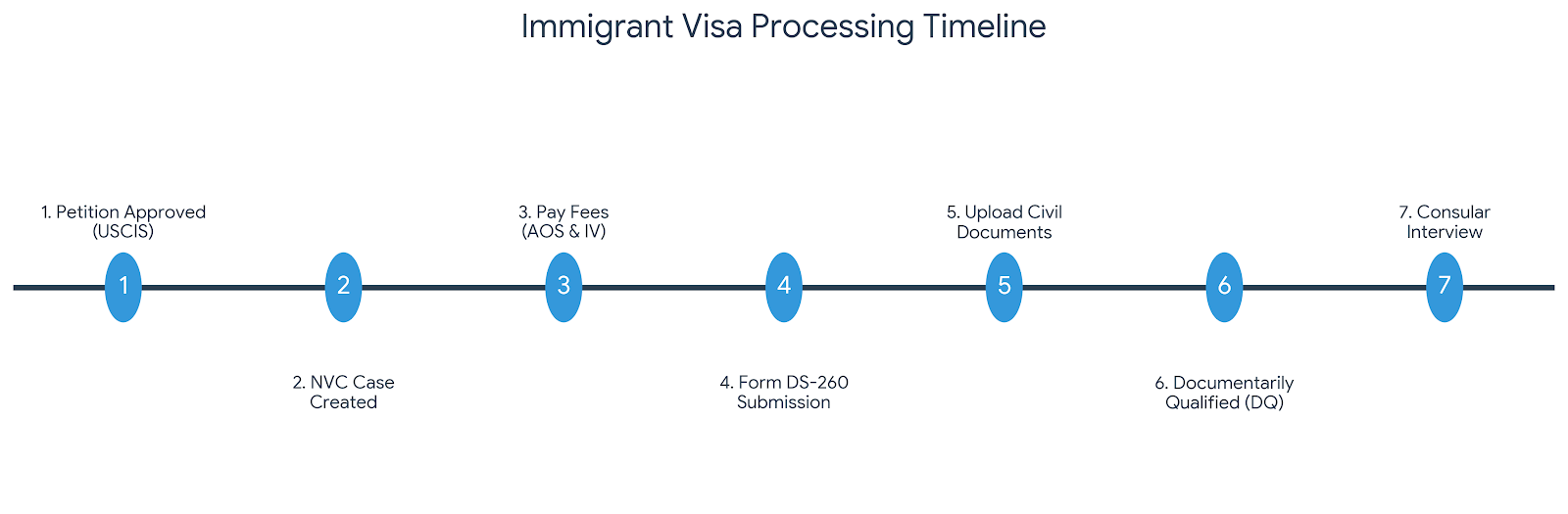
The general sequence is:
- Petition approval (USCIS)
- Case creation at the NVC
- DS-261 submitted (Choice of Agent)
- Fee invoices become available
- DS-260 immigrant visa application completed
- Civil documents submitted
- Interview scheduled at the U.S. embassy or consulate
Not every applicant is required to submit DS-261, but for many family-based immigrant visa cases, it is a standard step.
Where Do You Complete DS-261?
Form DS-261 is completed online through the Consular Electronic Application Center (CEAC), the same portal used for DS-260.
Applicants log in using:
- Their NVC Case Number
- Invoice ID Number
Once logged in, the system will show DS-261 as an available step if required.
What Information Is Required?
DS-261 is relatively short compared to DS-260.
It mainly asks for:
- The applicant's preferred mailing address
- The name of the person receiving correspondence (agent)
- Contact information for that agent
Most applicants simply choose themselves, which avoids unnecessary complexity.
Common Mistakes to Avoid
When completing DS-261, applicants should be careful about:
- Selecting an agent who may not reliably forward notices
- Entering incorrect contact information
- Forgetting that all future communication may go only to the chosen agent
- Confusing DS-261 with DS-260 (DS-261 does not contain visa eligibility questions)
How DS-261 Connects to DS-260
DS-261 is often the step that unlocks the next stages of the immigrant visa process.
After DS-261 is submitted and processed, the applicant will typically be able to:
- Pay required immigrant visa fees
- Begin completing Form DS-260
- Upload supporting civil documents
Therefore, understanding DS-261 helps applicants avoid delays before reaching the DS-260 stage.
DS-260 vs Adjustment of Status (Form I-485)
DS-260 is used only in consular processing.
| Process Type |
Location |
Form Used |
| Adjustment of Status |
Inside the U.S. |
Form I-485 |
| Consular Processing |
Outside the U.S. |
Form DS-260 |
Applicants abroad generally cannot file I-485 and must instead proceed through DS-260 immigrant visa processing under FAM-governed consular procedures.
When Do You File Form DS-260?
DS-260 is filed only after major earlier steps are complete.
You typically file DS-260 after:
- USCIS approves the immigrant petition (I-130, I-140, I-526, etc.)
- The case is transferred to the National Visa Center (NVC)
- The applicant receives the NVC Welcome Letter
- The applicant pays the applicable visa application fee
- The applicant provides NVC with requested documentation
- Once the required documentation has been provided the applicant becomes “Documentarily Qualified / Complete.” 9 FAM 504.1
- The case becomes eligible for immigrant visa application processing and the applicant is invited to complete Form DS-260.
The FAM confirms that the NVC is responsible for issuing instructions and initiating the DS-260 stage before interview scheduling.
How to Complete Form DS-260 (Online Only)
Form DS-260 is not mailed or submitted on paper.
It is completed electronically through the Department of State's CEAC portal.
Step 1: The CEAC “Sign In” Screen
This is the portal entrance. Applicants must log in before they can see any application details.
- URL: CEAC Immigrant Visa Portal
- NVC Case Number: Three letters followed by ten digits
- Invoice I.D. Number: The alphanumeric code from the NVC Welcome Letter
- Select Participant Role: A dropdown where the user selects “Applicant,” “Attorney,” or “Petitioner”
Step 2: IV Application Summary Screen
This screen acts as the “Dashboard” for the entire family's case.
- Key Visuals: A table listing the Principal Applicant and all Derivative family members (spouse/children)
- Status Column: Shows “NOT STARTED,” “INCOMPLETE,” or “SUBMITTED”
- Action Button: Usually a blue “Start Now” or “Edit” button to the right of each name
Step 3: Complete Required Sections
DS-260 requires detailed responses covering:
- Full legal name and aliases
- Date and place of birth
- Passport information
- Address history
- Employment and education history
- Family members and derivatives
- Prior immigration filings or refusals
- Security and admissibility questions
A left-hand navigation sidebar shows the list of completed and remaining sections (Personal, Family, Work/Education, etc.). Small “?” icons on the right side of the screen provide FAM-based definitions for certain questions.
Important: Click the “Save” button at the bottom of every page frequently to avoid session timeouts.
Consular officers review DS-260 answers under FAM standards, and incomplete applications may be reopened for correction.
Step 4: Review Carefully Before Submission
Once submitted, DS-260 cannot typically be edited directly online.
If changes are needed, applicants must work through:
- The National Visa Center
- The embassy or consulate handling the case
The FAM allows consular staff to reopen DS-260 forms when necessary before visa issuance.
Step 5: Submit and Print the Confirmation Page
This is the critical “Point of No Return” screen.
- E-Signature Field: Often requires the applicant to re-enter their Case Number exactly as it appears
- Submission Warning: Text stating that once submitted, the form cannot be edited online without NVC or Embassy intervention
Step 6: The DS-260 Confirmation Page
This is the only page the applicant must print and bring to the interview.
- Case Details: Displays the Applicant Name, Case Number, and the specific U.S. Embassy/Consulate where the interview will occur
- Barcode: A large, unique barcode at the top or bottom of the page
- Print Confirmation Button: Use the specific button for printing; do not just use the browser's “Print” function on the summary screen
Supporting Documents After DS-260 Submission
After DS-260 is filed, applicants must provide civil and identity documentation, typically including:
- Passport biographic page
- Birth certificate
- Marriage or divorce certificates
- Police certificates
- Military or court records (if applicable)
The NVC and consular post review documentation requirements under State Department and FAM standards before scheduling interviews.
DS-260 Fees
DS-260 is submitted after required immigrant visa processing fees are paid through the NVC/CEAC workflow. There is not typically a separate payment step at the moment you click “Submit DS-260,” but visa fees still apply as part of the process.
Additional costs may include:
- Medical exam fees
- Translation fees
- Embassy interview-related expenses
What Happens After Filing DS-260?
After DS-260 submission:
- NVC reviews the application and documents
- The case becomes “documentarily qualified”
- The interview is scheduled at the U.S. consulate
- The applicant completes the required medical exam
- A consular officer adjudicates the immigrant visa
The FAM provides procedures for visa refusal, additional document requests, and reopening DS-260 when corrections are needed.
DS-260 in EB-5 Investor Green Card Cases
DS-260 plays a major role in EB-5 cases when the investor is applying from abroad.
When DS-260 Appears in EB-5
EB-5 applicants file DS-260 only after:
- USCIS approves Form I-526 or I-526E
- A visa number becomes available
- The case is transferred to the NVC
- The investor receives CEAC login credentials
At that stage, DS-260 becomes the immigrant visa application leading to the embassy interview.
Special Notice for EB-5 Applicants
If You Filed Adjustment of Status and Receive DS-260 Notices Warning Your Visa Case Will Be “Canceled”
This issue most commonly affects EB-5 applicants who have already filed Form I-485 (adjustment of status) in the United States but later receive Department of State messages through CEAC warning that their immigrant visa application — including Form DS-260 — will be canceled if they do not respond. That language is understandably frightening, and many applicants assume it means their conditional green card case will be canceled too.
Why DS-260 May Still Appear in an EB-5 Case
Form DS-260 is the immigrant visa application used for consular processing. In EB-5 cases, lawyers sometimes indicate “consular processing” on Form I-526 or I-526E even when the investor expects to pursue adjustment of status in the United States. This is often a default selection because it preserves flexibility if the applicant later decides to complete the process abroad.
Why You May Receive DS-260 or CEAC Cancellation Warnings
Because consular processing may have been selected at the I-526 stage, the Department of State's immigrant visa system can still generate automated CEAC reminders or warnings about completing DS-260, even if the investor is now pursuing AOS through USCIS.
What “Cancellation” Means if You Filed Form I-485
For applicants who have filed adjustment of status (Form I-485), these DS-260 cancellation notices usually refer only to the Department of State's separate immigrant visa (consular) case track. In most situations, they do not mean USCIS will cancel a pending I-485, and they do not mean a conditional green card will be taken away. If the applicant is pursuing adjustment of status through USCIS, the DS-260 consular processing track is simply not the path being used, and State Department warnings about canceling the immigrant visa application generally have no bearing on the AOS green card process.
DS-260 Is Not the Same as Form I-829
A common misunderstanding is that DS-260 is part of the removal of conditions process.
It is not.
- DS-260 leads to the initial immigrant visa issuance
- Form I-829 is filed two years later to remove conditions
DS-260 is the immigrant visa application stage governed by State Department procedure and the FAM.
Common Mistakes to Avoid
Applicants frequently delay their immigrant visa case by:
- Filing before NVC instructions
- Leaving gaps in address or employment history
- Giving inconsistent answers compared to prior petitions
- Forgetting to print the confirmation page
Under FAM procedure, incomplete DS-260 submissions may be reopened for correction before interview completion.
Preparing to File DS-260: An Immigration Lawyer's Advice
Many applicants complete DS-260 themselves, often with attorney guidance. Even when an attorney assists with preparation, the applicant remains responsible for the accuracy of all answers and signs electronically under penalty of perjury.
- Factsheets — your law firm will have a factsheet, often sent by letter, summarizing the information needed to complete the DS-260. Read the letter thoroughly and call your lawyer to clarify any questions before completing it.
- Use our Online Preparation Form — We have duplicated the online DS-260 form. If you complete this form we will e-mail you a copy so you have a copy of the information you will need available as you complete the form. Complete our DS-260 preparation form here.
- English Language — DS-260 must be completed in English. Using our online form will help you prepare in advance for this.
- Travel and Work History — The DS-260 form requires a lot of detailed information on your travel history and work history. Organizing this information in advance can be highly beneficial.
- Review your social media — DS-260 asks for social media identifiers used in recent years. Consular processing can include broader screening, which may involve review of publicly available online information. Applicants should answer truthfully and avoid omissions.
Frequently Asked Questions (FAQ) About Forms DS-260 and DS-261
This FAQ answers the most common questions applicants have when completing Form DS-260 and, where applicable, Form DS-261 as part of the immigrant visa process.
What is Form DS-260?
Form DS-260 is the official Online Immigrant Visa Application used by individuals applying for a U.S. immigrant visa through consular processing.
It is submitted online through the Consular Electronic Application Center (CEAC) and is required for most applicants who will attend an immigrant visa interview at a U.S. embassy or consulate abroad.
Who needs to file Form DS-260?
Most applicants applying for a U.S. immigrant visa from outside the United States must complete Form DS-260, including those applying through:
- Family-based immigrant petitions
- Employment-based immigrant petitions
- Diversity Visa (DV Lottery) selection
- EB-5 immigrant investor cases
If you are applying for permanent residence through consular processing, DS-260 is typically required.
What is Form DS-261?
Form DS-261 is called the Online Choice of Address and Agent.
It is used to designate who will receive official communication from the National Visa Center (NVC), such as:
- Fee payment instructions
- Document requests
- Interview scheduling notices
Many applicants simply choose themselves as the agent.
Do all applicants need to complete DS-261?
No. Not every immigrant visa applicant is required to submit DS-261.
DS-261 is most commonly required in family-based immigrant visa cases processed through the NVC. Some employment-based applicants may not see DS-261 listed separately.
The CEAC system will display DS-261 if it is required for your case.
When do I complete DS-261 and DS-260?
The general sequence is:
- USCIS approves the immigrant petition
- The case is transferred to the National Visa Center
- DS-261 is submitted (if required)
- Visa processing fees are paid
- DS-260 is completed and submitted
- Supporting civil documents are uploaded
- Interview is scheduled at the U.S. consulate
Where do I complete DS-260 and DS-261?
Both forms are completed online through the Consular Electronic Application Center (CEAC) website.
You will need:
- Your NVC Case Number
- Your Invoice ID Number
Once logged in, CEAC will show which forms and steps are available for your case.
Is there a fee to submit Form DS-260?
The DS-260 itself is generally submitted as part of the immigrant visa process after required fees are paid through the National Visa Center.
Applicants typically pay immigrant visa processing fees through CEAC before the case can move forward.
The DS-260 submission button does not usually involve a separate standalone payment step, but visa fees are still required as part of the overall process.
How long does it take to complete Form DS-260?
Most applicants take between 1 and 3 hours to complete DS-260, depending on:
- Travel history
- Address history
- Employment background
- Family information
It is common to complete the form over multiple sessions using the “Save” function.
What documents should I gather before starting DS-260?
Before beginning Form DS-260, applicants should have ready access to:
- Passport information
- Full address history since age 16
- Employment and education history
- Names and birth details of parents
- Prior U.S. travel or visa history
- Police and military records (if applicable)
- Case number and invoice ID
Having these details prepared helps avoid delays or errors.
Can my lawyer complete DS-260 for me?
Many applicants complete DS-260 themselves, but immigration attorneys often assist with preparation, review, and submission.
Even when a lawyer helps, the applicant remains responsible for ensuring that all answers are complete and accurate.
DS-260 is signed electronically under penalty of perjury.
Can I edit DS-260 after submission?
Once submitted, DS-260 cannot usually be edited directly online without intervention.
If changes are needed, applicants may request that the form be reopened or unlocked through:
- The National Visa Center, or
- The U.S. embassy or consulate handling the case
Procedures vary depending on the stage of processing and the specific consular post.
Minor corrections can also sometimes be addressed during the visa interview.
What happens after I submit DS-260?
After submission, the case typically proceeds through:
- Civil document review
- NVC case qualification
- Interview scheduling
- Medical examination requirements
- Immigrant visa interview at the consulate
Submitting DS-260 is a major milestone, but additional steps remain before visa issuance.
What are the most common mistakes on DS-260?
Common errors include:
- Incorrect address or employment history
- Missing prior U.S. visa refusals or overstays
- Inconsistent dates compared to supporting documents
- Listing incomplete family details
- Submitting without reviewing for accuracy
Because DS-260 is a sworn government form, mistakes should be corrected promptly.
Do I need to list all social media accounts?
DS-260 asks for social media identifiers used in recent years.
Applicants should answer truthfully and consistently.
The U.S. government may review publicly available online information as part of broader visa screening.
Applicants should not omit requested identifiers.
What is the difference between DS-160 and DS-260?
- DS-160 is for nonimmigrant (temporary) visas such as tourist, student, or work visas.
- DS-260 is for immigrant (permanent residence) visas processed through a consulate.
Applicants should complete the correct form based on visa category.
What if I cannot finish DS-260 in one session?
CEAC allows applicants to save progress and return later.
However:
- Sessions may time out
- Applicants should save frequently
- It is recommended to prepare information in advance
You can log back in using your case number and invoice ID.
What should I bring to my immigrant visa interview after DS-260?
Applicants should typically bring:
- DS-260 confirmation page
- Passport
- Original civil documents
- Medical exam results
- Police certificates
- Financial support documents (if applicable)
- Any additional documents requested by the consulate
Requirements vary by visa category and post.
How do I know if my DS-260 was submitted successfully?
After submission, CEAC generates a confirmation page.
Applicants should print or save this page, as it is required for:
- Interview attendance
- Medical appointment scheduling
- Case tracking
Can DS-260 delays affect my visa interview timeline?
Yes. Delays or incomplete information can slow down:
- Document qualification
- NVC review
- Interview scheduling
Submitting DS-260 accurately and promptly is one of the best ways to keep the process moving.
Conclusion
Form DS-260 is the central immigrant visa application for applicants completing the green card process through consular processing abroad.
It is a Department of State electronic form, submitted through CEAC, reviewed by consular officers, and governed by the procedures and standards of the Foreign Affairs Manual (FAM).
For EB-5 investors and other immigrant visa applicants abroad, careful DS-260 preparation is essential to reaching the immigrant visa interview and entering the United States as a lawful permanent resident.
About the Authors
Mark I Davies, Esq.
Chairman of Davies & Associates; focused on immigration strategy and complex consular processing filings.
Mark I Davies, Esq. JD, University of Pennsylvania Carey Law School, Licensed with the SRA (SRA ID: 384468) in the UK, Member Law Society of England & Wales, MBA, Wharton School of Business. Top 10 Investment Visa Lawyer, Licensed (USA), Georgia State Bar. AILA Member.
| Area |
Details |
| Education |
JD, University of Pennsylvania Carey Law School | MBA (Finance), The Wharton School, University of Pennsylvania | Chartered Accountant (ICAEW) |
| Financial Training |
Completed Analyst Training Program at a major international bank | Chartered Accountant background with professional training in financial analysis and reporting |
| Legal Practice |
Admitted to practice in Georgia (USA) | Registered Solicitor with the Law Society of England and Wales | Former CMBS lawyer at one of the world's largest international law firms |
| Immigration Track Record |
15+ years advising HNW investors | Zero denials for clients advised on source-of-funds compliance in EB-5 | Hundreds of successful immigration cases globally |
| Recognition |
Named a Top 25 EB-5 Immigration Attorney by EB5 Investors Magazine (2018–2023) |
| Professional Engagements |
Lecturer/trainer for other lawyers at AILA, ACA, University of Pennsylvania Law School | Frequent speaker at global investment immigration conferences |