EB-5 Grandfathering Deadline:
file Form I-526E by September 30, 2026 to lock in current terms under the EB-5 Reform & Integrity Act.
See what's protected →
EB-5 Visa Process: Roadmap to U.S. Residency Through Investment
Ask an EB-5 Immigration Lawyer
EB-5 Visa Process: Roadmap to U.S. Residency Through Investment
The EB-5 visa process enables a qualifying investor to
receive the right to Permanent Residency (aslo known as a 'Green Card') in the United States.
A Green Card enables an investor and
their immediate family to live and work in the United States.
As of June 2026, the EB-5 process entails several Core Steps. These Core Steps include:
source-of-funds preparation;
choosing a direct or regional center investment;
filing form I-526 (Direct Investments) or I-526E (Regional Center Investments);
applying for adjustment of status (AOS) or consular processing (CP);
The process is not only a filing sequence. The success of an EB-5 case depends
heavily on lawful source-of-funds documentation, project selection, visa
availability, job creation, and timing strategy. Investors already in the United
States may also be able to file Form I-485 concurrently with Form I-526E when a
visa number is available.
An
EB-5 Visa
is an investment-based immigrant visa that enables foreign investors to
acquire a lawful permanent resident status in the United States with a minimum
investment amount of $1,050,000 USD or $800,000 USD for targeted employment
area investment.
The investment must lead to the job creation of 10 full-time jobs in the U.S.
and must be at risk.
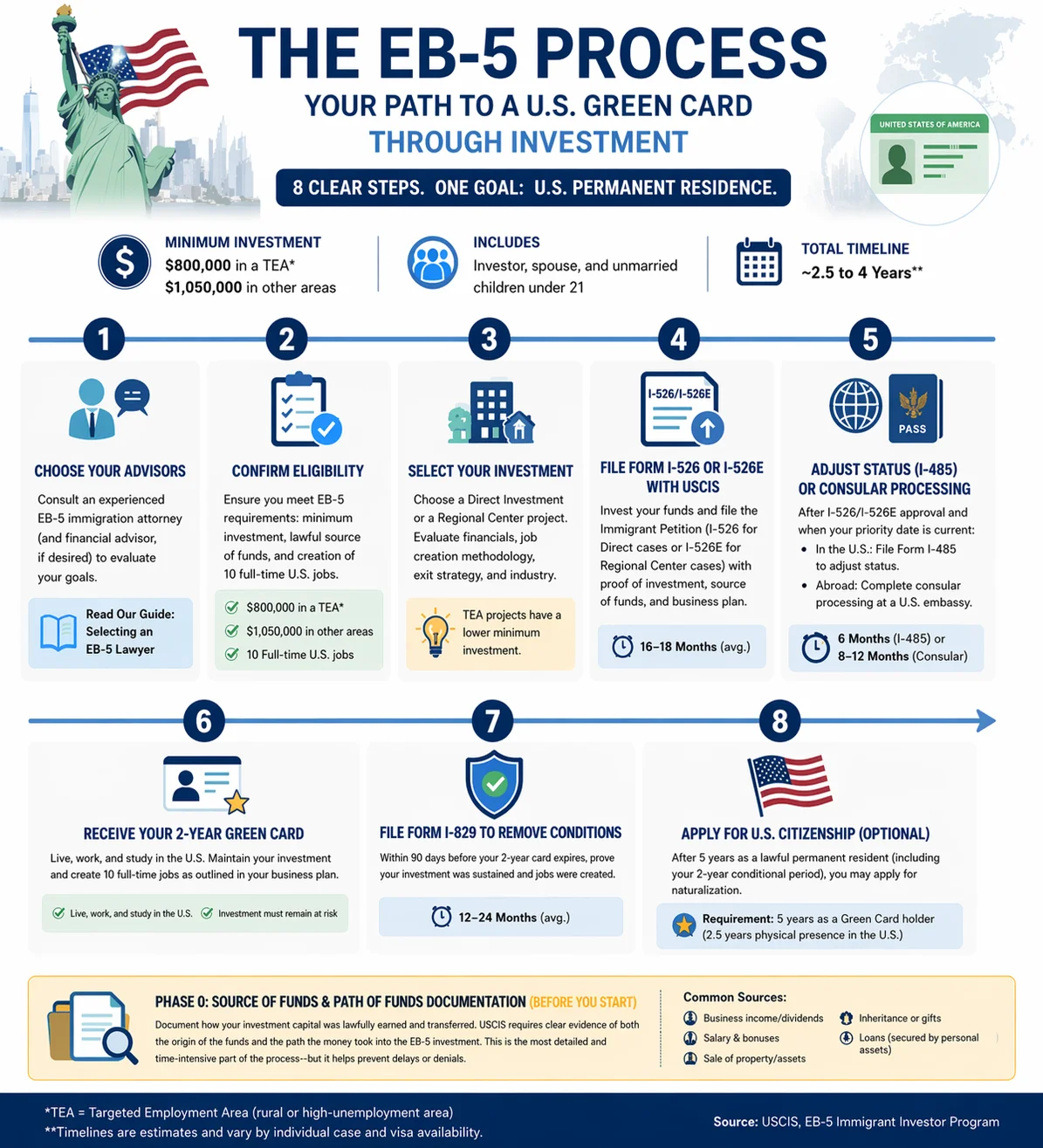
Step-by-step EB-5 process infographic outlining the full journey to a U.S. Green Card, including investment selection, I-526/I-526E filing, conditional residency, and permanent residence approval.
I-526E petition, adjustment of status, I-829 approval, and path to U.S. citizenship."
onclick="toggleEnlarge()">
Complete EB-5 process roadmap—from initial investment and petition filing (I-526 or I-526E) through conditional residency to permanent Green Card approval. (Click image to enlarge)
Step 1. Confirm your EB-5 strategy and immigration eligibility
Before you go through the entire EB-5 process, it's crucial to first consult
with an immigration attorney who can help you determine whether an EB-5 Visa
is the right option for you based on your goals and circumstances.
At the start of the EB-5 process, your attorney should review your immigration
goals, family timeline, country of chargeability, source of funds, investment
budget, project preference, and whether you may qualify for concurrent filing.
This early review helps determine whether EB-5 is the right route and whether
timing issues such as child age-out, visa bulletin backlogs, or adjustment of
status eligibility need to be addressed before filing.
There are two key outcomes to weigh as you evaluate the program: the likely
return on your capital and the likelihood of securing a green card.
You will
also need to decide whether to invest inside or outside a targeted employment
area (TEA) — areas that are rural or have high unemployment — and
to confirm that your investment can create the required 10 full-time U.S.
jobs. Your financial return, exit strategy, and choice of industry all factor
into this assessment.
Early in the EB-5 process, investors complete a Source of Funds (SOF) review.
This phase involves documenting how the investment capital was lawfully earned and transferred. U.S. immigration authorities require clear evidence showing both the origin of the funds and the path the money took into the EB-5 investment.
Typical sources of funds may include:
Business income or dividends
Salary and bonuses
Sale of property or assets
Inheritance or gifts
Loans secured against personal assets
In addition to proving the source, applicants must also trace the movement of funds through bank accounts, currency exchanges, and international transfers.
Because this step directly impacts the success of the Form I-526 or I-526E petition, it is often the most detailed and time-intensive part of the EB-5 process. Proper documentation here helps prevent delays, requests for evidence (RFEs), or petition denials later in the process.
Step 3. Select a direct or regional center investment
The EB-5 Visa lets you either make a
direct investment
or invest through a regional center. Starting a new business, buying an
existing business, or investing in one are common examples of direct
investments. Regional centers, by contrast, are entities designated by the
United States Citizenship and Immigration Services (USCIS) that pool capital
from EB-5 investors to develop projects such as hotels and resorts.
Investments within a TEA have a lower minimum capital investment, which as of
today stands at $800,000 USD. This is to attract EB5 investors to stimulate
the economy of TEAs.
For commercial enterprises outside TEAs, the required
minimum investment amount is $1,050,000 USD. These RIA amounts are scheduled
for a CPI inflation adjustment effective January 1, 2027 (the TEA minimum is
widely expected to rise to roughly $900,000), so filing before then locks in
the current figures.
Under the EB-5 Reform and Integrity Act of 2022 (RIA), capital from petitions
filed on or after March 15, 2022 must remain invested and 'at risk' for at
least 2 years from the date it is invested and placed at risk in the project
— a major change from the old rule that tied sustainment to the entire
conditional residency. Many regional center projects are still structured
around longer 5–7 year holds for operational reasons, so confirm the
actual term of any specific deal.
To commit your funds, you sign a subscription agreement — a request to
join the partnership or limited liability company — and transfer the
money to an escrow account managed by an appointed escrow agent.
Choosing the right investment is crucial in the EB5 process, and you have to
research extensively to make sure that the investment you selected suits your
goals and needs. If you're unsure of what steps to take regarding your
investment, you can also work with a registered investment advisor or a broker
who has experience with EB5 investments.
Step 4. File your I-526 or I-526E petition with USCIS and place your capital at
risk
Once you've selected a project, you invest your funds in the new commercial
enterprise and provide evidence that you have invested, or are actively in the
process of investing, your capital.
However, bear in mind that merely demonstrating an intention to contribute
does not suffice, and demonstrating future investment plans without a legally
binding promise will not be accepted.
Then you prepare and file your immigrant petition. Direct (standalone)
investors file Form I-526 (Immigrant Petition by Standalone Investor), while
investors in a regional center project file Form I-526E (Immigrant Petition by
Regional Center Investor). The petition includes documents relating to you,
the business, the new commercial enterprise, and the source and path of your
funds.
The funds can be sourced from the investor's own money, in the form of a loan
not secured by the EB5 investment or a gift.
As of 2026, USCIS reports roughly 29–32 months on average for these petitions, though rural set-aside projects qualify for Priority Processing and some have been adjudicated far faster.
Step 5. Apply for adjustment of status (Form I-485) or consular processing
There are two routes to a conditional green card: adjustment of status (if you
are inside the U.S.) and consular processing (if you are abroad). For
adjustment of status, an EB-5 investor lawfully present in the U.S. can file
Form I-485 as soon as a visa number is available for their category —
either concurrently with the Form I-526 or I-526E petition or after it —
rather than having to wait for the petition to be approved first.
⚠ Adjustment of status is now more complex
On May 21, 2026, USCIS issued Policy Memorandum PM-602-0199, directing officers to treat adjustment of status as a discretionary, closely scrutinized benefit rather than a routine step. EB-5 concurrent filing of Form I-485 remains available and is expressly authorized by Congress under INA § 245(n), but a concurrent I-485 should now be prepared as a thorough legal submission rather than a routine form filing. See EB-5 Concurrent Filing After the USCIS Discretion Memo for what this means for investors.
For adjustment of status, you file Form I-485 (Application to Register
Permanent Residence or Adjust Status) with USCIS while you are inside the
United States. Filing concurrently can also let you apply for a work permit
(EAD) and an advance parole travel document while your case is pending.
As
part of the process you complete a medical exam with a USCIS-approved doctor
and attend a biometrics appointment for fingerprinting and background checks. Adjustment of status commonly takes around 2 to 6 months once a visa is
available.
USCIS now emphasizes that adjustment of status is a discretionary
benefit rather than an automatic one. Each application is reviewed on its own
merits, and meeting the basic eligibility requirements is not necessarily the
end of the analysis — officers also weigh whether an applicant has
complied with the terms of their admission. As a result,
maintaining your underlying nonimmigrant status, work-authorization
compliance, and a clean immigration record is now more important than
before.
Meanwhile, if you are living abroad when your Form I-526 or I-526E is approved,
you go through consular processing. USCIS forwards your approved petition to
the National Visa Center (NVC) — a single U.S. Department of State
facility in Portsmouth, New Hampshire that handles all immigrant visa cases
(there is not a separate center in each country). The NVC issues fee bills and
instructions for filing Form DS-260 and submitting your civil and financial
documents.
Once the NVC finds your case documentarily qualified, it forwards
the file to the U.S. embassy or consulate in your home country, which
schedules and conducts the immigrant visa interview. If you're eligible, you
receive your immigrant visa after the interview and enter the U.S. as a
conditional permanent resident. This stage typically takes around 3 to 12
months and varies by consulate.
Step 6. 2-Year Green Card
Once you've become a conditional green card holder, you will have the same
rights and privileges as a lawful permanent resident, except that the
conditional green card lasts only 2 years. During this period, you must
establish a permanent residence in the United States and maintain your
qualifying investment in the commercial enterprise, operating in line with the
EB-5 business plan you submitted with your Form I-526 or I-526E.
Moreover, during this time, you have to keep your capital investment at risk
and you have to create 10 full-time jobs for U.S. workers.
Step 7. Filing your Form I-829 petition for permanent resident status
Within 90 days of the expiration of your 2-year conditional permanent
residence, you are required to file a Form I-829, which is a petition to
remove the conditional status on your permanent resident status. Filing this
petition means that you're proving that you've met the
EB5 Visa requirements
such as you've created 10 full-time jobs and that you maintained your
investment in the new commercial enterprise.
Once your Form I-829 has been approved, you are officially a lawful permanent
resident of the U.S.
Step 8. Applying for U.S. Citizenship (optional)
To become a U.S. citizen, you have to undergo a process called naturalization.
To be eligible, you have to be a lawful permanent resident for at least 5
years. You are also required to be physically present in the U.S. for at least
2 and a half years
Your 2-year conditional lawful permanent residency also counts toward this
5-year requirement provided that you've consistently lived in the U.S. since
obtaining a conditional lawful permanent residence status.
Duration of EB5 Process
The duration of your EB-5 process varies with investment type, project
category, and your country of chargeability. As of 2026, USCIS processing
times run roughly 29.5 months for Form I-526E (regional center), about 32
months for the standalone Form I-526, and around 20 months for Form I-829.
Adjustment of status (Form I-485) typically takes about 2 to 6 months, and
consular processing about 3 to 12 months once a visa is available. Rural
set-aside projects benefit from Priority Processing and are often adjudicated
more quickly.
Visa availability is published monthly in the Department of State Visa
Bulletin (not by USCIS). As of the 2026 bulletins, the reserved set-aside
categories (rural, high-unemployment, and infrastructure) remain Current for
all countries, while the unreserved category continues to show backlogs for
investors born in China and India. For the latest movement in the Visa
Bulletin and the current backlog position, see our
EB-5 Program Updates page.
📖 Read Our EB-5 Visa Processing Time Guide for 2026
Beyond the investment itself, an EB-5 green card gives you and your family the
right to live, work, and study anywhere in the U.S. Some of the main benefits
of obtaining an EB-5 Visa include:
Freely travel in and out of the United States with your permanent resident
status;
Potential return of capital depending on the project documents and investment performance, with no guarantee of repayment;
Obtaining lawful permanent residency as well for your spouse or unmarried
children under the age of 21;
Option to apply for U.S. citizenship; and
Travel to countries that allow visa-free passage to green card holders
You can also
visit here
if you need more information about the EB5 Visa so you can have a general
overview of the visa and gain an informed decision before proceeding with your
application.
Conclusion
The EB-5 Visa is a great option for investors and entrepreneurs who want to
invest in a business outside of their home country and immigrate to another
country. With its line of benefits, the EB-5 Visa can be the best option for
your financial and immigration goals.
Because EB-5 visas are numerically
limited and visa availability depends on country of chargeability and
category, backlogs or retrogression can affect the timing of the green card
stage even after an I-526 or I-526E approval. Understanding the full
EB-5 visa costs and fees
is also essential before you start, including the current I-526E filing fee, which rises on November 30, 2026.
For other employment-based immigrant petitions, see our complete guide for Form I-140.
Here at
Davies & Associates, our expert immigration lawyers can help you with your EB5 process so that
all necessary documents and steps are taken.
AOS vs Consular Processing
After the I-526E petition is approved (or filed concurrently, if eligible), the EB-5 process follows one of two paths depending on the investor’s location:
Adjustment of Status
Investors already inside the United States may apply for permanent residence through Adjustment of Status by filing Form I-485. This path lets applicants remain in the U.S. while their green card application is processed and, in many cases, continue working and traveling with interim authorization.
USCIS now treats adjustment of status as a discretionary decision reviewed on the merits of each individual case, so maintaining lawful underlying status throughout the process carries more weight than it once did.
Consular Processing
Investors residing outside the United States complete the process through consular processing at a U.S. embassy or consulate in their home country.
This involves:
Submitting documentation to the National Visa Center (NVC)
Attending an immigrant visa interview
Entering the U.S. with an immigrant visa to receive a conditional green card
Choosing between these two paths is determined by the applicant’s location and immigration status, but both lead to the same outcome: conditional permanent residency under the EB-5 program.
EB-5 Process: Frequently Asked Questions
How long will it take for me to obtain a Green Card through the EB-5 program?
EB-5 timelines can vary significantly depending on your investment location, TEA category, and personal circumstances—some options may offer faster processing.
Get a personalised estimate of your EB-5 processing time using our timeline and calculator.
Can I live anywhere in the U.S. with my EB-5 Visa?
Yes, once you have obtained your EB-5 Visa, you can live and work anywhere in the U.S. This also applies if you have invested through a regional center. You don't need to live in the same State as the commercial enterprise you invested in.
If you made a direct investment, however, you may need to be near the enterprise you invested in as you would need to prove that you are active in the company.
Can my spouse or children join me in the U.S.?
Yes, once your EB-5 Visa is approved, your spouse and unmarried children under the age of 21 can join you in the U.S. and will also be eligible for conditional and permanent residence.
For spouses, same-sex spouses qualify but common-law spouses do not. As for children, this includes birth children, adopted children and stepchildren. You must be able to prove that you're their legitimate parent.
How many EB-5 Visas are issued each year?
Each year, there are around 10,000 EB-5 Visas issued. These visas are given to EB-5 investors, their spouses and their unmarried children under the age of 21.
What is the EB-5 Regional Center Program?
Through the EB-5 Regional Center Program, investors act as passive investors and contribute capital to USCIS-designated regional centers. These entities promote economic growth in particular geographic areas and may count 'indirect' jobs toward the job-creation requirement using approved economic methodologies. The program was reauthorized and reformed by the EB-5 Reform and Integrity Act of 2022; the older 'Regional Center Pilot Program' name is now historical.
How long do I wait for my visa interview after my I-526 application is approved and my priority date is current?
If you're outside the U.S., the National Visa Center coordinates the collection of certain documents from you and sends a file to the local consulate which then schedules your interview. The waiting time can take from 3 to 9 months.
For a more detailed breakdown see our EB-5 Visa Timeline and Duration Calculator
About the Author
Mark I. Davies, Esq.
Managing Partner of Davies & Associates; focused on E visa strategy and complex consular filings.
Mark I. Davies, Esq., J.D., University of Pennsylvania Law School, licensed by the
SRA (SRA ID: 384468) in the UK, and a member of The Law Society of England & Wales,
MBA, Wharton School of Business. Named a Top 25 EB-5 Immigration Attorney by EB5 Investors Magazine.
Ranked Band 1 for E-2 visas in Singapore by Global Citizenship Services (2026). Admitted to practice in Georgia (USA).
Georgia State Bar member. AILA member.
Area
Details
Education:
JD, University of Pennsylvania Carey Law School | MBA (Finance), The Wharton School, University of Pennsylvania | Chartered Accountant (ICAEW)
Financial Training:
Completed the Analyst Training Program at a major international bank | Chartered Accountant background with professional training in financial analysis and reporting
Legal Practice:
Admitted to practice in Georgia (USA) | Registered Solicitor with the Law Society of England and Wales | Former CMBS lawyer at one of the world's largest international law firms
Immigration Track Record:
15+ years advising HNW investors | While, as of October 21, 2026, the firm has never had an EB-5 case denied on the basis of its source-of-funds work, there can never be a guarantee of future success. | Hundreds of successful EB-5 cases globally
Davies & Associates is one of the longest-established EB5 law firms in the industry and our team regularly contribute to the global media on the subject. We have helped hundreds of families, business owners and entrepreneurs relocate to America and have never had a case rejected on Source of Funds, which is one of the most challenging aspects of an EB5 application. Click here to meet some of our EB5 clients. Our success helping clients demonstrate they meet EB5 visa requirements comes from blending our highly qualified lawyers with an understanding of the culture, law, business practices and banking regulations in each jurisdiction we operate.
Our success comes from the strength of the unique team of lawyers we place around every client
Each Davies & Associates client is assigned a team of industry-leading EB5 lawyers each highly experienced with a specific area of the law. Our client EB5 teams typically include:
A local EB5 lawyer versed in the currency laws and practices of the countries
from which a clients funds are to be sourced
A real estate lending or finance lawyer to assist with project due diligence
A specialist US Source of Funds documentation lawyer
A senior EB5 attorney responsible for supervising the filing and submission of
each
client's case
Contact Davies & Associates Offices in United States
We are known for our creative solutions that obtain "impossible" visas. We solve the most complex immigration problems for businesses, investors, individuals, and families.
Several lawyers told me I would not be able to get a TN visa. Two weeks after contacting Davies & Associates I was working in New York, visa in hand.
Individual seeking 'Impossible' TN Visa
D&A was very detail-oriented and very thorough in what they did. They worked on my case 24/7 and were very patient in answering all my questions.
E-2 Visa Client
My case felt complex but D&A managed the whole process carefully and helped me move seamlessly from one stage to the next.
E2 + CBI Client
D&A was my guiding light through the entire EB-5 process.
EB-5 Visa Client
I would definitely be a big advocate for the rest of my life for anyone wanting to explore the Grenada Citizenship by Investment Programme leading to the E-2 visa. The most important thing is a good team behind you.
With Davies & Associates, you're in safe hands... you need someone who can support you on the ground and, again, you are well taken care of by D&A. The people are really warm, very helpful and quite open-minded when it comes to business... Not to mention as a passport it's great from a travel perspective... It's just 4 to 5 hours from New York.
Grenada CBI + E2 Visa Client
The entire process of getting an EB-5 visa is handled in a professional way by Mark Davies and his team. EB-5 is a wonderful option for anyone considering moving to the United States if you have the means. I was hoping to use the H-1B route for my children, but it became unreliable and so I looked to the EB-5 visa instead.
It is great for anyone who has the resources. Mark gives you the first meetings himself which gives you great comfort. Both Mark and Sanjay are abundantly available and I even had the pleasure of hosting them at my house.
Parent of 2 EB-5 visa holders
I'm in the process of extending my L-1 visa. I submitted a few questions regarding my case, and he contacted me back almost immediately, both by email and telephone. Unlike other attorneys I met before, he gave me the impression of knowing off the top of his head what kind of visa I have, and what actions had to be taken to extend it.
He is very thorough and clear regarding the process and what to expect in terms of timelines and issues that may arise. He is constantly in contact, so you definitely know he's working on your case.
L-1B Visa Holder
Mark Davies is a joy to work with. His extensive knowledge, speedy response and attentive service took away all my fears of dealing with immigration and visa applications. He is very generous with his time in explaining every step along the way and I have already and will in the future recommend him to anybody who is looking for an immigration lawyer.
E2 Visa for Small Professional Business With International Offices
Davies & Associates assisted us with an immigration emergency involving my brother's fiancée who was outside the United States. They assisted us in a highly professional manner, working with the relevant US embassy, US immigration and the governments of two other countries.
As a result of their efforts the individual involved is now working in the United States. While their knowledge of the law is exemplary what really distinguishes this firm and attorney Davies from any other firm we have worked with is their dedication to customer service and their unrivaled level of professionalism.
Complex Fiancée Visa Need Involving Multiple International Jurisdictions
Several lawyers told me I would not be able to get a TN visa. Two weeks after contacting Davies & Associates I was working in New York, visa in hand. I have recommended this firm to several friends and colleagues, they do an excellent job every time.
Individual Seeking 'Impossible' TN Visa
I was qualified as a physician in a foreign country. Being on a J1 visa I was facing having to leave the United States and return to my home country. Davies & Associates secured one of only 30 J1 visa waivers available in my State, allowing me to work for a US hospital and remain in the United States.
Doctor Seeking J1 Visa Waiver
I am very satisfied with the services Mark Davies has provided me. He has a very extensive knowledge in immigration laws and has a thorough approach to any case.
Looking to relocate or having trouble with a visa application?
We are known for our creative solutions that obtain
"impossible" visas. We solve the most
complex immigration problems for business, investors, individuals and families.








 I-526E petition, adjustment of status,
 Work with an experienced EB-5 Lawyer
Avoid costly mistakes with investor-focused legal guidance →

 Applying for an EB-5 Visa in the UK
 Applying for an EB-5 Visa in Dubai
 Applying for an EB-5 Visa in Singapore
 Applying for an EB-5 Visa in India
 Applying for an EB-5 Visa in Vietnam