
| Area | Details |
|---|---|
| Education | JD, University of Pennsylvania Carey Law School | MBA (Finance), The Wharton School, University of Pennsylvania | Chartered Accountant (ICAEW) |
| Financial Training | Completed Analyst Training Program at a major international bank | Chartered Accountant background with professional training in financial analysis and reporting |
| Legal Practice | Admitted to practice in Georgia (USA) | Registered Solicitor with the Law Society of England and Wales | Former CMBS lawyer at one of the world's largest international law firms |
| Immigration Track Record | 15+ years advising HNW investors | Zero denials for clients advised on source-of-funds compliance in EB-5 | Hundreds of successful immigration cases globally |
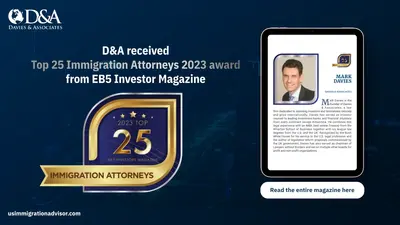
| Recognition | Named a Top 25 EB-5 Immigration Attorney by EB5 Investors Magazine (2018–2023) |
| Professional Engagements | Lecturer/trainer for other lawyers at AILA, ACA, University of Pennsylvania Law School | Frequent speaker at global investment immigration conferences |
How to Open a Business in the United States in 2026
Frequently Asked Questions About Opening a Business in the United StatesOptions for Indian Entrepreneurs and Business OwnersEB-5 DirectE-2 Visa GuideL-1 Visa Guide
Key Takeaways
- Forming a U.S. company is often simple; maintaining proper compliance is where most founders run into issues
- Each state has different procedures and requirements
- The lowest cost state involves more than just state income tax
- Delaware is frequently not the best state for many businesses
- Entity choice, state selection, and governance decisions have long-term consequences
- Standard "one-size-fits-all" forms can cause serious issues, especially if the business supports a visa application
- Well-drafted employment and contractor agreements are essential from day one
Table of Contents
- ► How Long Does it Take to Form a Business?
- ► Step 1: Choose the Right US Entity
- ► Step 2: Choose the Right State
- ► Step 3: Choose the Business Name
- ► Step 4: Form the Company and Appoint a Registered Agent
- ► Step 5: Get an EIN, Even Without an SSN
- ► Step 6: VIBE Registration (Immigration Purposes)
- ► Step 7: Banking and Payments Setup
- ► Step 8: Core Documents You Should Have From Day One
- ► Step 9: Compliance You Cannot Ignore
- ► If Your US Company Is Connected to a Visa Plan
- ► Our Entity Formation and Start Up Services
- ► Frequently Asked Questions
How Long Does it Take to Form a Business in the United States?
This varies from state to state and can be as fast as a few hours.
Davies and Associates advises founders and international companies on US entity formation, governance documents, contracts, and the ongoing compliance needed to operate confidently in the US market.
Davies and Associates advises founders and international companies on US entity formation, governance documents, contracts, and the ongoing compliance needed to operate confidently in the US market.
Quick overview of the formation path
- Choose the right entity type
- Choose the best state for your facts
- Form the company and appoint a registered agent
- Get an EIN
- Set up banking and payments
- Put governance and contracts in place
- Plan tax and compliance from day one
Step 1: Choose the right US entity
| ENTITY TYPE | LIABILITY PROTECTION | TAXATION STRUCTURE | IMMIGRATION APPLICABILITY |
|---|---|---|---|
| Sole Proprietorship | None. No legal distinction between owner and business. | Pass-through; taxed at individual rates. | Highly Discouraged. Signals "self-employment" rather than a real enterprise. Fails to provide the clear entity structure required for L-1 transfers. |
| Limited Liability Company (LLC) | High. Protects personal assets from business debts. | Flexible; pass-through or corporate election. | Excellent. Highly popular for E-2, New Office L-1 and EB-2 NIW due to flexibility. Allows for unlimited non-US citizen owners. |
| C-Corporation | Highest. Complete legal separation of assets. | Double taxation (corporate and dividend levels). | Often Used for L-1. Preferred for multinational transfers and venture-backed startups. |
| S-Corporation | High. Same protection as a C-Corp. | Pass-through; avoids double taxation. | Restricted. Non-resident aliens cannot be shareholders in S-Corporations. This may disqualify it for non-resident E-2 or L-1 investors. |
| Partnership (LP/LLP) | Variable. Varies based on partner type. | Pass-through to personal tax returns. | Risky. Can complicate the "at least 50% ownership" requirement for E-2 visas if not structured carefully with treaty-national partners. |
Most international founders choose one of these:
Limited Liability Company (LLC)Often preferred for flexibility and simpler formalities, especially for closely held businesses.
C corporation
Often used for venture-backed startups, equity compensation, and certain investor or exit structures.
We help you choose a structure that aligns with your operations, ownership, tax profile, and immigration goals.
Step 2: Choose the right state
- Where your business will operate
- Where your employees will be located
- Taxation considerations
- Requirements of any investors
- State and local licenses and regulations
- The cost of operations in different locations
- Proximity to customers and other business considerations
Common Mistake in Selecting a State
A common mistake is to elect a state with a low state income tax. This can be a mistake because:- If a business has operations or sales in a state, it will be required to file local taxes and will not easily be able to evade those responsibilities by incorporating in another state.
- Other costs, such as ad valorem property taxes and operating costs, may make a state with a low income tax rate less desirable.
Incorporation Example 1 - Local Regulations
Our Singaporean client wanted to establish an investment fund in the State of New York. Under New York State law, the client would be required to obtain expensive licenses.New Jersey did not have the same licensure requirements.
By locating the business just 10 minutes away in the State of New Jersey, the client was able to avoid complex licensing requirements.
Example 2 - Taxation
Our client intended to have all operations in the State of California to serve its clients, who were all located in California.The client had incorrectly read on the internet that incorporating in Nevada could enable them to lawfully avoid California taxes.
This is false. Our tax team explained that it is not possible to completely avoid California State income tax and other obligations where customers and the business operations are located in California simply by incorporating in Nevada or any other state.
The client incorporated in California and avoided the administrative burden of registering in two states.
| State | Corporate Income Tax (2026) | Franchise Tax | Personal Income Tax | Privacy Rank | Best For |
|---|---|---|---|---|---|
| Delaware | 8.7% (only if operating in DE) | $300+ annual fee | None for non-residents | ⭐⭐⭐ | VC-backed startups & IPO paths. |
| Wyoming | 0% | None | None | ⭐⭐⭐⭐⭐ | Lean E-2 startups & privacy. |
| Nevada | 0% | None (Commerce Tax only if >$4M rev) | None | ⭐⭐⭐⭐⭐ | Cash-strapped profitable firms. |
| Texas | 0% | 0.375% - 0.75% of revenue (approx) | None | ⭐⭐ | Logistics, Energy, & High-Growth tech. |
Common patterns:
- Delaware for venture-backed startups and standardized corporate governance
- Wyoming or similar low-overhead states for certain owner-managed businesses
- Your operating state when you will have offices, employees, or significant activity there
Step 3: Choose the Business Name
Choose a name.There are restrictions on names. The most significant one can be that the business name is not too similar to one already in use.
Go to the website for the relevant Secretary of State and search the business records to check if your chosen name is available in that State.
For example, in Delaware you can go to the Department of State: Division of Corporations search form. Enter the name you propose to use to see if it is already in use.
Note: In L-1 visa cases the name of the U.S. business can be but does not have to be similar to the name of your foreign business.
Reserve the Name
In many States you can make a "name reservation”. If you are not ready to form the business but want to reserve a name so only you can use it then a name reservation can be very helpful
Tip: Every State has a different registry of business names. That means that unless you take applicable steps an existing business name registered in State A can be freely used by another party in State B.
Step 4: Form the company and appoint a registered agent
Most states require a registered agent with a physical address in the state of formation to receive legal and government notices. We coordinate registered agent setup and file the formation documents correctly the first time.Step 5: Get an EIN, even without an SSN
An Employer Identification Number is the federal tax ID used to open bank accounts, hire workers, and file US tax forms. Foreign founders often cannot apply online and may need to use alternate IRS submission methods. We guide the EIN process and make sure the company record is consistent across agencies.How to Apply for an EIN (Employer Identification Number)
IRS Form SS-4Applications for an EIN are made using IRS Form SS-4.
Before you start, make sure you have:
- Your legal business name
- Your entity type (LLC, C-Corp, Partnership, etc.)
- Your state of incorporation (Delaware, NY, CA, etc.)
- The Responsible Party (a real human who controls the business)
- The business start date
- A U.S. or foreign address
Option 1: Online (Fastest – Same Day)
Best if the responsible party has an SSN or ITINWho can use this:
- U.S. citizens
- Green card holders
- Many visa holders
- Foreign founders with an ITIN
- Go to the IRS EIN Online Application
- Select your entity type
- Enter business details
- Enter the responsible party’s SSN or ITIN
- Submit
- EIN issued immediately
- Download the confirmation letter (CP 575)
- One EIN per responsible party per day
- The application only works during U.S. business hours
Option 2: By Fax (Best for Foreign Founders Without SSN)
Most common method for non-U.S. foundersWho should use this:
- Foreign founders
- No SSN
- No ITIN
- Outside the U.S.
- IRS Form SS-4
- Completed correctly (see details below)
- Fill out Form SS-4
- Write "Foreign" in the SSN/ITIN field
- Fax it to the IRS international fax number
- Usually 4–10 business days
- EIN returned by fax
- This is the most reliable method for non-U.S. founders.
Option 3: By Mail (Slow, but works)
Who should use this:- Anyone who can wait
- Backup option if faxing is not possible
- 4–6 weeks (sometimes longer)
- Mail Form SS-4 to the IRS international address.
Option 4: By Phone (Foreign Applicants Only)
Yes, this is real — and very IRS.Who can use this:
- Foreign founders
- No SSN or ITIN
- Call the IRS international EIN line
- Answer questions live
- EIN issued verbally
- Written confirmation mailed later
- Long hold times
- Must be available during U.S. hours
- Easy to mess up if you are unprepared
- Most founders prefer fax over the phone.
How to Fill Out Form SS-4 (Key Lines)
These are the lines people typically mess up:- Line 1: Legal name of the entity (must match incorporation documents)
- Line 2: Trade name (optional)
- Line 7a: Responsible party name (you)
- Line 7b: SSN/ITIN → write "Foreign" if you don’t have one
- Line 8a: Is this an LLC? → Yes/No
- Line 9a: Entity type (LLC, Corporation, etc.)
- Line 10: Reason for applying → "Started a new business"
- Line 18: Check "Yes" if this is a newly formed entity
Common Founder Scenarios
Foreign founder, Delaware C-Corp, living abroad
- No SSN
- No ITIN
- Apply by fax
- EIN approved without issue
Foreign founder, U.S. LLC (pass-through)
- EIN required
- ITIN may be required later for tax filing
- EIN still issued without an ITIN
L-1 / E-2 / O-1 founder in the U.S.
- Likely has an SSN
- Apply online
- EIN issued same day
After You Get the EIN
You’ll use it for:- Opening a U.S. business bank account
- Stripe, payments, and payroll
- Issuing invoices and tax forms
- Federal and state tax filings
Important Warnings (Please read)
- EIN ≠ work authorization
- EIN ≠ immigration status
- EIN ≠ permission to live in the U.S.
Step 6: VIBE Registration (Immigration Purposes)
USCIS verifies the legitimacy of a business in part by confirming it appears in VIBE (Validation Instrument for Business Enterprises). If you intend to use the business to support a visa application, it is important to ensure it is properly listed.Our firm can verify your VIBE status and ensure your business is listed in the databases USCIS uses.
Read our VIBE guide. Written by: Mark I. Davies, Esq., MBA (Wharton School), Fellow University of Pennsylvania Carey Law School. Ga. Bar License #: 250186, AILA Member, SRA ID: #384468.
Step 7: Banking and payments setup
Many founders form a US company primarily to access US banking and payment processors. In practice, account opening requirements vary by bank and by founder profile, and some providers may require additional identity and documentation.We help you prepare a bank-ready package, formation documents, EIN confirmation, ownership records, and supporting governance materials so you can move faster.
Step 8: Core documents you should have from day one
We draft and tailor the documents that protect founders, prevent disputes, and support future fundraising.Typical documents include:
- Operating agreement or bylaws and shareholder agreements
- Board resolutions and equity issuance documentation
- Founder vesting and IP assignment
- Employment and contractor agreements
- Form I-9s
- Customer and supplier contracts
- Lease review and commercial terms
- Cross-border contracting and dispute provisions
Step 9: Compliance you cannot ignore
Various Reporting and Compliance Requirements
US companies have ongoing compliance obligations that vary by state and by tax classification. We help you build a simple compliance calendar.One important reporting requirement involves
Beneficial Ownership Reporting
US beneficial ownership reporting rules involve reporting certain information on foreign-owned businesses to the U.S. Financial Crimes Enforcement Network (FinCEN).These rules have changed through regulation and litigation in 2025. Treasury and FinCEN have published an interim final rule narrowing reporting to certain foreign reporting companies, with agency guidance on deadlines for those entities.
We confirm what applies to your company based on your facts and the latest agency guidance. See US Financial Crimes Enforcement Network Notice.
If your US company is connected to a visa plan
Entity structuring is often part of an immigration strategy, especially for:- L-1 new office and related US expansion planning
- E-2 treaty investor planning
- EB-1C multinational manager planning
- EB-5 Direct businesses
Our entity formation and start up services
Depending on your needs, we can support:- Entity and tax structure planning
- Formation filings at state and federal levels
- Licenses and operational registrations
- Trademark strategy and filings
- Contract drafting and review
- Employment documentation
- Business purchase support, valuations, and deal negotiation
Speak with a business and immigration attorney
If you tell us where you live, where you will operate, your ownership structure, and whether a visa is involved, we can recommend the most efficient formation plan and next steps.Frequently Asked Questions
Can a non-U.S. resident form a U.S. company?
Yes. U.S. states generally allow non-residents and non-citizens to form corporations and LLCs, subject to the formation statute and registered agent rules. Delaware, included here purely as an example, corporation filing requirements are in 8 Del. C. § 102 and Delaware LLC formation is in 6 Del. C. § 18-201.Do I need a Social Security Number to form a U.S. company?
No. A Social Security Number is not required for a business formation, but a taxpayer identification number (TIN) can be useful. A TIN is issued for federal tax administration purposes, see 26 CFR § 301.6109-1.Can I get an EIN if I do not have a Social Security Number?
Often yes, but you must correctly identify the responsible party and avoid "nominee" filings. IRS guidance on responsible parties and nominees is here and the related IRS instructions for Form SS-4 are here.What is the difference between forming the entity and running it properly?
Formation is just the public filing. Governance and ownership terms usually live in private documents such as bylaws, shareholder agreements, operating agreements, consents, and equity records, and state statutes supply default rules when documents are silent. Delaware corporate formation content requirements are in 8 Del. C. § 102 and Delaware LLC formation is in 6 Del. C. § 18-201.Can I use an online incorporation service?
Sometimes, for very simple situations. But "standard forms" can miss ownership, control, IP assignment, and employment terms that matter operationally and, in some cases, cause immigration issues and visa denials.IRS warns that nominees, including incorporation services, should not apply for an EIN or be listed as the responsible party. EIN identifying number rules are in 26 CFR § 301.6109-1
Sadly, L-1 and E-2 applicants relying on generic governance packets have sometimes faced denials where the record does not support the required legal elements under the INA and implementing regulations. See INA definitions at 8 U.S.C. § 1101 ; treaty investor regulations at 22 CFR § 41.51 ; E visa guidance at 9 FAM 402.9 ; L visa guidance at 9 FAM 402.12 ; USCIS L policy guidance ; E policy guidance ; and L regulations at 8 CFR § 214.2.
Does forming a U.S. company give me the right to live or work in the U.S.?
No. Company formation does not create immigration status or work authorization. Nonimmigrant admission is governed by the INA and regulations, including 8 U.S.C. § 1184.Do I need a U.S. bank account?
Most operating U.S. businesses do. Banking is not governed by one single formation statute, but banks commonly require consistent entity records, EIN issuance, and clear beneficial ownership and authority documentation, and mismatches between filings and internal documents create delays.What employment documents do I need early?
At minimum, clear offer letters or employment agreements, contractor agreements, confidentiality and invention assignment terms, and a compliant I-9 process when hiring in the U.S. Employment eligibility verification requirements are in 8 CFR § 274a.2 and the underlying statutory obligation is INA § 274A, codified at 8 U.S.C. § 1324a.What ongoing compliance should I expect?
Common items include state annual reports, tax filings, maintaining good standing, and maintaining accurate internal governance and equity records. Requirements vary by state and by the entity's activities, so a "set it and forget it" formation package is rarely sufficient.About the Authors
Mark I Davies, Esq.
Chairman of Davies & Associates; focused on business formation, immigration strategy, and complex corporate structuring.Note: Delaware as an Example
While Delaware is often the wrong choice for incorporation, Delaware law provides a good example of the laws and provisions in various States. We therefore cite to Delaware law purely as an example which may not be applicable to the laws in your State.Why make Davies & Associates Your Related Immigration Resources Lawyers
Business formation is often part of an immigration strategy. Explore these visa options:
Awards
Contact Davies & Associates Offices in United States
Check all of our locations around the world.
Company location
New York Office World Trade Center
1 World Trade Center, Suite 8500, New York, NY 10007
Map and Driving Directions
New York Office E69th Street
200 E 69th Street, 2N, New York, NY 10022
Map and Driving Directions
California Office
555 Anton Blvd, Suite 150, Costa Mesa, CA 92626
Map and Driving Directions
Philadelphia Office
1500 John F Kennedy Blvd, Suite 450, PMB 41, Philadelphia, PA 19102
Map and Driving Directions
Los Angeles Office
601 South Figueroa Street, Suite 4050, Los Angeles, CA 90017
Map and Driving Directions
Chicago Office
155 N. Upper Wacker Dr., Suite 4250, Chicago, IL 60606
Map and Driving Directions
Miami Office
80 S.W. 8th St., Suite 2000, Miami, FL 33130
Map and Driving Directions
Atlanta Office
1075 Peachtree Street NE, Suite 3650, Atlanta, GA 30309
Map and Driving Directions
Telephone number
New York Office World Trade Center
+1 212 537 9196
Fax: +1 949 396 1371
New York Office E69th Street
+1 212 537 9196
Fax: +1 949 396 1371
California Office
+1 949 620 1811
Fax: +1 949 396 1371
Philadelphia Office
+1 215 525 1881
Fax: +1 949 396 1371
Chicago Office
+1 312 261 8560
Fax: +1 949 396 1371
Miami Office
+1 305 423 7163
Fax: +1 949 396 1371
Contact us by email


Looking to acquire an US Visa?
We are known for our creative solutions that obtain "impossible" visas. We solve the most complex immigration problems for businesses, investors, individuals, and families.
US Visa Immigration lawyer near meSeveral lawyers told me I would not be able to get a TN visa. Two weeks after contacting Davies & Associates I was working in New York, visa in hand.
Individual seeking 'Impossible' TN VisaD&A was very detail-oriented and very thorough in what they did. They worked on my case 24/7 and were very patient in answering all my questions.
E-2 Visa ClientMy case felt complex but D&A managed the whole process carefully and helped me move seamlessly from one stage to the next.
E2 + CBI ClientD&A was my guiding light through the entire EB-5 process.
EB-5 Visa ClientI would definitely be a big advocate for the rest of my life for anyone wanting to explore the Grenada Citizenship by Investment Programme leading to the E-2 visa. The most important thing is a good team behind you. With Davies & Associates, you're in safe hands... you need someone who can support you on the ground and, again, you are well taken care of by D&A. The people are really warm, very helpful and quite open-minded when it comes to business... Not to mention as a passport it's great from a travel perspective... It's just 4 to 5 hours from New York.
Grenada CBI + E2 Visa ClientThe entire process of getting an EB-5 visa is handled in a professional way by Mark Davies and his team. EB-5 is a wonderful option for anyone considering moving to the United States if you have the means. I was hoping to use the H-1B route for my children, but it became unreliable and so I looked to the EB-5 visa instead. It is great for anyone who has the resources. Mark gives you the first meetings himself which gives you great comfort. Both Mark and Sanjay are abundantly available and I even had the pleasure of hosting them at my house.
Parent of 2 EB-5 visa holdersI'm in the process of extending my L-1 visa. I submitted a few questions regarding my case, and he contacted me back almost immediately, both by email and telephone. Unlike other attorneys I met before, he gave me the impression of knowing off the top of his head what kind of visa I have, and what actions had to be taken to extend it. He is very thorough and clear regarding the process and what to expect in terms of timelines and issues that may arise. He is constantly in contact, so you definitely know he's working on your case.
L-1B Visa HolderMark Davies is a joy to work with. His extensive knowledge, speedy response and attentive service took away all my fears of dealing with immigration and visa applications. He is very generous with his time in explaining every step along the way and I have already and will in the future recommend him to anybody who is looking for an immigration lawyer.
E2 Visa for Small Professional Business With International OfficesDavies & Associates assisted us with an immigration emergency involving my brother's fiancée who was outside the United States. They assisted us in a highly professional manner, working with the relevant US embassy, US immigration and the governments of two other countries. As a result of their efforts the individual involved is now working in the United States. While their knowledge of the law is exemplary what really distinguishes this firm and attorney Davies from any other firm we have worked with is their dedication to customer service and their unrivaled level of professionalism.
Complex Fiancée Visa Need Involving Multiple International JurisdictionsSeveral lawyers told me I would not be able to get a TN visa. Two weeks after contacting Davies & Associates I was working in New York, visa in hand. I have recommended this firm to several friends and colleagues, they do an excellent job every time.
Individual Seeking 'Impossible' TN VisaI was qualified as a physician in a foreign country. Being on a J1 visa I was facing having to leave the United States and return to my home country. Davies & Associates secured one of only 30 J1 visa waivers available in my State, allowing me to work for a US hospital and remain in the United States.
Doctor Seeking J1 Visa WaiverI am very satisfied with the services Mark Davies has provided me. He has a very extensive knowledge in immigration laws and has a thorough approach to any case.
U Visa Applicant, A Victim of CrimeLooking to relocate or having trouble with a visa application?
We are known for our creative solutions that obtain "impossible" visas. We solve the most complex immigration problems for business, investors, individuals and families.
Request Free Consultation
New York Office World Trade Center:
1 World Trade Center, Suite 8500, New York, NY 10007
+1 212 537 9196
Map and Driving Directions
New York Office E69th Street:
200 E 69th Street, 2N, New York, NY 10022
+1 212 537 9196
Map and Driving Directions
California Office:
555 Anton Blvd, Suite 150, Costa Mesa, CA 92626
+1 949 620 1811
Map and Driving Directions
Philadelphia Office:
1500 John F Kennedy Blvd, Suite 450, PMB 41, Philadelphia, PA 19102
+1 215 525 1881
Map and Driving Directions
London Office:
69 Old Broad Street, Dashwood House, London EC2M 1QS, United Kingdom
+44 20 3884 1812
Map and Driving Directions
London Office Beaufort Court:
Beaufort Court, Admiral Way, London E14 9XL, United Kingdom
+44 20 3884 1812
Map and Driving Directions
Edinburgh Office:
28 Rutland Square, Edinburgh, Scotland, EH1 2BW
+44 131 392 0686
Map and Driving Directions
Milton Keynes Office:
The Pinnacle, 170 Midsummer Blvd, Milton Keynes MK9 1FE, United Kingdom
+44 7740 000769
Map and Driving Directions
Glasgow Office:
+44 131 392 0686
Map and Driving Directions
Vietnam Office:
46th Floor, Bitexco Financial Tower, 2 Hai Trieu, Ben Nghe Ward, District 1, Ho Chi Minh City, Vietnam
+84 28 6287 5912
Map and Driving Directions
India Office:
Enam Sambhav C-20, G Block, Bandra-Kurla Complex, Mumbai 400051, Maharashtra
+91 720 856 4057
Map and Driving Directions
Italy Office:
Via Bonifacio Lupi 29, 50129 Firenze FI, Italy
+39 055 076 3054
Map and Driving Directions
Manila Office:
Unit 107, AIC Burgundy Empire Tower, ADB Ave. cor Garnet and Sapphire Streets, Ortigas Center, Pasig City 1605, Metro Manila, Philippines
+63 2 7215 7878
Map and Driving Directions
Sydney Office:
Level 12, 210 George Street, Sydney NSW 2000, Australia
+61 2 9156 1032
Map and Driving Directions
Perth Office:
Davies & Associates LLC, Level 1, 12 St Georges Terrace, Perth WA 6000, Australia
+61 2 9156 1032
Map and Driving Directions
Singapore Office:
160 Robinson Road, #14-04, Singapore Business Federation Centre, Singapore 068914
65 8012 9546
Map and Driving Directions
Looking for an Immigration attorney?
Immigration lawyer near meList of US Embassies, Consulates and USCIS
List of Italian Embassies, Consulates and USCIS
Copyright ©2026 by Davies & Associates LLC.