2026 Guide to Selecting an EB-5 Visa Attorney:
Invest Your Way to a U.S. Green Card

Last Updated: March 2026 (Includes USCIS new EB-5 Inventory Management model effective March 2, 2026)
Written by: Mark I. Davies, Esq., MBA (Wharton School), Fellow University of Pennsylvania Carey Law School. Ga. Bar License #: 250186, AILA Member, SRA ID: #384468.
Reviewed by: Richard Latta, Esq., Ga. Bar License #: 291546, AILA Member

EB-5 VisaEB-5 DirectEB-5 RequirementsEB-5 ProcessEB-5 Visa Processing TimeEB-5 Visa CostEB-5 Visa GuideEB-5 Direct vs Regional Center

The 10 Questions Every EB-5 Investor Should Ask

Investors should evaluate an EB-5 attorney based on ten key factors:

  1. How many EB-5 investor petitions (direct or regional center, as applicable) have you handled? How many approvals, RFEs, NOIDs, and denials?
  2. How much experience do you have documenting complex lawful source and path of funds?
  3. Have you, your firm, or any affiliated person ever received compensation from a regional center, issuer, promoter, broker, or project developer connected to an EB-5 investment?
  4. Do you represent only the investor, or do you also represent the regional center, project sponsor, issuer, or other parties in the same offering?
  5. What experience do you have with cross-border transfer rules, currency controls, and documenting lawful movement of funds from my country?
  6. How do you coordinate with securities counsel, corporate or financial structuring counsel, and international tax advisors?
  7. What is your process if the project is delayed, materially changed, terminated, or becomes noncompliant after I file?
  8. What post-filing monitoring do you perform on the project and regional center, and how will you update investors if there is a material development?
  9. What specific risks should I understand about this investment, this offering structure, and my immigration case before I invest?
  10. What services are included in your representation, what is excluded, and who is responsible for issues that arise through I-829 and beyond?

Executive Summary: The Right EB-5 Lawyer

Choosing the right EB-5 visa lawyer is one of the most important decisions an investor will make when applying for a U.S. green card through investment. The EB-5 program involves complex immigration rules, strict source-of-funds documentation, and large capital investments. A qualified EB-5 immigration attorney can help protect both your immigration outcome and your investment.

Biggest Mistake in Hiring an EB-5 Lawyer

The biggest mistake in hiring an EB-5 lawyer is to assume that all EB-5 lawyers offer identical services and to choose a lawyer based on price alone.

What is an EB-5 Lawyer?

An EB-5 lawyer is an immigration lawyer who specializes in EB-5 cases. EB-5 law is complex, and many EB-5 lawyers restrict their practice to EB-5 matters only.

What Type of EB-5 Lawyer Do You Want?

EB-5 lawyers have different experiences and offer different client experiences. Think carefully about what you need:

1. Filing Form I-526E or I-526?

This is the most essential function of an EB-5 lawyer. Filing an I-526E (Regional Center) EB-5 case or an I-526 (“stand‑alone” or “Direct”) EB-5 case requires very different experience.
Are you filing through a regional center or a direct (stand‑alone) case?

📖 Read Our Guide to

Completing Form I-526 or I-526E →

2. Source‑of‑Funds Documentation

Source‑of‑funds documentation involves more forensic‑accounting work. For that reason, some clients use accountants to create source‑of‑funds documentation.
Advantages of using a lawyer:
  • EB-5 law firms are experienced in preparing source‑of‑funds documentation in the format USCIS expects. This can avoid delays and RFEs.
  • If your EB-5 lawyer prepares your source‑of‑funds documentation, you are asking them to take full professional responsibility for that documentation.
Disadvantages of using a lawyer:
  • A lawyer may charge more than a local accountant.
  • A lawyer unfamiliar with documenting sources of funds from the relevant jurisdiction may struggle to address specific local issues. For example, cases involving funds from GCC countries may lack normal income tax documentation; a lawyer experienced with GCC cases will know how to document it appropriately.

3. Pathway‑of‑Funds Documentation

Tip: Pathway of Funds

Ask your lawyer for a professional opinion that your funds were lawfully transmitted in compliance with applicable local laws. This accomplishes three goals:

  • ✅ An opinion letter indicates that your lawyer is taking professional responsibility for the pathway of funds.
  • ✅ An opinion letter may provide some protection if you are later audited concerning the transfer of your funds.
  • ✅ An opinion letter included in your filing may prevent consular delays.
This is extremely important, as it has been the cause of RFEs, NOIDs, and denials.
This involves confirming that the pathway used to transfer the funds is lawful. This becomes controversial among lawyers as it can involve the examination of non-U.S. law, especially in countries with currency transfer restrictions.
Major countries involved: India, Vietnam, China, Bangladesh, Morocco, and South Africa.
Advantages of using a lawyer:
  • A lawyer familiar with filings from the applicable country will be experienced in documenting them to USCIS and consular standards.
  • Some firms also have lawyers qualified in relevant foreign jurisdictions, which can be particularly helpful where local transfer restrictions must be understood and documented. For example, Davies & Associates has lawyers familiar with Indian and Vietnamese transfer regimes.
Disadvantages of using a lawyer:
  • Most EB-5 lawyers, but not all, are licensed only in the U.S. and therefore cannot give opinions on foreign law.

4. Project Due Diligence and Deal Structure Lawyer

This is a significant area of variation.

EB-5 compliance (EB-5 immigration lawyer)

An EB-5 lawyer will typically review your project to ensure that it meets the requirements of the EB-5 law. This is one of the reasons you rely on EB-5 counsel.
The reality is that most projects offered by major Regional Centers will be EB-5 compliant. What varies is the security of your capital.

Safeguarding your capital (deal‑structure lawyer vs. financial advisor)

A common misunderstanding is that the security of your capital is purely a financial issue. This is false. There are two issues:
  1. A project that is structured so it protects investor capital in the event something goes wrong; and
  2. Financial issues.
A deal structure lawyer focuses on the transaction mechanics and capital stack. Typical issues:
  • Senior debt vs EB-5 position
  • Mezzanine layers
  • Intercreditor agreements
  • Collateral and security packages
  • Waterfall structures
  • Lender covenants
  • Guarantees
  • Remedies on default
  • Cash flow control
  • Reserve mechanics
The job of a deal‑structure lawyer is to determine how the investment operates legally when problems occur, and how well investor capital is protected.

5. Relevant Consular Experience (Consular Processing Cases)

Different U.S. consulates have different procedures and can ask different questions at interview. If you are using consular processing for your case it makes sense to use a lawyer who has recent experience with the relevant consulate.

6. Experience with Troubled Projects

While no EB-5 investor expects a project to “go wrong,” there are no guarantees. Having a lawyer experienced with what to do if things go wrong can be critical.
There are two aspects if a project “goes wrong”:

Taking steps to protect your EB-5 immigration benefit; and
Taking steps to protect your capital.
While an EB-5 lawyer with immigration experience is best positioned to assist with your immigration position, a structured finance lawyer with workouts experience may be best positioned to assist you in protecting your capital.

Basic Due Diligence on Your Lawyer

  1. Check the lawyer's disciplinary record with the state(s) where the lawyer is licensed (note Avvo will do this for you).
  2. Check with the law school where your lawyer claims to have graduated from.
  3. AILA membership is not indicative of a lawyer's quality but it does show a commitment to immigration law.
  4. Ask for press articles. Well-known EB-5 lawyers all have multiple mentions in major media. Examples of meaningful third-party coverage include citations in The Wall Street Journal, Economic Times, Times of India, Business Standard, and Indian Express.

Why the Project's Deal Structure Lawyers Do Not Represent You

Many EB-5 projects are structured by experienced real estate finance and securities lawyers. These lawyers draft the legal architecture of the investment, including loan agreements, security packages, and investor rights. For this reason many immigration lawyers and Regional Centers will tell you to “trust” the Regional Center's due diligence.

Who Project Deal Lawyers Represent

These lawyers represent the project sponsor or the regional center — not EB-5 investors.
Even when the documents appear carefully drafted, the lawyers preparing them have a professional duty to protect the interests of their client, which is usually:
  • the project developer
  • the regional center
  • the New Commercial Enterprise (NCE)
They do not represent the individual EB-5 investor. This raises two points:

(1) Purpose of Structure

Because of this, investors should assume that the deal structure is designed primarily to facilitate the project's financing rather than to maximize investor protections.
This does not mean the project is unsafe or improperly structured. It simply means that the investor's interests may not have been the primary focus when the structure was created.

(2) Reliance on Work Product

As EB-5 investors are not the client of lawyers retained by the Regional Center, EB-5 investors are not entitled to rely on their work-product. In the event of an error or omission EB-5 investors would likely have no recourse against these lawyers.

Potential Conflicts of Interest

A common misunderstanding among EB-5 investors is to assume that because the offering documents were prepared by a large law firm, the investment must be safe.
In reality, the project's lawyers are responsible for ensuring that:
  • the offering complies with securities laws
  • the documentation accurately discloses risks
  • the financing structure is legally valid
Their role is not to evaluate whether the investment is attractive for the investor, nor to negotiate stronger investor protections.
This creates a natural conflict of interest:
The same legal structure that protects the project developer may increase the risk borne by EB-5 investors.
For example, the structure may place EB-5 investors:
  • behind senior lenders in the capital stack
  • in a subordinated position in repayment priority
  • with limited voting or enforcement rights
These arrangements may be commercially reasonable for the project but still expose investors to significant risk.
For this reason, many experienced EB-5 investors choose to obtain independent legal review of the deal structure.

How Investors Can Perform Their Own Deal Structure Due Diligence

Investors do not need to become experts in real estate finance in order to evaluate a project. However, they should understand several key structural issues before investing.
Below are some legal questions investors should consider when reviewing an EB-5 offering.

1. Where Does EB-5 Capital Sit in the Capital Stack?

Ask:
  • Is EB-5 capital senior debt, mezzanine debt, or equity?
  • Are there lenders who must be repaid before EB-5 investors?
  • If a senior lender borrows more money will it come in front or behind EB-5 investors?
If EB-5 capital sits behind multiple layers of senior debt, investor risk may increase significantly.

2. What Security Protects the EB-5 Loan?

Determine whether EB-5 investors have:
  • a mortgage on the project property
  • a pledge of project ownership interests
  • no collateral at all
Collateral may improve recovery prospects if a project fails.

3. Are There Personal Guarantees?

Some projects provide guarantees from the developer or sponsor.
Investors should ask:
  • who provides the guarantee
  • what assets support it
  • whether the guarantee is enforceable
Not all guarantees provide meaningful protection.

4. Who Controls the Funds?

Investors should understand:
  • whether funds are held in escrow
  • when escrow is released
  • who administers the accounts
Strong escrow protections can reduce certain risks during the investment process.

5. What Happens if the Project Encounters Problems?

Investors should review whether the structure includes:
  • reserve accounts
  • rights to replace the manager
  • enforcement rights if the developer defaults
The real test of a deal structure is how it performs when things go wrong.

Independent Legal Review

Because the project's lawyers represent the sponsor, investors may wish to seek independent legal advice regarding the deal structure.
A lawyer experienced in real estate finance or structured investment transactions can help investors understand how the legal provisions of the offering may affect the security of their capital.
This type of review focuses on the legal architecture of the investment, rather than the financial projections of the project.
Financial analysis of the project's viability should typically be conducted by an independent financial advisor or investment professional.


The Right Lawyer: What Are the Two Types of EB-5 Visa?

There are two types of EB-5: (a) EB-5 through a Regional Center; and (b) Direct EB-5 where the investment is not made through a Regional Center.

Regional Centers are private companies licensed by the U.S. government to operate a Regional Center. Regional Centers find projects suitable for EB-5 investment purposes. Despite positive changes in 2023, Regional Centers remain largely unregulated and are not subject to frequent government oversight and review.

D&A Warning

Direct (Stand-Alone) EB-5 cases require a different skill set. A lawyer who has only previously worked Regional Center EB-5 cases is unlikely to have the full set of experience needed to successfully prosecute a Direct (Stand-Alone) EB-5 case.

For a detailed comparison, see Direct EB-5 vs Regional Center EB-5.

Regional Center Recommendations and EB-5 Lawyers

Regional Center Recommendations and EB-5 Lawyers

Sometimes Regional Centers try to push clients towards specific lawyers:

  • ✅ Both the Regional Center and the client have a common interest in ensuring that a client's I-526E is properly filed. Many Regional Centers therefore ask that EB-5 lawyers evidence experience with filing I-526E Petitions.
  • ✅ Most Regional Centers know which EB-5 lawyers are reputed and competent.
  • ❌ Many Regional Centers will actively refer clients to lawyers who in turn refer that Regional Center clients.
  • ❌ Regional Centers want to “sell” you a participation in one of their projects. Lawyers who ask detailed legal questions about project quality are often seen as a “nuisance”. Some Regional Centers may attempt to guide clients away from lawyers known to ask difficult questions.
  • ❌ Regional Centers may try and push you to the law firm who prepared their project documentation. This is a conflict of interest. A lawyer who also represents the Regional Center is not free to find defects in the project and, if the need arises, take legal action against the Regional Center on your behalf.

Who Are the EB-5 Lawyers and Professionals Who Can Assist You?

Various professionals are available to assist you with your EB-5 journey:

EB-5 Lawyer

What They Do: For most clients, the EB-5 lawyer is the single most important advisor. An EB-5 lawyer will guide you through the entire process and help ensure you have the right team of advisors on board. An EB-5 lawyer will also review a project to ensure that it complies with the requirements of U.S. immigration law.

What They Do Not Do: An EB-5 lawyer is an immigration lawyer. They will not conduct due diligence on projects other than to ensure they meet the requirements of the immigration law.

Lending/Finance Lawyer

What They Do: A lending/finance lawyer will be able to review an EB-5 project to ensure that the project is properly structured to protect your legal rights as an investor. Where losses in EB-5 have occurred, it is usually because the project was not properly structured to protect your rights as an investor.

What They Do Not Do: Financial review of projects to ensure that the business plan and the financial forecasts are reasonable and make sense. No lawyer will perform financial stress tests on a project to test the limits of its durability.

Tax Lawyer

What They Do: A tax lawyer will help you plan for the taxation obligations that will fall on you as a U.S. Permanent Resident. EB-5 investors frequently structure their assets in contemplation of a U.S. move.

What They Do Not Do: Enable you to avoid paying taxes that you lawfully owe under U.S. laws.

Independent Investment Advisor

What They Do: A properly licensed and experienced independent financial advisor will be able to help you review your project from a financial perspective. Look for a Certified Financial Analyst (CFA) trained in a major financial institution.

Broker-Dealers

What They Do: Sell investments and earn a commission.

What They Do Not Do: Meaningful financial analysis of your project or any stress-testing.

How Can an EB-5 Visa Lawyer Help?

An EB-5 Visa lawyer is an immigration lawyer who specializes in EB-5 law and has a thorough knowledge of the EB-5 program. A number of EB-5 lawyers have extensive experience with the entire EB-5 process and will be able to guide you through each step.

EB-5 immigration attorneys assist you with the entire EB-5 process, including:

  1. Advising you as to the entire EB-5 process and identifying other professionals
  2. Documenting your source‑of‑funds
  3. Devising a plan for the lawful transfer of your funds
  4. Assisting you with immigration due diligence on a related immigration project
  5. Filing your application using Form I-526/I-526E
  6. Obtaining your Immigrant Visa and Conditional Permanent Residency in the United States (a “Green Card”) via adjustment of status (Form I-485) or consular processing
  7. Assisting you with a consular interview when needed
  8. Filing Form I-829 to convert your Conditional Green Card into a full/permanent “Green Card”
  9. For those who wish to obtain U.S. citizenship

D&A Alert

If your funds are being remitted from a country with currency transfer restrictions (such as India, Vietnam, China, Morocco, and Bangladesh), it is critical that you also document that the funds were remitted to the U.S. in a lawful manner.

Where relevant, select an EB-5 lawyer who is experienced with cases involving funds being remitted from restricted countries.

Why Do You Need a Competent EB-5 Visa Lawyer?

Foreign nationals who decide to relocate their family to the United States have made a significant decision involving the investment of a significant amount of money. EB-5 continues to see frequent rule changes and, as a common law country, EB-5 is subject to the interpretations of the courts. Meeting all the requirements of an EB-5 Visa as laid by the United States Citizenship and Immigration Services increases your chance of getting the visa and achieving a permanent residency status.

Moreover, obtaining an EB-5 Visa can be rigorous, long, and complex, and any mistake during your application can cost you not only money and time but also the risk of rejection. An experienced immigration lawyer can guide you throughout the process and increase your chances of getting approved. Further, these lawyers are familiar with NCE developers and can help you locate a reliable regional center sponsor.

Choosing an EB-5 Lawyer (“CORER”) and Questions to Ask

There are a lot of immigration lawyers who provide their services to foreign nationals who want to move to the U.S. However, with the complexity of the EB-5 Visa process, you must engage the services of a lawyer who has the experience and a strong track record.

Since you’ll be trusting your EB-5 immigration lawyer concerning your visa application, you should be careful in screening the lawyer you are going to work with.

Here are some questions you can ask the immigration lawyer so you can assess their services:

Competency

  • What awards have you received? Leading EB-5 lawyers are recognized by industry vote in the annual “Top 25” EB-5 lawyer survey.
  • Have you or your firm been quoted or featured in major publications discussing EB-5 or U.S. immigration issues? For example: The Wall Street Journal, Economic Times, Times of India, Business Standard, or Indian Express.
  • Have you ever been subject to any professional disciplinary proceeding or charge of any kind? In the United States, the record of every lawyer is available from the applicable State Bar. While the Avvo grading system may leave some room for improvement, Avvo does check that lawyers are properly licensed and their online record is clear.
  • Where did you go to law school?
  • How many years have you been practicing EB-5?
  • Describe your experience with complex structured real estate investments. EB-5 is a complex structured real estate investment. Your lawyer should not only be familiar with EB-5 but also with how real estate deals are structured and how to make sure your legal rights are properly protected.
  • Will you personally be handling all aspects of my case? Make sure that the lawyer you are speaking to will be handling your case and, if not, that you are comfortable with the person who will be handling your case.

Operations

  • How quickly will you respond to my questions?
  • Can I speak to you by phone as frequently as I wish to with no extra charges?
  • Will you monitor my project and act as needed to preserve my capital?
  • Will you monitor my project and take actions necessary to preserve my immigration benefits?
  • What do you charge for responding to a substantive RFE caused by USCIS error?

Experience

Ask the lawyer to answer certain questions:

  • Number of I-526 Petitions have you filed?
  • Number of I-829 Petitions have you filed?
  • Number of RFEs received on cases you have filed?
  • Number of NOIDs received on cases you have filed?
  • Have any of the EB-5 cases you have filed been denied? If so, please explain why.
  • Number of cases involving applicants from my country?
  • What experience do you have documenting funds from my country and documenting that those funds were lawfully transferred under foreign law (if relevant)?

References

  • Do you have any references from previous clients? A competent immigration lawyer will have a list of previous clients who have worked with them and who have provided testimonials on the lawyer’s capabilities.
  • Ask the lawyer to refer you to a couple of clients who are willing to talk to you about their experience. Ask for clients who have completed the entire EB-5 process and have had their I-829 applications approved.

Conflicts of Interest

Conflicts of interest are common in EB-5. Ask your lawyer if:

  1. Either they or their firm represent the Regional Center in this project. If so, you are asking the lawyer to perform due diligence on their own work product and potentially sue their own client.
  2. Which Regional Centers are clients of the firm.
  3. If there is any issue that might impair their independence.
  4. Will you confirm in writing that you represent only the investor.

EB-5 Attorney Red Flags 🚩

Avoid lawyers who:

  • Guarantee approval or returns
  • Push one, or any, regional center(s)
  • Refuse to explain fees clearly
  • Won’t share prior EB-5 case experience
  • Discourage you from independent review
  • Are vague about source-of-funds documentation
  • Are not experienced with cases involving remitting funds from any relevant country with restrictions on fund transfers (such as India, Vietnam, China, Morocco, and Bangladesh)

Investor Protection Checklist

Before you sign anything, make sure you can answer yes to each item.

Independence

  • My lawyer confirmed in writing they receive no compensation from the project side
  • My lawyer explained any prior relationship with the regional center or sponsor

Scope and Accountability

  • I have a written engagement letter that defines what is included and excluded
  • I know who writes the source-of-funds narrative and who signs off
  • I know who leads RFE responses and what happens if staff change

Fees and Surprises

  • I received a written fee breakdown including filing stages and future stages
  • I know whether RFEs are included or billed separately
  • I know what third-party costs I might pay, such as translations and accounting

Project and Structure Questions

  • I understand escrow terms, release triggers, and refund conditions
  • I understand who controls the funds and who administers them
  • I understand senior debt above EB-5 capital and how it affects risk
  • I understand job creation methodology at a high level and what happens if it falls short

Related EB-5 Resources

EB-5 Form Guides

About the Authors

Davies & Associates attorneys have been quoted or featured in publications including The Wall Street Journal, Economic Times, Times of India, Business Standard, and Indian Express on immigration and investor visa issues.

Mark I. Davies, Esq.

Chairman of Davies & Associates; focused on EB-5 investor visa strategy and complex immigration filings.

Mark I. Davies, Esq. JD, University of Pennsylvania Law School, Licensed with the SRA (SRA ID: 384468) in the UK, Member Law Society of England & Wales, MBA, Wharton School of Business. Top 10 Investment Visa Lawyer, Licensed (USA), Georgia State Bar. AILA Member.

Area Details
Education JD, University of Pennsylvania Carey Law School | MBA (Finance), The Wharton School, University of Pennsylvania | Chartered Accountant (ICAEW)
Financial Training Completed Analyst Training Program at a major international bank | Chartered Accountant background with professional training in financial analysis and reporting
Legal Practice Admitted to practice in Georgia (USA) | Registered Solicitor with the Law Society of England and Wales | Former CMBS lawyer at one of the world's largest international law firms
Immigration Track Record 15+ years advising HNW investors | Zero denials for clients advised on source-of-funds compliance in EB-5 | Hundreds of successful EB-5 cases globally
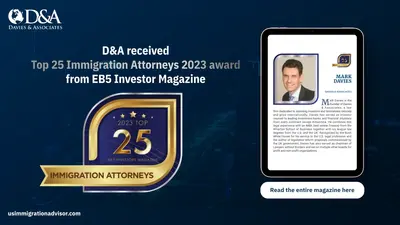
Recognition Named a Top 25 EB-5 Immigration Attorney by EB5 Investors Magazine (2018–2023)
Professional Engagements Lecturer/trainer for other lawyers at AILA, ACA, University of Pennsylvania Law School | Frequent speaker at global investment immigration conferences

FAQ: How to Choose the Right EB-5 Lawyer

How do I choose the right EB-5 lawyer?

Choose an EB-5 lawyer with direct EB-5 experience, strong source‑of‑funds knowledge, familiarity with regional center cases, and a clear record handling I-526E and I-829 petitions.

What does an EB-5 lawyer do?

An EB-5 lawyer prepares the investor's immigration filings, organizes source‑of‑funds evidence, responds to USCIS issues, and guides the case from petition filing through removal of conditions.

Why is choosing the right EB-5 attorney important?

Choosing the right EB-5 attorney is important because EB-5 cases involve both immigration compliance and a substantial investment, and mistakes can lead to delay or denial.

What should I ask an EB-5 lawyer before hiring them?

Ask about EB-5 case volume, source‑of‑funds experience, regional center experience, attorney involvement, fees, and whether the lawyer represents you, the project, or both.

What are red flags when hiring an EB-5 lawyer?

Red flags include guaranteed approvals, vague fees, weak EB-5 experience, poor source‑of‑funds knowledge, and unclear conflicts of interest.

Can one lawyer represent both the investor and the EB-5 project?

One lawyer can sometimes represent both, but investors should be cautious because dual representation may create conflicts of interest.

How important is source‑of‑funds experience?

Source‑of‑funds experience is critical because USCIS requires investors to prove that invested capital came from lawful sources and was transferred properly.

Should I hire an independent EB-5 lawyer?

Many investors benefit from hiring an independent EB-5 lawyer because independent counsel is often better positioned to focus solely on the investor's interests.

Awards

Top 25 Immigration Attorneys


Avvo Client Reviews Badge for Mark Ivan DaviesMark Ivan DaviesReviewsout of 24 reviews


Davies & Associates BBB Business Review logo

Top 25 EB-5 Immigration Attorneys 2023

Davies & Associates Trustpilot reviews badge


Request Free Consultation
Yes, I agree to receive occasional text messages (SMS)
 
Confidential. No obligation. We do not sell your information.

Looking to acquire an ?

We are known for our creative solutions that obtain "impossible" visas. We solve the most complex immigration problems for businesses, investors, individuals, and families.

Immigration lawyer near me

Looking to relocate or having trouble with a visa application?

We are known for our creative solutions that obtain "impossible" visas. We solve the most complex immigration problems for business, investors, individuals and families.

Request Free Consultation