
L-1 New Office Visa: Establishing Your US Startup in 2026
L-1 Visa OverviewBusiness PlanUS Business Set-UpL-1 Visa BlogL-1 Visa Costs and L-1 Visa FeesL-1 Visa RenewalL-1 Visa Change of EmployerL-1 Visa RequirementsL-1 Visa Documents RequiredL-1 Visa Process
Table of Contents
- ► New Office L-1 for Entrepreneurs and Founders
- ► What Is a New Office Case?
- ► Advantages and Disadvantages of the L-1 New Office Rule
- ► What USCIS Looks for in a New Office Case
- ► The Business Plan Requirement
- ► L-1 Visa New Office Mini Checklist
- ► Interactive L-1 Readiness Screener
- ► L-1 Lawyers for U.S. Business Expansion
- ► L-1 Visa Process: Petition to Consular Processing
- ► L-1 New Office Documentation Track Record
- ► L-1 Qualifying Relationship Checklist
- ► L-1 Entrepreneur and New Office FAQ
Looking for general requirements or other L-1 categories?
Visit Our Comprehensive L-1 Visa Page
New Office L-1 for Entrepreneurs and Founders
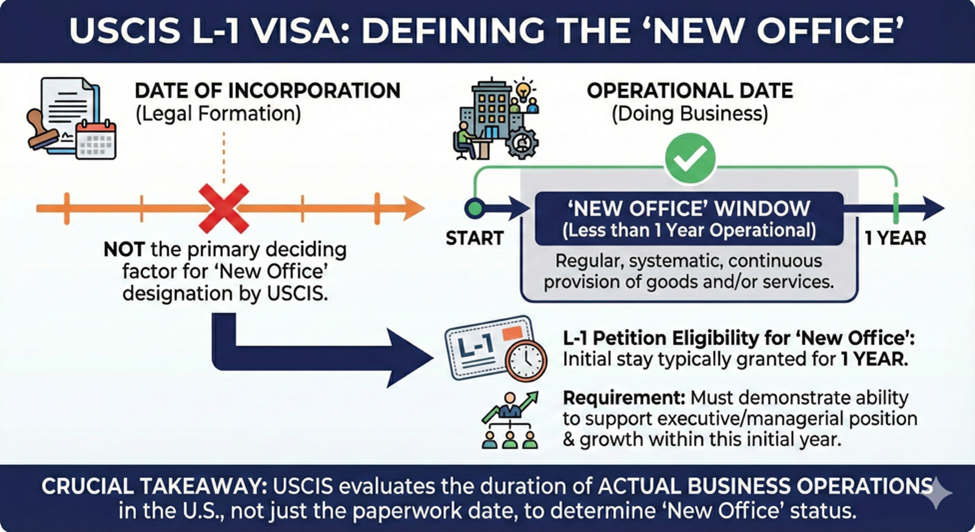
Many people associate the L-1 visa with large companies, but it is also a core tool for entrepreneurs expanding to the United States through a qualifying foreign business.What Is a New Office Case?
Advantages and Disadvantages of the L-1 New Office Rule
Advantages of L-1 New Office Rule:- ✅ New businesses are granted one year to establish and grow.
- ✅ L-1A Managers are given a year to grow into a truly "managerial" position.
- ✅ Founders or key executives can be physically present in the U.S. during the most critical phase of a startup's lifecycle.
- ❌ L-1A visa holders are only granted a one-year visa.
- ❌ An L-1A manager must apply to renew the visa after one year.
- ❌ Businesses must prove they have the financial "fuel" to keep the office running for a year without revenue.
| Risk Factor | New Office (L-1) | Established Office (L-1) |
|---|---|---|
| Failure Rate | High (at the 1-year extension) | Moderate |
| Documentation | Heavy (Future-focused) | Heavy (Past-performance focused) |
| Financial Burden | High (Cash reserves required) | Moderate (Revenue-based) |
| Site Visit Probability | Very High | Moderate |
What USCIS Looks for in a New Office Case
In a new office case, USCIS typically looks for credible evidence that:- The foreign company is real and operating
- The U.S. entity is properly formed and will do business
- There is a plan for physical premises
- The U.S. role is truly executive, managerial, or specialized knowledge, and will remain so as the business hires and grows
The business plan is not optional in practice
For new office cases, the business plan often becomes the narrative backbone of the petition because it connects staffing, revenue, operations, and the claimed executive or managerial job duties into a coherent growth story.For a deeper dive into what makes an L plan credible, see: L-1 business plan guide.
L-1 Visa New Office Mini Checklist
In addition to the standard checklist, the following should be included in a new office L-1 petition:- Proof the foreign business is operating and can pay and direct the transferee
- Proof the U.S. entity is formed and ready to do business
- Premises plan, even if flexible or serviced office, plus a timeline
- Hiring plan tied to an org chart that protects the executive or manager narrative
- Revenue plan, pipeline, contracts or LOIs where available
- A business plan that ties duties to staffing and growth (see L-1 business plan guide)
Our Estimation tool: L-1 New Office Readiness
Before beginning the formal petition process, it is vital to evaluate if your corporate structure and US business plan meet the strict criteria set by USCIS. Use the interactive tool below to generate a preliminary readiness score based on current regulatory standards for new office expansions.
This is just a rough guidance. To confirm eligability please contact an experienced L-1 Visa Lawyer today.
Case Profile
Readiness Analysis
Preparation Score (1-5)
--
Speak to an L-1 Visa Lawyer about your eligibility
This score indicates the strength of your foundational evidence. Adjudication is subjective; even a score of 5/5 does not guarantee a government approval.
Ready to Scale your Business to the United States?
The L-1 New Office petition involves a strict 1-year timeline. Speak with an experienced L-1 visa lawyer about your company and determine eligibility before you file.
Find Out If You Are Eligible
An L-1 visa lawyer will contact you to discuss the specific circumstances of your company.
L-1 Lawyers for U.S. Business Expansion
This guide provides a technical breakdown of the L-1 New Office petition—a specific route for foreign companies that have been operating in the U.S. for less than one year. While the core L-1 requirements still apply, "New Office" filings face higher scrutiny regarding physical premises and hiring projections. For a broader look at the path, see our guides on required documentation, startup costs, and the filing process.- International Entrepreneurs establishing a first-time physical footprint in the United States.
- Foreign Parent Companies needing to transfer a "pioneer" executive to manage the setup and initial hiring phase of a new subsidiary.
- Expansion Strategists who need to understand the 1-year "New Office" limit and the strict requirements for renewing the visa at month 12.
Expanding from overseas? Start with your local roadmap:
- Singapore: Singapore Expansion Guide | L-1 Requirements
- United Kingdom: UK to US Expansion | L-1 Guide for British Founders
- Japan: Japan Corporate Transfer | L-1 Guide for Japanese Entities
- Philippines: L-1 Guide for Filipino Business Owners
L-1 Visa Process: Petition to Consular Processing
We have a deeper dedicated process guide here: L-1 visa process.Most cases follow this sequence.
L-1 New Office Documentation Track Record
A strong L-1 petition is not just about Form I-129.A successful L-1 application requires a package of evidence designed to satisfy the regulatory elements in 8 CFR §214.2(l) and the interpretive expectations in USCIS Policy Manual, Volume 2, Part L.
L-1 Qualifying Relationship Checklist
For the full checklist used in real-world filings, see: L-1 document review checklist.L-1 New Office Documentation Track Record
A strong L-1 petition is not just about Form I-129.A successful L-1 application requires a package of evidence designed to satisfy the regulatory elements in 8 CFR §214.2(l) and the interpretive expectations in USCIS Policy Manual, Volume 2, Part L.
L-1 Entrepreneur and New Office FAQ:
Can a startup founder apply for an L-1 visa?
Yes. A startup founder can qualify for an L-1 visa if they own or control a foreign company that is actively doing business and are transferring to a related U.S. company as an executive or manager. The companies must have a qualifying corporate relationship such as parent, subsidiary, or affiliate.What is a "New Office" L-1 visa for entrepreneurs?
The L‑1 ‘new office’ visa is designed for entrepreneurs and founders who want to open or expand a new U.S. office for their existing foreign business. The initial approval is granted for one year, during which the business must demonstrate active operations and growth to qualify for extension.Can I own 100 percent of the U.S. company and still qualify for L-1?
Yes. Full ownership does not prevent L-1 approval. However, you must show that you will work primarily in an executive or managerial capacity rather than performing day to day operational tasks. A clear staffing and growth plan is essential.Do I need revenue before applying for an L-1 New Office visa?
No. Revenue is not required at the time of filing. However, you must show sufficient capitalization to launch and sustain the U.S. business and a credible business plan demonstrating the ability to support an executive or managerial role within one year.How much investment is required for an L-1 startup?
There is no fixed minimum investment amount. The required funding depends on the nature of the business. The investment must be sufficient to secure premises, hire staff, and cover operating expenses during the initial growth phase.Can a founder perform operational work on an L-1 visa?
In the early stages of a New Office case, some operational involvement is expected. However, USCIS must see that the long term role is primarily executive or managerial, with employees or contractors handling the core day to day functions.Is the L-1 visa better than the E-2 visa for entrepreneurs?
Not automatically. If you qualify for both an L-1 visa and an E-2 visa as a founder, the E-2 is often the simpler and more flexible option for running your business day to day. The L-1 visa is more document-heavy and can be harder to get approved, especially in “new office” cases, so it usually involves more cost and risk.Choosing an E-2 visa instead of an L-1 does not make you less eligible for an EB-1C green card later on. EB-1C looks at your company structure and your executive or managerial roles in the foreign and U.S. businesses, not which temporary visa you used. The main extra benefit of the L-1 is that it is treated as a dual-intent visa, which can make it easier to have a green card case pending while you remain in L-1 status. For most new businesses, however, you will need at least a year or more of real operations before an EB-1C case is realistic, so the choice between E-2 and L-1 is usually about practicality and cost, not about EB-1C “alignment.”
Can an L-1 founder apply for a green card?
Yes. L-1A executives and managers may qualify for permanent residence under the EB-1C multinational manager category. This route does not require labor certification and can be a strategic option for founders scaling U.S. operations.What happens after the first year of a New Office L-1?
To extend the visa, the U.S. company must show active operations, revenue generation or meaningful business activity, and sufficient staffing to support a primarily managerial or executive role. Extensions are typically granted in two year increments.Can a small business qualify for an L-1 transfer?
Yes. There is no minimum company size requirement. Even relatively small but active foreign businesses can qualify, provided they have been doing business for at least one year and can support a legitimate executive or managerial transfer.Disclaimer
thi This page is general information, not legal advice. L-1 eligibility is fact-specific, and both USCIS policy and consular practice can change. Always confirm current requirements in the primary sources, including 8 CFR §214.2(l), USCIS Policy Manual, Volume 2, Part L, and 9 FAM 402.12.About the Authors
Mark Davies, L-1 Immigration Lawyer for Transferees
Chairman of Davies & Associates; focused on E visa strategy and complex consular filings.Page revision history
- 4 September 2026: Link added to the Form I-129 guide.
- 4 September 2026: Westminster (Big Ben and Union Flag) hero image added across the L-1 pages, Shutterstock 2209687145.
Latest case studies
- August 2024: L-1 visa extension petition approved for a manager from India
- June 2024 - Employment-based petition for a multinational executive from India approved in 14 days with premium processing
- August 2024 - L-1 extension petition approved for an executive from India
- June 2024 - New office L-1A petition approved for an executive from Vietnam
- July 2024 - L-1A petition approved for a manager from China
- July 2024 - L-1B Petition Approval for a Specialized Knowledge Employee
- L-1A petition for an executive from India approved for three years
- L-1B visas for specialized knowledge employees of an engineering solutions company in the Semiconductor Industry
- L-1B Petition approved for a specialized knowledge employee from Germany
- New office L-1A approved for a manager from India
- CEO from India granted an extension of two years as L-1A intracompany transferee
- New office L-1A petition approved for an executive from Vietnam
- L1 India client video
- L-1A petition approved for three years for an executive from Australia
- L-1 petition in the “functional manager category” approved for a Singaporean national.
- L1 Visa for a Multinational Company: How to Transfer Employees from India to the US
- U.S. visas for critical employees of a Singapore-based wealth management company
- L-1A Executive Transfer for Music Production
- L-1A Intracompany Transfer for Small Business Videographer
- L-1A Visa for an Executive of a Birding Tours Company
- L-1A extension petition approved for a Canadian manager
- L-1A extension petition approved for an executive from India in 7 days with premium processing
- L1A for Information Technology and I.T. Staffing
- New office L-1A petition approved for an executive from India
- New office L-1A petition approved for an executive from Vietnam
- Success Story: L1A Visa Approval for Nigerian Telecoms Executive
- A client's journey from a denied L-1A petition to green card
- A client's journey from a denied L-1A petition to green card
- Approved L1-B petition for a specialized knowledge employee from the UK
- August 14th, 2024. L-1 extension petition approved for an executive from India with a Request for Evidence
- July 2024 - Employment-based immigrant petition for a multinational executive from India approved
- L-1 Visa approved by Ho Chi Minh City consulate for an executive from Vietnam
- L-1A extension petition approved for an executive from India
- L-1A petition approved for three years for an operations manager from Germany
- May, 2024 - L1A petition approved for an executive from the United Kingdom
- New office L-1A petition approved for a founder and CEO of the related Vietnamese company
- New office L-1A petition approved for an executive from Vietnam
Our L-1 Team by Location: U.S., UK, UAE, Asia
Check all of our locations around the world.
Company location
New York Office World Trade Center
1 World Trade Center, Suite 8500, New York, NY 10007
Map and Driving Directions
New York Office E69th Street
200 E 69th Street, 2N, New York, NY 10022
Map and Driving Directions
California Office
555 Anton Blvd, Suite 150, Costa Mesa, CA 92626
Map and Driving Directions
Philadelphia Office
1500 John F Kennedy Blvd, Suite 450, PMB 41, Philadelphia, PA 19102
Map and Driving Directions
Los Angeles Office
601 South Figueroa Street, Suite 4050, Los Angeles, CA 90017
Map and Driving Directions
Chicago Office
155 N. Upper Wacker Dr., Suite 4250, Chicago, IL 60606
Map and Driving Directions
Miami Office
80 S.W. 8th St., Suite 2000, Miami, FL 33130
Map and Driving Directions
Atlanta Office
1075 Peachtree Street NE, Suite 3650, Atlanta, GA 30309
Map and Driving Directions
Telephone number
New York Office World Trade Center
+1 212 537 9196
Fax: +1 949 396 1371
New York Office E69th Street
+1 212 537 9196
Fax: +1 949 396 1371
California Office
+1 949 620 1811
Fax: +1 949 396 1371
Philadelphia Office
+1 215 525 1881
Fax: +1 949 396 1371
Chicago Office
+1 312 261 8560
Fax: +1 949 396 1371
Miami Office
786 490 2661
Fax: +1 949 396 1371
Contact us by email


Looking to obtain an L-1 visa with confidence?
Our immigration lawyers help intracompany transferees pursue U.S. work authorization through carefully planned qualifying relationship and role strategies.
Looking for an L-1 Immigration Lawyer?We serve intracompany transfers worldwide from offices in the U.S., UK, Dubai, and Asia.
Several lawyers told me I would not be able to get a TN visa. Two weeks after contacting Davies & Associates I was working in New York, visa in hand.
Individual seeking 'Impossible' TN VisaD&A was very detail-oriented and very thorough in what they did. They worked on my case 24/7 and were very patient in answering all my questions.
E-2 Visa ClientMy case felt complex but D&A managed the whole process carefully and helped me move seamlessly from one stage to the next.
E2 + CBI ClientD&A was my guiding light through the entire EB-5 process.
EB-5 Visa ClientI would definitely be a big advocate for the rest of my life for anyone wanting to explore the Grenada Citizenship by Investment Programme leading to the E-2 visa. The most important thing is a good team behind you. With Davies & Associates, you're in safe hands... you need someone who can support you on the ground and, again, you are well taken care of by D&A. The people are really warm, very helpful and quite open-minded when it comes to business... Not to mention as a passport it's great from a travel perspective... It's just 4 to 5 hours from New York.
Grenada CBI + E2 Visa ClientThe entire process of getting an EB-5 visa is handled in a professional way by Mark Davies and his team. EB-5 is a wonderful option for anyone considering moving to the United States if you have the means. I was hoping to use the H-1B route for my children, but it became unreliable and so I looked to the EB-5 visa instead. It is great for anyone who has the resources. Mark gives you the first meetings himself which gives you great comfort. Both Mark and Sanjay are abundantly available and I even had the pleasure of hosting them at my house.
Parent of 2 EB-5 visa holdersI'm in the process of extending my L-1 visa. I submitted a few questions regarding my case, and he contacted me back almost immediately, both by email and telephone. Unlike other attorneys I met before, he gave me the impression of knowing off the top of his head what kind of visa I have, and what actions had to be taken to extend it. He is very thorough and clear regarding the process and what to expect in terms of timelines and issues that may arise. He is constantly in contact, so you definitely know he's working on your case.
L-1B Visa HolderMark Davies is a joy to work with. His extensive knowledge, speedy response and attentive service took away all my fears of dealing with immigration and visa applications. He is very generous with his time in explaining every step along the way and I have already and will in the future recommend him to anybody who is looking for an immigration lawyer.
E2 Visa for Small Professional Business With International OfficesDavies & Associates assisted us with an immigration emergency involving my brother's fiancée who was outside the United States. They assisted us in a highly professional manner, working with the relevant US embassy, US immigration and the governments of two other countries. As a result of their efforts the individual involved is now working in the United States. While their knowledge of the law is exemplary what really distinguishes this firm and attorney Davies from any other firm we have worked with is their dedication to customer service and their unrivaled level of professionalism.
Complex Fiancée Visa Need Involving Multiple International JurisdictionsSeveral lawyers told me I would not be able to get a TN visa. Two weeks after contacting Davies & Associates I was working in New York, visa in hand. I have recommended this firm to several friends and colleagues, they do an excellent job every time.
Individual Seeking 'Impossible' TN VisaI was qualified as a physician in a foreign country. Being on a J1 visa I was facing having to leave the United States and return to my home country. Davies & Associates secured one of only 30 J1 visa waivers available in my State, allowing me to work for a US hospital and remain in the United States.
Doctor Seeking J1 Visa WaiverI am very satisfied with the services Mark Davies has provided me. He has a very extensive knowledge in immigration laws and has a thorough approach to any case.
U Visa Applicant, A Victim of CrimeLooking to relocate or having trouble with a visa application?
We are known for our creative solutions that obtain "impossible" visas. We solve the most complex immigration problems for business, investors, individuals and families.
Request Free L-1 Consultation
New York Office World Trade Center:
1 World Trade Center, Suite 8500, New York, NY 10007
+1 212 537 9196
Map and Driving Directions
New York Office E69th Street:
200 E 69th Street, 2N, New York, NY 10022
+1 212 537 9196
Map and Driving Directions
California Office:
555 Anton Blvd, Suite 150, Costa Mesa, CA 92626
+1 949 620 1811
Map and Driving Directions
Philadelphia Office:
1500 John F Kennedy Blvd, Suite 450, PMB 41, Philadelphia, PA 19102
+1 215 525 1881
Map and Driving Directions
London Office:
69 Old Broad Street, Dashwood House, London EC2M 1QS, United Kingdom
+44 20 3884 1812
Map and Driving Directions
London Office Beaufort Court:
Beaufort Court, Admiral Way, London E14 9XL, United Kingdom
+44 20 3884 1812
Map and Driving Directions
Edinburgh Office:
28 Rutland Square, Edinburgh, Scotland, EH1 2BW
+44 (20) 38841812
Map and Driving Directions
Milton Keynes Office:
The Pinnacle, 170 Midsummer Blvd, Milton Keynes MK9 1FE, United Kingdom
+44 7740 000769
Map and Driving Directions
Glasgow Office:
+44 131 392 0686
Map and Driving Directions
Vietnam Office:
46th Floor, Bitexco Financial Tower, 2 Hai Trieu, Ben Nghe Ward, District 1, Ho Chi Minh City, Vietnam
+84 28 44582309
Map and Driving Directions
India Office:
Enam Sambhav C-20, G Block, Bandra-Kurla Complex, Mumbai 400051, Maharashtra
+91 720 856 4057
Map and Driving Directions
Italy Office:
Via Bonifacio Lupi 29, 50129 Firenze FI, Italy
+39 055 076 3054
Map and Driving Directions
Manila Office:
Unit 107, AIC Burgundy Empire Tower, ADB Ave. cor Garnet and Sapphire Streets, Ortigas Center, Pasig City 1605, Metro Manila, Philippines
+63 2 7215 7878
Map and Driving Directions
Sydney Office:
Level 12, 210 George Street, Sydney NSW 2000, Australia
+61 2 9156 1032
Map and Driving Directions
Perth Office:
Davies & Associates LLC, Level 1, 12 St Georges Terrace, Perth WA 6000, Australia
+61 2 9156 1032
Map and Driving Directions
Singapore Office:
160 Robinson Road, #14-04, Singapore Business Federation Centre, Singapore 068914
+65-9615-0528
Map and Driving Directions
Looking for an Immigration attorney?
Immigration lawyer near meList of US Embassies, Consulates and USCIS
List of Italian Embassies, Consulates and USCIS
Copyright ©2026 by Davies & Associates LLC.