Expanding an Agricultural Business into the United States: What You Need to Know
Foreign agribusiness expansion into the U.S. typically requires coordination across four areas:
- U.S. entity formation and corporate structuring
- Visa strategy aligned with ownership and operations
- Operational and compliance documentation
- Awareness of federal and USDA programs that may strengthen your expansion plan
We integrate these elements so your business plan supports your visa eligibility, and your visa strategy supports your commercial reality.
Business Set-Up and Visa Planning for Agricultural Expansion
Many international agricultural businesses need more than visa filing support. They require a properly structured U.S. presence.
Establishing a U.S. agricultural operation may involve:
- Forming a U.S. corporation or LLC
- Structuring foreign parent and U.S. subsidiary relationships
- Securing tax registrations
- Meeting federal and state regulatory requirements
- Leasing land or facilities
- Structuring capital investment
- Preparing payroll and employment compliance systems
The structure of the U.S. entity directly affects immigration eligibility.
For example:
- The L-1 Visa requires a qualifying corporate relationship between the foreign entity and U.S. company
- The E-2 Visa requires a properly structured and operational U.S. investment enterprise
- The EB-5 Visa requires qualifying investment and job creation
- Seasonal agricultural labor may require the H-2A Visa
L-1 Visa for Agriculture and Agribusiness Companies
The L-1 visa is one of the most effective tools for international agriculture companies expanding into the United States. It allows a foreign parent company to transfer key executives, managers, and specialized knowledge employees to a U.S. subsidiary, affiliate, or branch office.
Agriculture companies use the L-1 visa to relocate personnel who understand the foreign operation and can build or manage the U.S. side of the business.
L-1A vs L-1B for Agriculture Roles
The L-1 visa has two classifications:
- L-1A (Managers and Executives): For farm operations directors, agribusiness CEOs, commodities trading managers, and agricultural supply chain executives transferring to lead U.S. operations.
- L-1B (Specialized Knowledge): For agronomists, crop scientists, precision agriculture engineers, and food safety specialists whose knowledge of the foreign company's proprietary systems, processes, or products is essential to the U.S. operation.
L-1 New Office Petitions for Agriculture Companies
Many agriculture companies entering the U.S. market for the first time use the L-1 new office petition. This allows a foreign agribusiness to open a brand-new U.S. entity and immediately transfer a key person to run it.
Common L-1 new office scenarios in agriculture include:
- An Indian cotton producer opening a U.S. trading and distribution subsidiary
- An Australian grain company establishing a U.S. export office
- A Turkish food manufacturer launching U.S. packaging and distribution operations
- An agtech company from Israel or Europe opening a U.S. headquarters
- A Latin American commodities firm setting up a U.S. trading desk
The L-1 new office petition requires a detailed business plan showing how the U.S. entity will grow and support the transferred employee's managerial or specialized role within the first year.
Davies & Associates has extensive experience with L-1 petitions for agriculture companies and can advise on both corporate structuring and visa strategy. Contact us to discuss your L-1 agriculture case.
L-1 Visa Advantages for Agribusiness
- No annual cap or lottery — petitions can be filed year-round
- Allows the transferred employee to work only for the sponsoring U.S. entity
- L-1A holders may apply for a green card through the EB-1C category without labor certification
- Spouses receive L-2 status with work authorization
- Valid for up to seven years (L-1A) or five years (L-1B)
E-2 Visas for Agricultural Businesses
The U.S. E-2 visa is one of the most flexible and easily obtained visas for entrepreneurs in the world. It requires relatively low investment coupled with rapid processing through a local consulate. USCIS are only involved with Change of Status cases for applicants already in the United States.
Key for agriculture, the value of stocks of produce can be capitalized as investment for E-2 Visa purposes. 9 FAM 402.9-6(D)(1).
2026 Example: E-2 Farming Visa Client
E-2 Investor: Our client is a sheep farmer from Western Australia.
Brief Facts: By valuing inventories of lamb shipped to the United States the client was able to obtain a U.S. E-2 investor visa and an E-2 essential worker visa.
2026 Example: E-2 Visa for French Wine Producer from Lyon
E-2 Investor: Our client is a small producer of wine from the Lyon region of France.
Brief Facts: By capitalizing on the value of shipped wine as investment our client was able to obtain an E-2 investor visa.
EB-5 Visa for Farms and Agricultural Investment
The EB-5 investor visa provides a pathway to U.S. permanent residence for individuals who make a qualifying capital investment in a U.S. commercial enterprise that creates at least 10 full-time jobs.
Agricultural operations, including farms, food processing facilities, dairy operations, and aquaculture businesses, can qualify as EB-5 projects when properly structured.
EB-5 Investment Thresholds for Farm Projects
The minimum investment amounts for EB-5 are:
- $800,000 if the project is in a Targeted Employment Area (TEA) — most rural farming locations qualify as TEAs
- $1,050,000 for projects outside a TEA
Because many agricultural projects are located in rural areas, farm-based EB-5 investments frequently qualify for the lower $800,000 threshold.
Direct EB-5 vs Regional Center for Agriculture
Farm investors can pursue EB-5 through two pathways:
- Direct EB-5: The investor directly owns and operates the agricultural business. Job creation is counted through direct W-2 employees. This is common for hands-on farm operations, food production facilities, and vertically integrated agricultural businesses.
- Regional Center EB-5: The investor places capital into an approved regional center project. Job creation can include indirect and induced jobs calculated through economic modeling. This may suit investors who prefer a passive role.
Types of Farm and Agriculture EB-5 Projects
Agricultural EB-5 projects that Davies & Associates has advised on or that commonly qualify include:
- Crop production operations (cotton, grain, specialty crops)
- Dairy and livestock operations
- Aquaculture and fish farming
- Food processing and packaging facilities
- Cold storage and agricultural logistics centers
- Agtech and precision farming enterprises
- Organic and specialty food production
Can I Buy a Farm with EB-5?
Simply purchasing an existing farm does not automatically qualify for EB-5. The investment must be in a new commercial enterprise or a substantial restructuring of an existing business, and it must create at least 10 new full-time jobs. Buying farmland alone without creating qualifying employment does not satisfy EB-5 requirements.
However, acquiring a farm and expanding its operations — building new facilities, adding production lines, hiring workers — can meet the threshold if structured correctly from the outset.
Davies & Associates works with agricultural investors to structure EB-5 farm projects that satisfy USCIS requirements. Contact us to discuss your EB-5 farm investment.
H-2A Agricultural Worker Visas: When They Apply (and When They Don't)
H-2A is for temporary, seasonal agricultural labor for U.S. farm operations when there aren't enough U.S. workers.
H-2A applies when the job is:
- Seasonal or peak load farm work (planting, harvesting, production)
- Hands on agricultural labor for a defined period
- The employer can meet strict recruitment, wage, and housing rules
H-2A does not apply when the role is:
- Permanent or year round
- Management, executive, professional, or corporate agribusiness work
- A founder or cross border expansion role
If H-2A isn't the fit, we typically evaluate options like L-1, E-2, EB-2 NIW, EB-3, or O-1 depending on the business and the person.
Cotton: From Seed to Catwalk

The cotton industry illustrates how agriculture, commodities, manufacturing, and fashion are deeply interconnected. We represent clients across the entire cotton value chain.
This matters because immigration eligibility, capital planning, and expansion structure often depend on how each stage connects to the next.
1. Research and Cotton Seed Development
Our clients include research institutions and biotechnology firms which develop cotton genetics and seed improvements. These clients are involved with the genesis of cotton production.
Common immigration solutions include:
2. Seed Producers and Distributors
Seed companies operate in licensing, distribution, and export. Our seed producers supply cotton seed into India, China, United States, Pakistan, Brazil, Egypt and other major markets.
We assist with:
3. Cotton Farmers and Producers
At the cultivation stage, cotton is grown and harvested. Our clients include cotton producers in India, Australia, Pakistan, United States, Egypt and Turkey.
Key issues include:
- Seasonal workforce planning via H-2A Visa
- Expansion capital planning
- Long term management transfers via L-1 Visa
- Investment structuring through EB-5 Visa when appropriate
4. Commodity Purchasers and Traders
Cotton moves into gins, processors, exporters, and trading houses.
We support:
- Intracompany mobility under the L-1 Visa
- International trade finance
- Treaty based strategies under the E-2 Visa
- Structuring compliant U.S. trading entities
5. Textile Manufacturing and Weaving
Textile firms convert raw cotton into fabric.
Expansion may involve:
6. Designers and Apparel Companies
Designers transform textiles into garments.
Common strategies include:
7. Fashion Retailers and U.S. Market Entry
Retail expansion requires:
USDA Resources for Agribusiness Expansion
Many foreign business owners are surprised to learn that U.S. government programs may support agricultural expansion.
USDA Foreign Agricultural Service
The USDA Foreign Agricultural Service maintains offices in U.S. embassies worldwide.
Learn more:
These representatives can provide market intelligence and regulatory guidance.
USDA Market Development Programs
USDA Rural Development Programs
USDA Rural Development may provide support for eligible rural business projects.
USDA Rural Development Business Programs
Specific programs include:
Representative Matters
U.S. Farms Owned by Indian Nationals: Expansion Through EB-5
Client needed capital to expand acreage and increase output.
Challenge: EB-5 direct model typically allows one investor per standalone project.
Strategy:
- Structured farm operations into separate qualifying business entities
- Designed job creation planning aligned with EB-5 requirements
- Coordinated documentation and capital deployment
Expansion lesson: Agricultural businesses can sometimes align growth capital with EB-5 where structuring is done carefully.
Vietnamese Fish Sauce Brand: USDA Supported Expansion
Client launched U.S. packaging and distribution operations.
Strategy included:
- Leveraging USDA guaranteed financing
- Structuring U.S. operations to support immigration petitions
- Coordinating expansion with executive mobility
Expansion lesson: Government backed financing can strengthen both operational stability and immigration credibility.
Work Visa Options for Agronomists & Agriculture Professionals
U.S. immigration offers multiple pathways for professionals in agriculture and agronomy, including:
- TN Visa for Canadian/Mexican agronomists and agriculturists under the USMCA professional list.
- H-1B Specialty Occupation Visa for highly qualified agronomy roles such as research scientists and crop management specialists.
- EB-2 / EB-3 Employment-Based Green Cards for long-term employment in agricultural science and agribusiness.
- O-1 Visa for individuals with extraordinary achievement in agriculture.
FAQ: Expanding an Agricultural Business into the U.S.
What visa is best for expanding an agricultural business into the United States?
Often E-2, L-1, or EB-5, depending on nationality, investment size, and structure.
Can a foreign owned farm qualify for an L-1 visa?
Yes, if a qualifying corporate relationship exists between the foreign and U.S. entities.
Can cotton or textile businesses use EB-5 for expansion?
In certain cases, if job creation and capital thresholds are satisfied.
Does USDA help foreign agricultural companies?
USDA programs may support financing, rural development, and market access depending on eligibility.
Do you coordinate business formation and visa strategy?
Yes. Corporate structure directly affects visa eligibility.
Can I use an L-1 visa to manage a U.S. farm?
Yes. If you currently work for a foreign agriculture company in a managerial or executive role, and that company establishes a U.S. subsidiary or affiliate, you may qualify for an L-1A visa to transfer and manage the U.S. farming operation. The foreign and U.S. entities must have a qualifying corporate relationship.
Can I invest in a U.S. farm through EB-5?
Potentially, yes. The EB-5 visa requires a qualifying investment and the creation of at least 10 full-time jobs. Simply buying farmland does not qualify, but acquiring and expanding a farm operation with new facilities, production, and employees can meet the requirements if structured correctly. Most rural farm locations qualify for the reduced $800,000 investment threshold.
Can I Buy and Run a Farm with EB-5 or E-2?
Yes. You can buy and run a farm with an E-2 or an EB-5 visa.
Our firm has assisted clients in acquiring and operating agricultural businesses across the United States using both visa categories. The key requirements differ between the two programs, but both can support farm ownership when the investment is structured correctly and the business is actively operated.
Contact us to discuss your farm investment case.
I Have Read That Investments in Land or Property Do Not Count for EB-5 and E-2 Investment?
What you have read is incorrect. Investments in land and property can count for EB-5 and E-2 visas.
Our firm has assisted a number of clients make investments in farms, dairies, orchards, and aquaculture projects where the value of the land has been included in the value of the investment made. The key is that the land in these cases is an asset that is actively being used by the business to grow crops, raise livestock, or support agricultural production. It is not idle or speculative land held purely for appreciation.
When land serves a direct operational purpose within a functioning business, it forms a legitimate part of the overall qualifying investment under both the E-2 and EB-5 frameworks.
Speak With an Immigration Attorney
If you are expanding an agricultural, cotton, textile, or commodities business into the United States, we can help structure your business and immigration strategy for long term success.
Contact our office to schedule a consultation.
About the Authors
Mark I Davies, Esq.
Chairman of Davies & Associates; focused on E visa strategy and complex consular filings.
Mark I Davies, Esq. JD, University of Pennsylvania Law School, Licensed with the SRA (SRA ID: 384468) in the UK, Member Law Society of England & Wales, MBA, Wharton School of Business. Top 10 Investment Visa Lawyer, Licensed (USA), Georgia State Bar. AILA Member.
| Area |
Details |
| Education |
JD, University of Pennsylvania Carey Law School | MBA (Finance), The Wharton School, University of Pennsylvania | Chartered Accountant (ICAEW) |
| Financial Training |
Completed Analyst Training Program at a major international bank | Chartered Accountant background with professional training in financial analysis and reporting |
| Legal Practice |
Admitted to practice in Georgia (USA) | Registered Solicitor with the Law Society of England & Wales | Former CMBS lawyer at one of the world's largest international law firms |
| Immigration Track Record |
15+ years advising HNW investors | Zero denials for clients advised on source-of-funds compliance in EB-5 | Hundreds of successful EB-5 cases globally |
| Recognition |
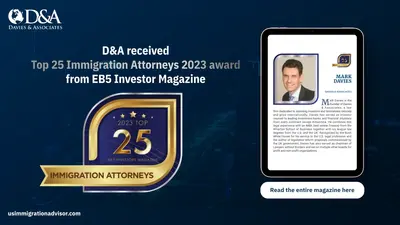
Named a Top 25 EB-5 Immigration Attorney by EB5 Investors Magazine (2018–2023) |
| Professional Engagements |
Lecturer/trainer for other lawyers at AILA, ACA, University of Pennsylvania Law School | Frequent speaker at global investment immigration conferences |
| Agriculture and Commodities Experience |
Mark Davies previously advised one of the world’s largest agribusiness and commodities companies (Cargill), giving our practice direct industry insight beyond immigration law alone. |

 Agri Visas in the UK
 Agri Visas in Italy