L-1 Visa for Indians: Complete Guide to US Business Expansion
Looking to expand your Indian business into the United States? The L-1 Visa for Indians is one of the most powerful tools for entrepreneurs, executives, and specialized employees to establish a US presence. With India consistently ranking as the largest user of L-1 visas worldwide, this guide explains everything you need to know — L1 visa requirements, process, costs, and strategies for success
Fast track to US business expansion: Ideal for Indian IT firms, startups, and family-owned businesses.
Dual intent advantage: Allows you to pursue a US Green Card (EB1C) while maintaining L1 status.
Family benefits: L2 spouses can work in the US, making relocation smoother.
Alternative to H1B: With H1B restrictions tightening, the L1 visa is increasingly popular among Indian professionals.
Executive Summary
Whether you’re a corporate mobility manager coordinating transfers, a founder expanding your Indian business into the U.S., or a professional relocating to take on a leadership role, our India–U.S. immigration team provides the clarity, coordination, and compliance that cross-border mobility requires.
With offices across India in Mumbai, New Delhi, and Bangalore, as well as in New York and London, our team of L1 Visa Consultants has successfully guided hundreds of L-1 Visa filings for clients in technology, finance, manufacturing, and consulting.
Discover how our expertise in L-1A and L-1B visas can help you establish your U.S. presence and secure long-term growth.
Streamlined immigration programs tailored for HR, legal, and global mobility teams.
Ensure compliance while moving executives, managers, and specialized employees across borders.
Proven success supporting Indian companies expanding operations into the U.S. through L-1A and L-1B visas.
Step-by-step guidance for establishing new U.S. entities and handling first-time L-1 filings.
Customized strategies for Indian founders, startups, and family-owned businesses entering the U.S. market.
Business plan development and legal structuring to meet USCIS requirements.
Responsive support and clear communication from petition filing to visa stamping.
Assistance for executives, managers, and specialized knowledge employees relocating from India to the U.S.
Family benefits explained, including L-2 spouse work authorization and dependent visas.
L-1 Visa Overview
A Single Visa Type — Three Distinct Use Cases
The L1 Visa for Indians enables companies to transfer executives, managers, and specialized knowledge employees from India to a related U.S. entity. It is one of the most effective pathways for Indian businesses expanding internationally.
At Davies & Associates, we assist:
Enterprises managing ongoing global mobility programs.
SMEs and founders establishing new U.S. offices under the “new-office” L-1A category.
Employees seeking a professionally managed, predictable relocation process.
For a full breakdown of timing, PERM, EB-1C, and adjustment of status, see our guide to L1 visa to green card options.
L-1 Visa Categories
Visa Type
Typical Applicant
Duration
L-1A
Executives and managers
Up to 7 years
L-1B
Employees with specialized knowledge
Up to 5 years
Benefits of the L-1 Visa for Indian Nationals
Transfer senior leaders or specialized staff from India to U.S. operations with ease.
Establish new U.S. businesses as affiliates, branches, or subsidiaries under the “new-office” L-1A category (8 C.F.R. § 214.2(l)(3)(v)).
Spousal work authorization (L-2): Spouses may work incident to status. While some employers still request an Employment Authorization Document (EAD), it can be obtained if needed (8 C.F.R. § 274a.12(a)(18)).
No quota or lottery system for L-1 applicants — unlike the H-1B program.
Pathway to permanent residency via the EB-1C category for multinational managers and executives (INA § 203(b)(1)(C)).
Family-friendly relocation: Spousal work authorization makes moving to the U.S. practical for Indian executives and their families.
Proven expertise: Davies & Associates has guided hundreds of Indian companies and entrepreneurs from entity formation through visa issuance and post-approval compliance.
Core L-1 Visa Requirements & Eligibility Criteria
To qualify for an L-1 visa for intracompany transfer, applicants and their employers must meet specific requirements under U.S. immigration law:
Qualifying Relationship Between Entities: The U.S. company and the foreign business must have a valid corporate relationship, such as parent company, branch office, subsidiary, or affiliate.
Employment History Abroad: The employee (beneficiary) must have worked for the foreign company for at least 1 continuous year within the past 3 years before applying for the L-1 visa (per 8 C.F.R. § 214.2(l)(3)(iii)).
Eligible Position in the U.S.: The transferee’s role in the U.S. must be either executive or managerial (qualifying for an L-1A visa) or involve specialized knowledge (qualifying for an L-1B visa).
Active U.S. Business Operations: The U.S. entity must be actively doing business. For new offices, the company must demonstrate credible plans to establish and operate in the United States.
Doing Business in the United States
For Indian entrepreneurs and companies, owning and operating a business in the USA offers unique opportunities compared to running a business in India. The U.S. business environment provides several advantages, including:
Strong Legal and Judicial System: Businesses benefit from reliable access to U.S. courts, making contract enforcement and dispute resolution more straightforward.
Enforceable Non-Compete Agreements: In certain states, employers can enforce non-compete clauses for employees, including those on L-1 visas and other work visas, helping protect business interests.
Pro-Business Environment: The U.S. market is known for its transparency, investor confidence, and ease of doing business, making it attractive for Indian companies expanding abroad.
For a deeper understanding of the legal, cultural, and operational differences, explore our Guide to Doing Business in the USA for Indians, which covers everything from business structures to compliance requirements.
⚙️ The L-1 Visa Process: How Davies & Associates Manages Your L1 Visa Case End-to-End
1. Strategic Assessment & Planning
We begin with a structured consultation to confirm eligibility under
8 CFR § 214.2(l)(1)(ii) and determine whether the petition will be filed for an
executive/manager (L-1A) or a
specialized-knowledge employee (L-1B).
Corporates: mapping organizational charts to USCIS definitions of
managerial and
executive roles (
USCIS PM Vol. 2 Pt. L Ch. 3).
Transferees: explaining evidence and timing standards per
9 FAM 402.12-10(B).
2. Entity & Documentation Preparation
We coordinate the Indian and U.S. entities to meet the
“qualifying relationship” and
“doing business” requirements of
8 CFR § 214.2(l)(1)(ii)(G) and
(l)(1)(ii)(H). Our deliverables include:
Corporate structure exhibits showing ownership and control
Financial and operational documentation suitable for both USCIS and consular review under
9 FAM 402.12-6(B)
3. Petition Filing with USCIS
We file the
Form I-129 with L Supplement and monitor adjudication under
8 CFR § 214.2(l)(13). Requests for Evidence (RFEs) are handled according to
USCIS PM Vol. 1 Pt. E Ch. 6 to ensure timely, complete responses. Corporate clients may opt for reporting dashboards to track petition stages.
4. Consular Processing & Visa Issuance
Upon USCIS approval, we prepare applicants for interview following
9 FAM 402.12-5 and consular guidance under the
Department of State’s 9 FAM. We provide mock interviews and confirm all supporting materials match the approved petition.
5. Post-Approval Compliance & Renewals
After arrival in the U.S., maintaining status requires adherence to
8 CFR § 214.2(l)(14) (Extension of stay) and ongoing
qualifying relationship documentation. We support renewals and transitions to
EB-1C classification as described in
USCIS PM Vol. 6 Pt. F Ch. 2.
If you are outside the United States, you will usually need an L1 visa stamp after USCIS approves the petition. The consular officer must have official evidence of petition approval (or blanket eligibility) and confirm you are classifiable as an L nonimmigrant.
Source:22 CFR § 41.54 – L Nonimmigrant Classification Source:9 FAM 402.12 – L Nonimmigrants See our full guide: L1 Visa Stamping in India.
*⚠️ Warning on Premium Processing
Many applicants assume that paying the Premium Processing fee guarantees that USCIS will take action within 15 business days. The Form I-907 language does not support that assumption. Premium Processing is a request for expedited processing, not a guaranteed outcome.
Refund language is not a guarantee of action.Form I-907 states: "USCIS will refund the Premium Processing fee if USCIS does not take action on the related case within the applicable processing timeframe." The form also lists examples of "actions," which can include an approval, denial, Request for Evidence, Notice of Intent to Deny, or other procedural steps.
Even when USCIS takes action quickly, the action may be an RFE or a NOID. That can extend the total timeline by weeks or months, depending on how long it takes to respond and how long USCIS takes to review the response.
⚠️ Common Pitfalls for Indian L-1 Visa Cases: What the Consulate Says
Over the years, Davies and Associates has had the privilege of speaking with consular officers who adjudicate L-1 visa cases. The pitfalls below are based on their feedback.
The qualifying relationship is unclear
Fix: Include a simple ownership chart and incorporation documents for every entity.
Consular tip: One officer told us a Certificate of Good Standing can prevent consular investigations.
The applicant's one year abroad is not provable
Fix: Build one clear timeline that matches payroll and travel history, then support it with HR and tax records.
The US role sounds hands-on rather than managerial for L-1A cases
Fix: Describe duties as leadership and oversight, and show who executes the work with an org chart and hiring plan.
The L-1A manager claim is weak
Fix: Prove people management or function management with reporting lines, scope, and approval authority.
Consular tip: Affidavits and support letters from subordinates can help.
L-1B specialized knowledge is described too generically
Fix: Tie the knowledge to company-specific products, tools, or processes and show why it cannot be hired quickly in the US.
The new office plan is thin or unrealistic
Fix: Show premises, budget, hiring plan, and credible pipeline evidence.
Documents conflict with each other
Fix: Do a consistency audit so the petition letter, resume, DS-160, and org charts tell the same story.
Prior US visa history is not addressed
Fix: Disclose and explain prior refusals or status issues with a short factual timeline.
Interview preparation is ignored
Fix: Prepare a one-page plain English summary and carry a focused evidence pack. We do this onsite in India.
The support letter has big claims and little proof
Fix: Reference a supporting evidentiary exhibit for every claim made.
L-1 Visas and the New Office Pathway
The L-1A Visa for a Business Entrepreneur
Many of our Indian clients are expanding into the United States and relocating personally at the same time, often moving with their spouse and children. The L-1 new office route is designed for that reality, launching a real US operation while the founder relocates to run it.
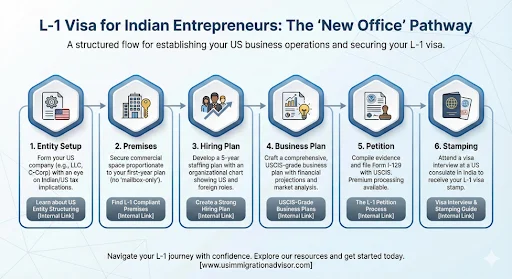
This roadmap shows the practical sequence we use to build strong new office cases. Some steps overlap, but this is the clearest way to understand the overall flow.
Entity SetupForm US company (LLC or C-Corp) considering tax implications and ownership structure.
PremisesSecure commercial space proportionate to first-year business plans and operations.
Hiring PlanDevelop a 5-year staffing plan with organizational chart showing managerial structure.
Business PlanCraft a USCIS-grade business plan with financial projections and market analysis.
Petition FilingFile Form I-129 petition with USCIS including all supporting documentation.
Visa StampingAttend visa interview at a US consulate in India and receive L-1 visa stamp.
The New Office Rules – The Concept
New Office L-1 visas are reserved for U.S. business which have been active for less than one year.
The concept is that a business might not be able to accommodate an L-1A manager in its first year of operation. USCIS allows an L1-A manager a year to get the business established enough to support a full “manager”.
The New Office Rules – The Practicalities
- L1A businesses less than one year old are granted L1-A visas of only one year
- After one year the New Office L-1A Manager will have to apply for an L-1 visa extension and prove that they meet the full criteria required for L1-A managers
New Office for a Jewelers from Surat
Industry: Jeweler Location: Surat, Mumbai, Antwerp, US Background: Our client owns a jewelry workshop in Surat and has a presence on the Mumbai diamond bourse. Client’s son wanted to come to the US and start a retail jewelry store. Challenge: Qualifying the son as an “L1 Manager”. Solution: We characterized the client’s son as a “functional manager” in charge of the global sales function of the client’s business. We included a suitable office for the son in the retail store in New York. Result: One year after the L-1 was granted the client’s son received an extension of his New Office L-1 visa.
For more examples of Indian new office L-1 visas visit our case studies page
Open and fund corporate account per capitalization plan.
Client (D&A Assists)
3–10 days
Requires formation docs and KYC; be aware of FinCEN BOI reporting.
11. Premises
Secure commercial office proportionate to the plan (no virtual offices).
Client (D&A Review)
1–4 weeks
Lease >1 year; include photos/layout to prove operational readiness.
12. Filing
Compile evidence and file Form I-129 (and I-907 for Premium).
D&A
10–15 days
Draft duties to emphasize supervision and executive discretion.
13A. Consular
DS-160 filing, biometrics, and interview (Mumbai/Delhi/etc).
Client (D&A Prep)
2–8 weeks
Mock interview; maintain consistency on team size and growth plan.
13B. Change Status
File COS if already in U.S.; no travel until approved.
D&A + Client
2–5 months
Request Premium Processing (possibly 15 days) available but may be declined*; travel abandons the COS.
Post-Approval
Execute hiring plan, launch ops, and maintain records for extension.
Client (D&A Oversight)
Ongoing
Thin hiring/revenue is the #1 extension risk—document monthly.
L-1 Visa Documentation Examples (L-1A & L-1B)
The following case examples illustrate how documentation should be prepared and presented for successful L-1A Manager/Executive and L-1B Specialized Knowledge petitions, addressing common challenges faced by Indian businesses.
1. Managerial Role Example (L-1A) 🧑💼
Focus: Demonstrating managerial/executive capacity via organizational structure and strategic authority.
Indian Role: A senior operations manager in Bangalore oversees five team leads who manage thirty-two software engineers. Responsibilities include budgeting, hiring, performance oversight, and strategic departmental planning.
US Role: The transferee supervises three project managers in the US, maintaining high-level operational decision-making authority and avoiding technical execution.
Why it Works: This structure clearly shows both direct and indirect reports, strategic control over resources, and decision-making authority, supporting the L-1A managerial classification.
7. Sample Support Letter Paragraph (L-1A) ✍️
Focus: Language recommended for the petition supporting cover letter to define a managerial role.
Ms. Ananya Rao serves as Senior Operations Manager and oversees a department of twenty-eight employees through three direct report team leaders. She is responsible for budgeting, workforce planning, performance management, allocation of resources, and the coordination of cross-departmental initiatives. She does not perform day-to-day technical tasks, but instead directs team leaders who execute operational activities. Her role is strategic and managerial in nature.
6. Common Mistake & Correct Approach (L-1A) ❌✅
Focus: Avoiding the #1 reason for managerial role denials.
Common Mistake: Applicants state the transferee “manages projects” without demonstrating that the individual manages people or strategic functions. USCIS does not consider project oversight alone to be managerial.
Correct Approach: Provide an organizational chart identifying direct and indirect reports, along with job descriptions that emphasize hiring authority, performance management, budget oversight, and strategic responsibility over the function or staff.
8. What NOT to Submit (L-1A/L-1B) 🛑
Focus: Guidance on writing job descriptions that avoid ambiguity.
Do Not Submit: Job descriptions that list daily technical tasks such as coding, testing, debugging, quality assurance, or hands-on operational work, followed by a single sentence claiming managerial duties. USCIS interprets this as evidence of a non-managerial function.
Correct Approach: Emphasize planning, strategy, oversight, supervision, decision-making authority, and the management of direct and indirect reports in the primary duties section.
2. Specialised Knowledge Example (L-1B) 🧠
Focus: Linking proprietary, essential knowledge gained in India to the critical need in the U.S.
Employee Profile: A software engineer at a Chennai-based FinTech company has advanced, proprietary familiarity with the company’s core payment routing algorithm and was a builder of the fraud detection engine.
US Requirement: The U.S. position requires the implementation and optimization of this exact proprietary architecture within the North American system.
Why it Works: The link between the employee’s unique knowledge gained in the Indian role and the essential nature of that knowledge in the U.S. position is the specialized knowledge USCIS looks for in L-1B cases.
3. Qualifying Relationship Example (Parent–Subsidiary) 🤝
Focus: Required documentation to prove the legal corporate link between the Indian and U.S. entities.
Evidence Submitted: Indian corporate registry records (confirming directors/shareholding), the Delaware Certificate of Incorporation, a notarized ownership chart, and bank statements showing capital transfers from the Indian to the U.S. entity.
Conclusion: These records demonstrated the required qualifying relationship between the Indian parent company and the U.S. subsidiary.
4. New Office Example (Initial L-1) 🏗️
Focus: Demonstrating viability and genuine need for a new U.S. entity.
Case: An engineering consultancy based in Pune opened a new U.S. office in Texas.
Key Evidence: A signed commercial office lease, U.S. bank account statements (funded via RBI/FEMA LRS/ODI compliant transfer), a detailed business plan projecting staffing growth over the first twelve months, and a description of the Indian manager’s plan to hire and structure the U.S. team.
Why it Works: These materials supported the viability of the new office and demonstrated that an executive or managerial transferee was genuinely required to manage the startup.
5. Doing Business Requirement Example 💼
Focus: Proving the Indian entity is still actively "doing business" continuously.
Company: ABC Manufacturing Private Limited.
Evidence Submitted: Six months of invoices for Indian clients, payroll records confirming forty-seven employees in India, vendor/supplier contracts, and tax filings for both the Indian and U.S. entities.
Conclusion: This evidence demonstrated ongoing, active business operations for both the Indian company and the U.S. office, satisfying the continuous “doing business” requirement.
Does Premium Processing guarantee a 15 business day approval or action?
No. It is a request. USCIS describes a fee refund if no action is taken within the timeframe, and an "action" may be an RFE (Request for Evidence) or NOID (Notice of Intent to Deny).
Can I apply for an L-1 Visa without a U.S. office?
Yes. This is achieved through a
"New Office" petition, as provided under
8 C.F.R. § 214.2(l)(3)(v). This path requires a strong U.S. Business Plan and a commitment to secure appropriate commercial premises post-approval, often leading to an initial visa validity of one year.
Can my spouse Work in the U.S.?
Yes, in general.
L-2 spouses are employment-authorized incident to status (meaning their legal status allows them to work) and may work for any employer. They are eligible to obtain an
Employment Authorization Document (EAD) as per
8 C.F.R. § 274a.12(a)(18).
Does an L-2 spouse require an EAD to work?
Legally, no, but practically, yes.
L-2 spouses are employment-authorized based on their status alone, especially if their I-94 Arrival/Departure Record is annotated with
"L-2S". They should be able to complete Form I-9 with the L-2S I-94 plus a List B photo ID.
However: Many U.S. employers and E-Verify systems still require the physical EAD card for onboarding. To prevent potential HR delays or confusion, we typically recommend
filing Form I-765 for the EAD as a backup, especially if the L-2 I-94 lacks the "S" annotation.
Can L-1 lead to a Green Card?
Yes, the
L-1A visa (for managers/executives) offers a clear path to permanent residency via the
EB-1C Immigrant Visa for Multinational Executives and Managers (INA § 203(b)(1)(C)).
The L-1A and EB-1C share nearly identical requirements concerning the role (manager/executive) and the corporate relationship, making the transition relatively streamlined once the U.S. office is well-established (typically after one year of operations).
Where can I review official policy?
The two main government sources for L-1 policy are the U.S. Department of State Foreign Affairs Manual and the Code of Federal Regulations:
What is the difference between an L-1 visa and an L-1 visa with Blanket Petition?
Key Difference: L-1 blanket is processed directly at the consulate using form I-129S. L1 blanket is therefore very much faster.
Blanket L-1 Eligibility: One of several factors including: Over 1,000 US employees; 25M in US sales; and 10+ L-1 approvals in a year.
Attorney Credentials (Mark I Davies, Esq.)
Mark I Davies, Esq. JD, University of Pennsylvania Law School, Licensed with the SRA (SRA ID: 384468) in the UK, Member Law Society of England & Wales, MBA, Wharton School of Business. Top 10 Investment Visa Lawyer, Licensed (USA), Georgia State Bar.AILA Member.
Area
Professional Credentials & Details
Education
JD, University of Pennsylvania Carey Law School |
MBA (Finance), The Wharton School |
Chartered Accountant (ICAEW)
Financial Training
Completed Analyst Training Program at a major international bank; professional expertise in financial analysis and reporting.
Legal Practice
Admitted in Georgia (USA) | Registered Solicitor (England & Wales) | Former CMBS lawyer at one of the world’s largest international law firms.
Track Record
15+ years advising HNW investors | Zero denials for source-of-funds compliance in EB-5 | Hundreds of successful cases globally.
Recognition
Named a Top 25 EB-5 Immigration Attorney by EB5 Investors Magazine (2018–2023).
Engagements
Lecturer/trainer for lawyers at AILA, ACA, and Penn Law; frequent speaker at global investment immigration summits.
We are known for our creative solutions that obtain "impossible" visas. We solve the most complex immigration problems for businesses, investors, individuals, and families.
Several lawyers told me I would not be able to get a TN visa. Two weeks after contacting Davies & Associates I was working in New York, visa in hand.
Individual seeking 'Impossible' TN Visa
D&A was very detail-oriented and very thorough in what they did. They worked on my case 24/7 and were very patient in answering all my questions.
E-2 Visa Client
My case felt complex but D&A managed the whole process carefully and helped me move seamlessly from one stage to the next.
E2 + CBI Client
D&A was my guiding light through the entire EB-5 process.
EB-5 Visa Client
I would definitely be a big advocate for the rest of my life for anyone wanting to explore the Grenada Citizenship by Investment Programme leading to the E-2 visa. The most important thing is a good team behind you. With Davies & Associates, you're in safe hands... you need someone who can support you on the ground and, again, you are well taken care of by D&A. The people are really warm, very helpful and quite open-minded when it comes to business... Not to mention as a passport it's great from a travel perspective... It's just 4 to 5 hours from New York.
Grenada CBI + E2 Visa Client
The entire process of getting an EB-5 visa is handled in a professional way by Mark Davies and his team. EB-5 is a wonderful option for anyone considering moving to the United States if you have the means. I was hoping to use the H-1B route for my children, but it became unreliable and so I looked to the EB-5 visa instead. It is great for anyone who has the resources. Mark gives you the first meetings himself which gives you great comfort. Both Mark and Sanjay are abundantly available and I even had the pleasure of hosting them at my house.
Parent of 2 EB-5 visa holders
I'm in the process of extending my L-1 visa. I submitted a few questions regarding my case, and he contacted me back almost immediately, both by email and telephone. Unlike other attorneys I met before, he gave me the impression of knowing off the top of his head what kind of visa I have, and what actions had to be taken to extend it. He is very thorough and clear regarding the process and what to expect in terms of timelines and issues that may arise. He is constantly in contact, so you definitely know he's working on your case.
L-1B Visa Holder
Mark Davies is a joy to work with. His extensive knowledge, speedy response and attentive service took away all my fears of dealing with immigration and visa applications. He is very generous with his time in explaining every step along the way and I have already and will in the future recommend him to anybody who is looking for an immigration lawyer.
E2 Visa for Small Professional Business With International Offices
Davies & Associates assisted us with an immigration emergency involving my brother's fiancée who was outside the United States. They assisted us in a highly professional manner, working with the relevant US embassy, US immigration and the governments of two other countries. As a result of their efforts the individual involved is now working in the United States. While their knowledge of the law is exemplary what really distinguishes this firm and attorney Davies from any other firm we have worked with is their dedication to customer service and their unrivaled level of professionalism.
Complex Fiancée Visa Need Involving Multiple International Jurisdictions
Several lawyers told me I would not be able to get a TN visa. Two weeks after contacting Davies & Associates I was working in New York, visa in hand. I have recommended this firm to several friends and colleagues, they do an excellent job every time.
Individual Seeking 'Impossible' TN Visa
I was qualified as a physician in a foreign country. Being on a J1 visa I was facing having to leave the United States and return to my home country. Davies & Associates secured one of only 30 J1 visa waivers available in my State, allowing me to work for a US hospital and remain in the United States.
Doctor Seeking J1 Visa Waiver
I am very satisfied with the services Mark Davies has provided me. He has a very extensive knowledge in immigration laws and has a thorough approach to any case.
Looking to relocate or having trouble with a visa application?
We are known for our creative solutions that obtain
"impossible" visas. We solve the most
complex immigration problems for business, investors, individuals and families.

 Hindi
Hindi English