







 Work with an experienced EB-5 Lawyer
Avoid costly mistakes with investor-focused legal guidance →
Work with an experienced EB-5 Lawyer
Avoid costly mistakes with investor-focused legal guidance →
Mark I. Davies, Esq., J.D., University of Pennsylvania Law School, licensed by the SRA (SRA ID: 384468) in the UK, and a member of The Law Society of England & Wales, MBA, Wharton School of Business. Top 10 Investment Visa Lawyer. Licensed in the USA. Georgia State Bar member. AILA member.
EB-5 Visa Process: Roadmap to U.S. Residency Through Investment
What is an EB5 Visa?Why make Davies & Associates Your EB5 LawyersEB5 VisaEB5 DirectEB5 RequirementsEB5 Visa Processing TimeEB5 Visa CostEB5 Visa GuideGuide to Selecting an EB5 LawyerEB5 Timeline CalculatorEB-5 Concurrent FilingForm I-485 Guide
Introduction
The EB-5 visa process enables a qualifying investor to
receive the right to Permanent Residency (aslo known as a 'Green Card') in the United States.
A Green Card enables an investor and
their immediate family to live and work in the United States.
As of June 2026, the EB-5 process entails several Core Steps. These Core Steps include:
- source-of-funds preparation;
- choosing a direct or regional center investment;
- filing form I-526 (Direct Investments) or I-526E (Regional Center Investments);
- applying for adjustment of status (AOS) or consular processing (CP);
- receiving a two-year conditional green card; and
- filing Form I-829 to remove conditions.
What is an EB5 Visa?
An
EB-5 Visa
is an investment-based immigrant visa that enables foreign investors to
acquire a lawful permanent resident status in the United States with a minimum
investment amount of $1,050,000 USD or $800,000 USD for targeted employment
area investment.
The investment must lead to the job creation of 10 full-time jobs in the U.S.
and must be at risk. Further, the source of the investor's funds must be
lawful.
EB-5 Visa Solutions by Country of Nationality or Residency
Select your country for more information
EB-5 Process at a Glance (2026)
Step-by-step EB-5 process infographic outlining the full journey to a U.S. Green Card, including investment selection, I-526/I-526E filing, conditional residency, and permanent residence approval.
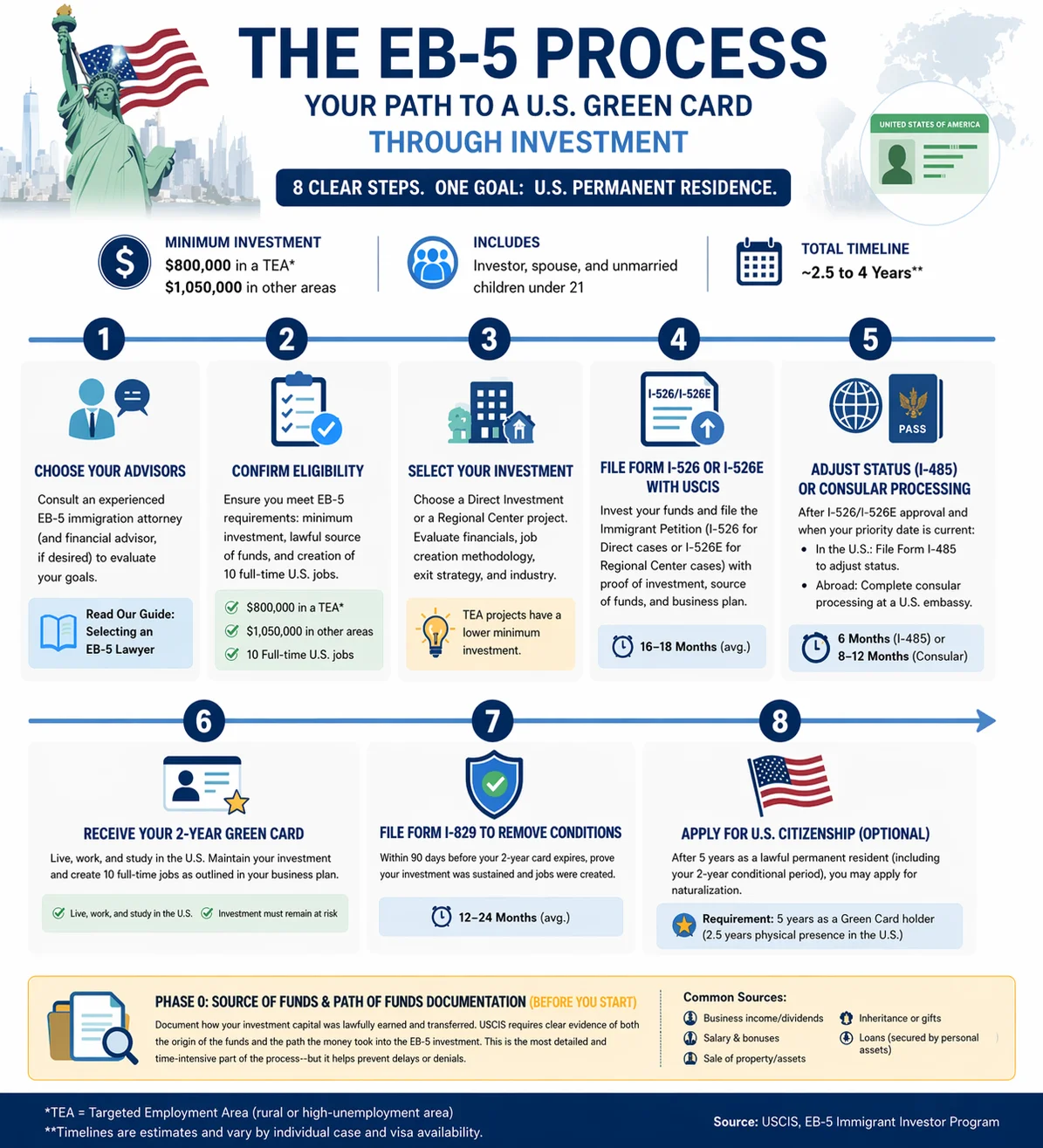 I-526E petition, adjustment of status, I-829 approval, and path to U.S. citizenship."
onclick="toggleEnlarge()">
I-526E petition, adjustment of status, I-829 approval, and path to U.S. citizenship."
onclick="toggleEnlarge()">
EB5 Visa Process: 8 Steps
EB-5 processing times vary depending on investment type, location, and TEA classification—use our timeline and calculator to get a clear estimate.
Step 1. Confirm your EB-5 strategy and immigration eligibility
Before you go through the entire EB-5 process, it's crucial to first consult with an immigration attorney who can help you determine whether an EB-5 Visa is the right option for you based on your goals and circumstances.
At the start of the EB-5 process, your attorney should review your immigration goals, family timeline, country of chargeability, source of funds, investment budget, project preference, and whether you may qualify for concurrent filing. This early review helps determine whether EB-5 is the right route and whether timing issues such as child age-out, visa bulletin backlogs, or adjustment of status eligibility need to be addressed before filing.
There are two key outcomes to weigh as you evaluate the program: the likely return on your capital and the likelihood of securing a green card. You will also need to decide whether to invest inside or outside a targeted employment area (TEA) — areas that are rural or have high unemployment — and to confirm that your investment can create the required 10 full-time U.S. jobs. Your financial return, exit strategy, and choice of industry all factor into this assessment.
📖 Read Our Guide to Selecting an EB-5 Lawyer
Step 2. Document your source and path of funds
Early in the EB-5 process, investors complete a Source of Funds (SOF) review.
This phase involves documenting how the investment capital was lawfully earned and transferred. U.S. immigration authorities require clear evidence showing both the origin of the funds and the path the money took into the EB-5 investment.
Typical sources of funds may include:
- Business income or dividends
- Salary and bonuses
- Sale of property or assets
- Inheritance or gifts
- Loans secured against personal assets
In addition to proving the source, applicants must also trace the movement of funds through bank accounts, currency exchanges, and international transfers.
Because this step directly impacts the success of the Form I-526 or I-526E petition, it is often the most detailed and time-intensive part of the EB-5 process. Proper documentation here helps prevent delays, requests for evidence (RFEs), or petition denials later in the process.
Step 3. Select a direct or regional center investment
The EB-5 Visa lets you either make a direct investment or invest through a regional center. Starting a new business, buying an existing business, or investing in one are common examples of direct investments. Regional centers, by contrast, are entities designated by the United States Citizenship and Immigration Services (USCIS) that pool capital from EB-5 investors to develop projects such as hotels and resorts.
Investments within a TEA have a lower minimum capital investment, which as of today stands at $800,000 USD. This is to attract EB5 investors to stimulate the economy of TEAs. For commercial enterprises outside TEAs, the required minimum investment amount is $1,050,000 USD. These RIA amounts are scheduled for a CPI inflation adjustment effective January 1, 2027 (the TEA minimum is widely expected to rise to roughly $900,000), so filing before then locks in the current figures.
Under the EB-5 Reform and Integrity Act of 2022 (RIA), capital from petitions filed on or after March 15, 2022 must remain invested and 'at risk' for at least 2 years from the date it is invested and placed at risk in the project — a major change from the old rule that tied sustainment to the entire conditional residency. Many regional center projects are still structured around longer 5–7 year holds for operational reasons, so confirm the actual term of any specific deal.
To commit your funds, you sign a subscription agreement — a request to join the partnership or limited liability company — and transfer the money to an escrow account managed by an appointed escrow agent.
Choosing the right investment is crucial in the EB5 process, and you have to research extensively to make sure that the investment you selected suits your goals and needs. If you're unsure of what steps to take regarding your investment, you can also work with a registered investment advisor or a broker who has experience with EB5 investments.
Step 4. File your I-526 or I-526E petition with USCIS and place your capital at risk
Once you've selected a project, you invest your funds in the new commercial enterprise and provide evidence that you have invested, or are actively in the process of investing, your capital.
However, bear in mind that merely demonstrating an intention to contribute does not suffice, and demonstrating future investment plans without a legally binding promise will not be accepted.
Then you prepare and file your immigrant petition. Direct (standalone) investors file Form I-526 (Immigrant Petition by Standalone Investor), while investors in a regional center project file Form I-526E (Immigrant Petition by Regional Center Investor). The petition includes documents relating to you, the business, the new commercial enterprise, and the source and path of your funds.
The funds can be sourced from the investor's own money, in the form of a loan not secured by the EB5 investment or a gift.
As of 2026, USCIS reports roughly 29–32 months on average for these petitions, though rural set-aside projects qualify for Priority Processing and some have been adjudicated far faster.
📖 Read Our Guide to
Step 5. Apply for adjustment of status (Form I-485) or consular processing
There are two routes to a conditional green card: adjustment of status (if you are inside the U.S.) and consular processing (if you are abroad). For adjustment of status, an EB-5 investor lawfully present in the U.S. can file Form I-485 as soon as a visa number is available for their category — either concurrently with the Form I-526 or I-526E petition or after it — rather than having to wait for the petition to be approved first.
⚠ Adjustment of status is now more complex
On May 21, 2026, USCIS issued Policy Memorandum PM-602-0199, directing officers to treat adjustment of status as a discretionary, closely scrutinized benefit rather than a routine step. EB-5 concurrent filing of Form I-485 remains available and is expressly authorized by Congress under INA § 245(n), but a concurrent I-485 should now be prepared as a thorough legal submission rather than a routine form filing. See EB-5 Concurrent Filing After the USCIS Discretion Memo for what this means for investors.
For adjustment of status, you file Form I-485 (Application to Register Permanent Residence or Adjust Status) with USCIS while you are inside the United States. Filing concurrently can also let you apply for a work permit (EAD) and an advance parole travel document while your case is pending. As part of the process you complete a medical exam with a USCIS-approved doctor and attend a biometrics appointment for fingerprinting and background checks. Adjustment of status commonly takes around 2 to 6 months once a visa is available.
USCIS now emphasizes that adjustment of status is a discretionary benefit rather than an automatic one. Each application is reviewed on its own merits, and meeting the basic eligibility requirements is not necessarily the end of the analysis — officers also weigh whether an applicant has complied with the terms of their admission. As a result, maintaining your underlying nonimmigrant status, work-authorization compliance, and a clean immigration record is now more important than before.
📖 Read Our Guide to Form I-485
Meanwhile, if you are living abroad when your Form I-526 or I-526E is approved, you go through consular processing. USCIS forwards your approved petition to the National Visa Center (NVC) — a single U.S. Department of State facility in Portsmouth, New Hampshire that handles all immigrant visa cases (there is not a separate center in each country). The NVC issues fee bills and instructions for filing Form DS-260 and submitting your civil and financial documents. Once the NVC finds your case documentarily qualified, it forwards the file to the U.S. embassy or consulate in your home country, which schedules and conducts the immigrant visa interview. If you're eligible, you receive your immigrant visa after the interview and enter the U.S. as a conditional permanent resident. This stage typically takes around 3 to 12 months and varies by consulate.
Step 6. 2-Year Green Card
Once you've become a conditional green card holder, you will have the same rights and privileges as a lawful permanent resident, except that the conditional green card lasts only 2 years. During this period, you must establish a permanent residence in the United States and maintain your qualifying investment in the commercial enterprise, operating in line with the EB-5 business plan you submitted with your Form I-526 or I-526E.
Moreover, during this time, you have to keep your capital investment at risk and you have to create 10 full-time jobs for U.S. workers.
Step 7. Filing your Form I-829 petition for permanent resident status
Within 90 days of the expiration of your 2-year conditional permanent residence, you are required to file a Form I-829, which is a petition to remove the conditional status on your permanent resident status. Filing this petition means that you're proving that you've met the EB5 Visa requirements such as you've created 10 full-time jobs and that you maintained your investment in the new commercial enterprise.
Once your Form I-829 has been approved, you are officially a lawful permanent resident of the U.S.
Step 8. Applying for U.S. Citizenship (optional)
To become a U.S. citizen, you have to undergo a process called naturalization. To be eligible, you have to be a lawful permanent resident for at least 5 years. You are also required to be physically present in the U.S. for at least 2 and a half years
Your 2-year conditional lawful permanent residency also counts toward this 5-year requirement provided that you've consistently lived in the U.S. since obtaining a conditional lawful permanent residence status.
Duration of EB5 Process
The duration of your EB-5 process varies with investment type, project category, and your country of chargeability. As of 2026, USCIS processing times run roughly 29.5 months for Form I-526E (regional center), about 32 months for the standalone Form I-526, and around 20 months for Form I-829. Adjustment of status (Form I-485) typically takes about 2 to 6 months, and consular processing about 3 to 12 months once a visa is available. Rural set-aside projects benefit from Priority Processing and are often adjudicated more quickly.
Visa availability is published monthly in the Department of State Visa Bulletin (not by USCIS). As of the 2026 bulletins, the reserved set-aside categories (rural, high-unemployment, and infrastructure) remain Current for all countries, while the unreserved category continues to show backlogs for investors born in China and India. For the latest movement in the Visa Bulletin and the current backlog position, see our EB-5 Program Updates page.
📖 Read Our EB-5 Visa Processing Time Guide for 2026
Benefits of EB-5 Green Card
Beyond the investment itself, an EB-5 green card gives you and your family the right to live, work, and study anywhere in the U.S. Some of the main benefits of obtaining an EB-5 Visa include:
-
Freely travel in and out of the United States with your permanent resident status;
-
Potential return of capital depending on the project documents and investment performance, with no guarantee of repayment;
-
Obtaining lawful permanent residency as well for your spouse or unmarried children under the age of 21;
-
Option to apply for U.S. citizenship; and
-
Travel to countries that allow visa-free passage to green card holders
You can also visit here if you need more information about the EB5 Visa so you can have a general overview of the visa and gain an informed decision before proceeding with your application.
Conclusion
The EB-5 Visa is a great option for investors and entrepreneurs who want to invest in a business outside of their home country and immigrate to another country. With its line of benefits, the EB-5 Visa can be the best option for your financial and immigration goals. Because EB-5 visas are numerically limited and visa availability depends on country of chargeability and category, backlogs or retrogression can affect the timing of the green card stage even after an I-526 or I-526E approval. Understanding the full EB-5 visa costs and fees is also essential before you start. For other employment-based immigrant petitions, see our complete guide for Form I-140.
Here at Davies & Associates, our expert immigration lawyers can help you with your EB5 process so that all necessary documents and steps are taken.
AOS vs Consular Processing
After the I-526E petition is approved (or filed concurrently, if eligible), the EB-5 process follows one of two paths depending on the investor’s location:
Adjustment of Status
Investors already inside the United States may apply for permanent residence through Adjustment of Status by filing Form I-485. This path lets applicants remain in the U.S. while their green card application is processed and, in many cases, continue working and traveling with interim authorization.
USCIS now treats adjustment of status as a discretionary decision reviewed on the merits of each individual case, so maintaining lawful underlying status throughout the process carries more weight than it once did.
Consular Processing
Investors residing outside the United States complete the process through consular processing at a U.S. embassy or consulate in their home country.
This involves:
- Submitting documentation to the National Visa Center (NVC)
- Attending an immigrant visa interview
- Entering the U.S. with an immigrant visa to receive a conditional green card
Choosing between these two paths is determined by the applicant’s location and immigration status, but both lead to the same outcome: conditional permanent residency under the EB-5 program.
EB-5 Process: Frequently Asked Questions
How long will it take for me to obtain a Green Card through the EB-5 program?
EB-5 timelines can vary significantly depending on your investment location, TEA category, and personal circumstances—some options may offer faster processing.
Get a personalised estimate of your EB-5 processing time using our timeline and calculator.
Can I live anywhere in the U.S. with my EB-5 Visa?
Yes, once you have obtained your EB-5 Visa, you can live and work anywhere in the U.S. This also applies if you have invested through a regional center. You don't need to live in the same State as the commercial enterprise you invested in.
If you made a direct investment, however, you may need to be near the enterprise you invested in as you would need to prove that you are active in the company.
Can my spouse or children join me in the U.S.?
Yes, once your EB-5 Visa is approved, your spouse and unmarried children under the age of 21 can join you in the U.S. and will also be eligible for conditional and permanent residence.
For spouses, same-sex spouses qualify but common-law spouses do not. As for children, this includes birth children, adopted children and stepchildren. You must be able to prove that you're their legitimate parent.
How many EB-5 Visas are issued each year?
Each year, there are around 10,000 EB-5 Visas issued. These visas are given to EB-5 investors, their spouses and their unmarried children under the age of 21.
What is the EB-5 Regional Center Program?
Through the EB-5 Regional Center Program, investors act as passive investors and contribute capital to USCIS-designated regional centers. These entities promote economic growth in particular geographic areas and may count 'indirect' jobs toward the job-creation requirement using approved economic methodologies. The program was reauthorized and reformed by the EB-5 Reform and Integrity Act of 2022; the older 'Regional Center Pilot Program' name is now historical.
How long do I wait for my visa interview after my I-526 application is approved and my priority date is current?
If you're outside the U.S., the National Visa Center coordinates the collection of certain documents from you and sends a file to the local consulate which then schedules your interview. The waiting time can take from 3 to 9 months. For a more detailed breakdown see our EB-5 Visa Timeline and Duration Calculator
About the Authors
Mark I. Davies, Esq.
Chairman of Davies & Associates; focused on E visa strategy and complex consular filings.
Why make Davies & Associates Your EB5 Lawyers
Davies & Associates is one of the longest-established EB5 law firms in the industry and our team regularly contribute to the global media on the subject. We have helped hundreds of families, business owners and entrepreneurs relocate to America and have never had a case rejected on Source of Funds, which is one of the most challenging aspects of an EB5 application. Click here to meet some of our EB5 clients. Our success helping clients demonstrate they meet EB5 visa requirements comes from blending our highly qualified lawyers with an understanding of the culture, law, business practices and banking regulations in each jurisdiction we operate.
Our success comes from the strength of the unique team of lawyers we place around every client
Each Davies & Associates client is assigned a team of industry-leading EB5 lawyers each highly experienced with a specific area of the law. Our client EB5 teams typically include:
- A local EB5 lawyer versed in the currency laws and practices of the countries from which a clients funds are to be sourced
- A real estate lending or finance lawyer to assist with project due diligence
- A specialist US Source of Funds documentation lawyer
- A senior EB5 attorney responsible for supervising the filing and submission of each client's case
Contact Davies & Associates Offices in United States
Check all of our locations around the world.
Company location
New York Office World Trade Center
1 World Trade Center, Suite 8500, New York, NY 10007
Map and Driving Directions
New York Office E69th Street
200 E 69th Street, 2N, New York, NY 10022
Map and Driving Directions
California Office
555 Anton Blvd, Suite 150, Costa Mesa, CA 92626
Map and Driving Directions
Philadelphia Office
1500 John F Kennedy Blvd, Suite 450, PMB 41, Philadelphia, PA 19102
Map and Driving Directions
Los Angeles Office
601 South Figueroa Street, Suite 4050, Los Angeles, CA 90017
Map and Driving Directions
Chicago Office
155 N. Upper Wacker Dr., Suite 4250, Chicago, IL 60606
Map and Driving Directions
Miami Office
80 S.W. 8th St., Suite 2000, Miami, FL 33130
Map and Driving Directions
Atlanta Office
1075 Peachtree Street NE, Suite 3650, Atlanta, GA 30309
Map and Driving Directions
Telephone number
New York Office World Trade Center
+1 212 537 9196
Fax: +1 949 396 1371
New York Office E69th Street
+1 212 537 9196
Fax: +1 949 396 1371
California Office
+1 949 620 1811
Fax: +1 949 396 1371
Philadelphia Office
+1 215 525 1881
Fax: +1 949 396 1371
Chicago Office
+1 312 261 8560
Fax: +1 949 396 1371
Miami Office
786 490 2661
Fax: +1 949 396 1371
Contact us by email

 Applying for an EB-5 Visa in the UK
 Applying for an EB-5 Visa in Dubai
 Applying for an EB-5 Visa in Singapore
 Applying for an EB-5 Visa in India
 Applying for an EB-5 Visa in Vietnam

Looking to acquire an EB5 Visa?
We are known for our creative solutions that obtain "impossible" visas. We solve the most complex immigration problems for businesses, investors, individuals, and families.
EB5 Visa Immigration lawyer near meSeveral lawyers told me I would not be able to get a TN visa. Two weeks after contacting Davies & Associates I was working in New York, visa in hand.
Individual seeking 'Impossible' TN VisaD&A was very detail-oriented and very thorough in what they did. They worked on my case 24/7 and were very patient in answering all my questions.
E-2 Visa ClientMy case felt complex but D&A managed the whole process carefully and helped me move seamlessly from one stage to the next.
E2 + CBI ClientD&A was my guiding light through the entire EB-5 process.
EB-5 Visa ClientI would definitely be a big advocate for the rest of my life for anyone wanting to explore the Grenada Citizenship by Investment Programme leading to the E-2 visa. The most important thing is a good team behind you. With Davies & Associates, you're in safe hands... you need someone who can support you on the ground and, again, you are well taken care of by D&A. The people are really warm, very helpful and quite open-minded when it comes to business... Not to mention as a passport it's great from a travel perspective... It's just 4 to 5 hours from New York.
Grenada CBI + E2 Visa ClientThe entire process of getting an EB-5 visa is handled in a professional way by Mark Davies and his team. EB-5 is a wonderful option for anyone considering moving to the United States if you have the means. I was hoping to use the H-1B route for my children, but it became unreliable and so I looked to the EB-5 visa instead. It is great for anyone who has the resources. Mark gives you the first meetings himself which gives you great comfort. Both Mark and Sanjay are abundantly available and I even had the pleasure of hosting them at my house.
Parent of 2 EB-5 visa holdersI'm in the process of extending my L-1 visa. I submitted a few questions regarding my case, and he contacted me back almost immediately, both by email and telephone. Unlike other attorneys I met before, he gave me the impression of knowing off the top of his head what kind of visa I have, and what actions had to be taken to extend it. He is very thorough and clear regarding the process and what to expect in terms of timelines and issues that may arise. He is constantly in contact, so you definitely know he's working on your case.
L-1B Visa HolderMark Davies is a joy to work with. His extensive knowledge, speedy response and attentive service took away all my fears of dealing with immigration and visa applications. He is very generous with his time in explaining every step along the way and I have already and will in the future recommend him to anybody who is looking for an immigration lawyer.
E2 Visa for Small Professional Business With International OfficesDavies & Associates assisted us with an immigration emergency involving my brother's fiancée who was outside the United States. They assisted us in a highly professional manner, working with the relevant US embassy, US immigration and the governments of two other countries. As a result of their efforts the individual involved is now working in the United States. While their knowledge of the law is exemplary what really distinguishes this firm and attorney Davies from any other firm we have worked with is their dedication to customer service and their unrivaled level of professionalism.
Complex Fiancée Visa Need Involving Multiple International JurisdictionsSeveral lawyers told me I would not be able to get a TN visa. Two weeks after contacting Davies & Associates I was working in New York, visa in hand. I have recommended this firm to several friends and colleagues, they do an excellent job every time.
Individual Seeking 'Impossible' TN VisaI was qualified as a physician in a foreign country. Being on a J1 visa I was facing having to leave the United States and return to my home country. Davies & Associates secured one of only 30 J1 visa waivers available in my State, allowing me to work for a US hospital and remain in the United States.
Doctor Seeking J1 Visa WaiverI am very satisfied with the services Mark Davies has provided me. He has a very extensive knowledge in immigration laws and has a thorough approach to any case.
U Visa Applicant, A Victim of CrimeLooking to relocate or having trouble with a visa application?
We are known for our creative solutions that obtain "impossible" visas. We solve the most complex immigration problems for business, investors, individuals and families.
Request Free Consultation
New York Office World Trade Center:
1 World Trade Center, Suite 8500, New York, NY 10007
+1 212 537 9196
Map and Driving Directions
New York Office E69th Street:
200 E 69th Street, 2N, New York, NY 10022
+1 212 537 9196
Map and Driving Directions
California Office:
555 Anton Blvd, Suite 150, Costa Mesa, CA 92626
+1 949 620 1811
Map and Driving Directions
Philadelphia Office:
1500 John F Kennedy Blvd, Suite 450, PMB 41, Philadelphia, PA 19102
+1 215 525 1881
Map and Driving Directions
London Office:
69 Old Broad Street, Dashwood House, London EC2M 1QS, United Kingdom
+44 20 3884 1812
Map and Driving Directions
London Office Beaufort Court:
Beaufort Court, Admiral Way, London E14 9XL, United Kingdom
+44 20 3884 1812
Map and Driving Directions
Edinburgh Office:
28 Rutland Square, Edinburgh, Scotland, EH1 2BW
+44 (20) 38841812
Map and Driving Directions
Milton Keynes Office:
The Pinnacle, 170 Midsummer Blvd, Milton Keynes MK9 1FE, United Kingdom
+44 7740 000769
Map and Driving Directions
Glasgow Office:
+44 131 392 0686
Map and Driving Directions
Vietnam Office:
46th Floor, Bitexco Financial Tower, 2 Hai Trieu, Ben Nghe Ward, District 1, Ho Chi Minh City, Vietnam
+84 28 44582309
Map and Driving Directions
India Office:
Enam Sambhav C-20, G Block, Bandra-Kurla Complex, Mumbai 400051, Maharashtra
+91 720 856 4057
Map and Driving Directions
Italy Office:
Via Bonifacio Lupi 29, 50129 Firenze FI, Italy
+39 055 076 3054
Map and Driving Directions
Manila Office:
Unit 107, AIC Burgundy Empire Tower, ADB Ave. cor Garnet and Sapphire Streets, Ortigas Center, Pasig City 1605, Metro Manila, Philippines
+63 2 7215 7878
Map and Driving Directions
Sydney Office:
Level 12, 210 George Street, Sydney NSW 2000, Australia
+61 2 9156 1032
Map and Driving Directions
Perth Office:
Davies & Associates LLC, Level 1, 12 St Georges Terrace, Perth WA 6000, Australia
+61 2 9156 1032
Map and Driving Directions
Singapore Office:
160 Robinson Road, #14-04, Singapore Business Federation Centre, Singapore 068914
+65-9615-0528
Map and Driving Directions
Looking for an Immigration attorney?
Immigration lawyer near meList of US Embassies, Consulates and USCIS
List of Italian Embassies, Consulates and USCIS
Copyright ©2026 by Davies & Associates LLC.